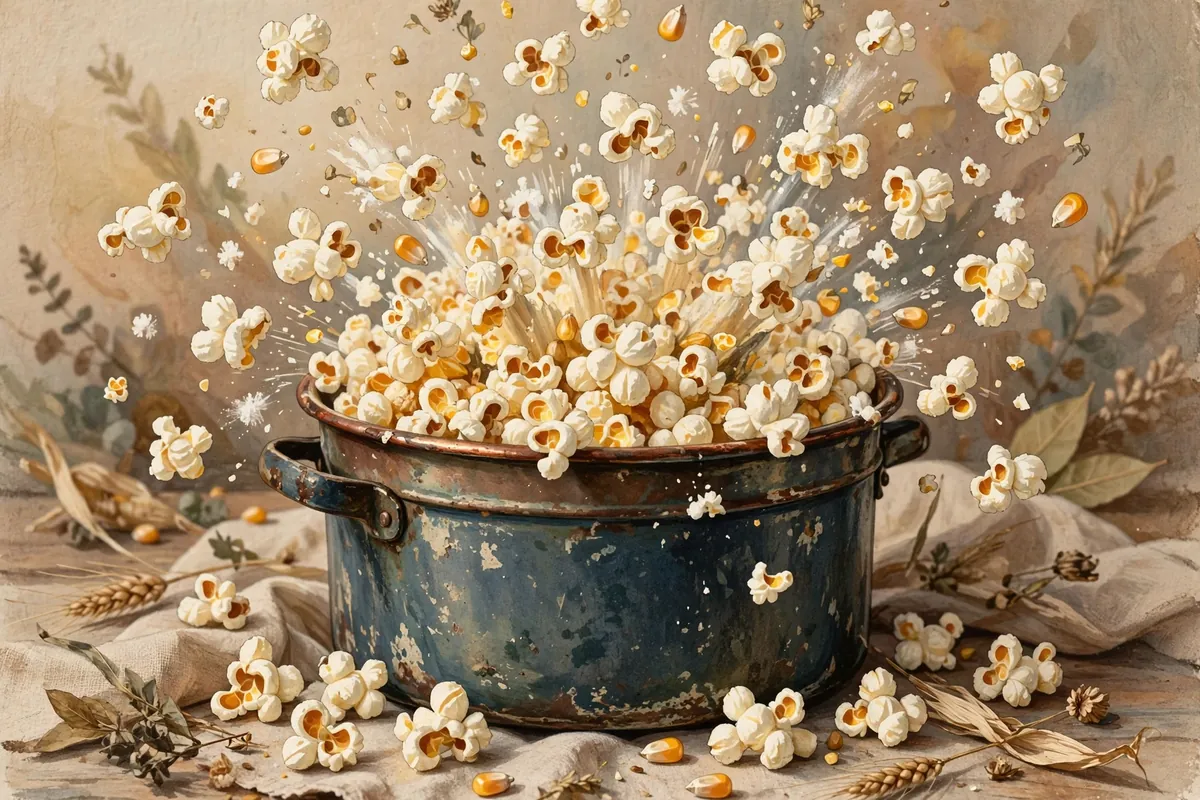
Pour some kernels into a hot pot, wait a minute, and suddenly the lid starts dancing. Pop, pop, pop! A hard little seed turns into a fluffy white snack right before your eyes. But what's really going on inside each one?
The answer is water. Every popcorn kernel holds a small amount of moisture sealed inside a tough outer shell called the hull. As the kernel heats up, that water turns to steam. The steam builds pressure until the hull bursts open, and the soft starch inside puffs up into a foam that sets as it cools.
A Tiny Pressure Cooker
What makes popcorn special is that hull. Unlike most other grains, the outer layer of a popcorn kernel is strong and doesn't let moisture escape. The inside is packed with a hard type of starch and holds about 14 to 20 percent moisture.
As it heats, the starch inside softens and turns gel-like. Pressure keeps building until the hull finally gives way, at around 135 pounds per square inch and a temperature of about 356°F. That's several times the pressure in a typical car tire.
When the hull ruptures, the pressure drops suddenly and the steam expands in a flash. It blows the softened starch and proteins into an airy foam, which quickly cools and sets into the crispy puff we know. A popped kernel can be 20 to 50 times bigger than it started.
Why Some Kernels Never Pop
Every bowl seems to have a few stubborn kernels left at the bottom. In the popcorn business, those duds are called “old maids.” They usually fail because they don't have enough moisture inside to make enough steam.
Heat matters too. If kernels heat too slowly, steam leaks out of the tip where the kernel was attached to the cob, and the pressure never gets high enough. If they heat too quickly, the hull can burst before the center softens, leaving a half-popped kernel with a hard middle. That's why growers carefully dry popcorn to just the right moisture level, usually around 14 to 15 percent.
Butterflies and Mushrooms
Popped kernels come in two main shapes. “Butterfly” flakes are irregular, with wings sticking out, and are considered more tender. “Mushroom” flakes are round and sturdy, so they're often used for packaged treats like caramel corn.
Here's another fun detail: kernels come in colors like yellow, red, purple, and even black, but the popped part is always white or off-yellow. That's because only the hull is colored.
An Ancient Snack With a Modern Machine
People have enjoyed popcorn for a very long time. Archaeologists found evidence of popping corn on the northern coast of Peru dating back to around 4,700 BCE.
The popcorn machine came much later. Chicago candy store owner Charles Cretors invented a steam-powered popper and introduced it at the 1893 Columbian Exposition. During the Great Depression, a bag cost just 5 to 10 cents, and popcorn thrived while other businesses failed.
Movie theaters weren't fans at first, since owners thought it distracted from the films. Then, in 1938, Midwestern theater owner Glen Dickinson put popcorn machines in his lobbies. Popcorn turned out to be more profitable than the tickets, and the idea spread fast.
So the next time you hear that first pop, picture the tiny drama inside: a drop of water, a sturdy shell, and a burst of steam turning a seed into a snack.