Wake up, work, eat dinner, sleep, repeat. Our whole lives run on the 24-hour cycle of Earth spinning once from sunrise to sunrise. It's so familiar that it's easy to assume every planet works about the same way.
The short answer: not even close. A day on Jupiter lasts less than 10 hours. On Mars it's just a bit longer than ours, about 24.6 hours. But on Mercury, one sunrise-to-sunrise day lasts about 176 Earth days, and on Venus a full spin takes 243 Earth days, which is longer than its whole year.
Two Ways to Measure a Day
Astronomers actually use two kinds of day. One is how long a planet takes to spin once compared with the distant stars. The other is the solar day, the time from one sunrise to the next.
On Earth the two are close, so we don't notice the difference. But on slow-spinning planets that are also moving around the Sun, the gap can be enormous, as Mercury and Venus show.
The Slow Spinners Near the Sun
Mercury takes about 59 Earth days to spin once and 88 Earth days to circle the Sun. Those two motions combine in a way that makes one sunrise-to-sunrise day last about 176 Earth days, exactly two Mercury years. One side of the planet bakes in sunlight for a whole Mercury year, then sits in darkness for the next.
Venus is even stranger. It spins very slowly, and backward compared with most planets, including Earth. One full spin takes 243 Earth days, longer than its year of about 225 Earth days. Thanks to that backward spin, the time from one sunrise to the next is shorter, about 117 Earth days. And yes, because it spins the other way, the Sun there would rise in the west.
Mars, Our Close Match
Mars is the planet most like home when it comes to time. Its solar day, called a sol, is about 24.6 hours. Its axis is tilted about 25 degrees, close to Earth's, so Mars also has seasons. The catch is that its year lasts 687 Earth days, so each season goes on far longer than ours.
The Speedy Giants
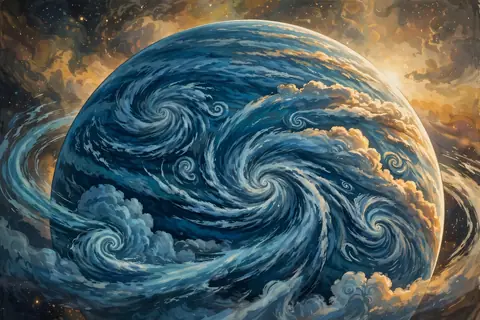
The big gas planets spin fast. Jupiter has the quickest rotation in the solar system, finishing a turn in slightly under 10 hours. It spins so fast that it bulges at the middle, with its equator about 7 percent wider than its poles.
Saturn isn't far behind, at roughly 10 and a half hours, though scientists have had trouble pinning down an exact figure. Uranus turns in about 17 hours and 14 minutes, and Neptune in about 16 hours.
Because these planets are made mostly of gas and fluid, different parts spin at different speeds. On Jupiter, the polar atmosphere takes about five minutes longer to go around than the equator. That's why astronomers often use the rotation of a giant planet's magnetic field to define its day.
The Weirdest Daylight of All
For truly odd sunlight, consider Uranus. It's tipped over on its side, so as it makes its 84-year trip around the Sun, each pole gets about 42 years of continuous sunlight, followed by about 42 years of darkness.
So the next time a day feels too long, or too short, remember that Earth's steady 24 hours is a pretty comfortable deal. Somewhere out there, a sunset is months away.