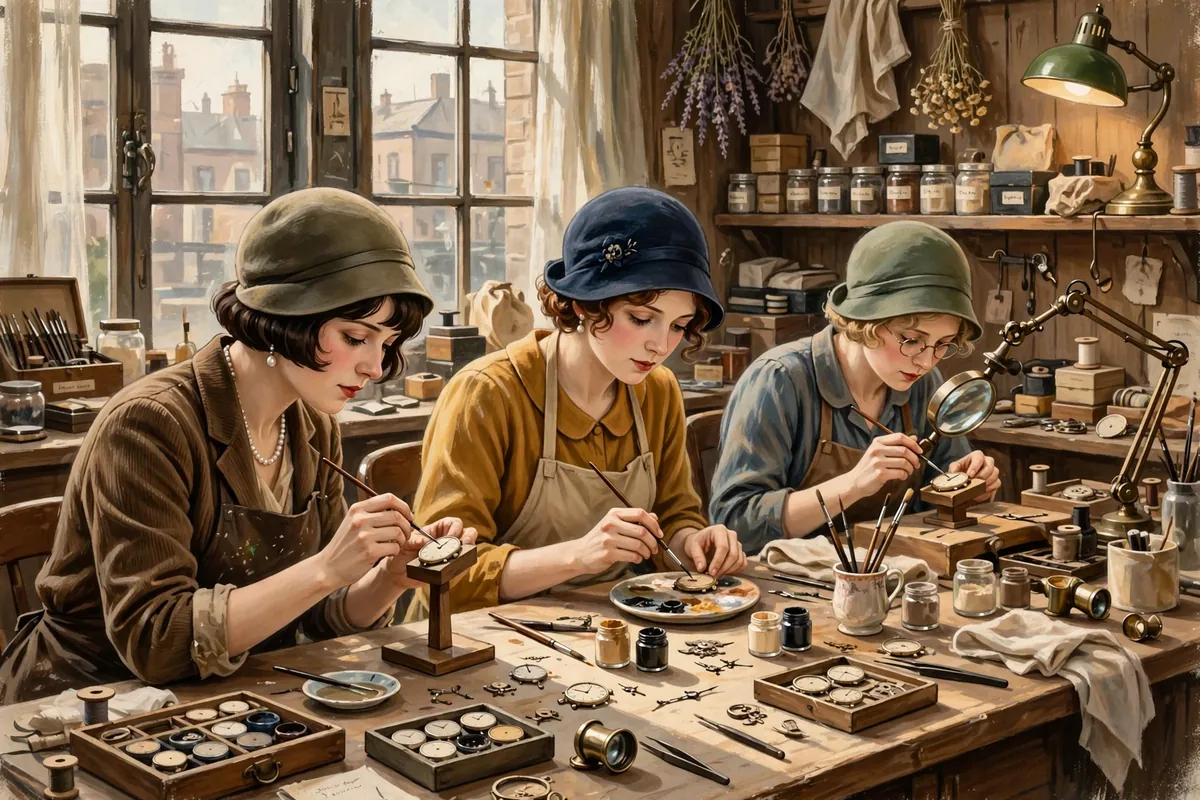
It sounded like a dream job for a young woman in the 1920s. Sit at a table, paint numbers on watch faces with a magical paint that glowed in the dark, and get paid for every dial. Some of the workers even painted their nails and teeth with it for fun. Nobody told them it would kill them.
Here's the short answer. The paint contained radium, a radioactive element. The women were told it was harmless and were instructed to shape their brushes into a fine point using their lips. Over time, they swallowed deadly amounts of radium. Many became gravely ill or died, and their lawsuits helped transform labor safety in the United States.
Lip, Dip, Paint
The story unfolded at three American factories: in Orange, New Jersey, starting around 1917, and in Ottawa, Illinois, and Waterbury, Connecticut, in the 1920s. In Orange, the United States Radium Corporation made a glowing paint sold under the name "Undark." The plant employed as many as 300 workers, mostly women.
The paint mixed powdered radium with zinc sulfide, gum arabic, and water. The camel hair brushes lost their shape after a few strokes, so supervisors encouraged a technique nicknamed "lip, dip, paint." Wiping the brushes on rags or rinsing them in water took more time and wasted paint.
The pay was about a penny and a half per dial. A worker who painted 250 dials in a shift earned $3.75. Meanwhile, the company's chemists used lead screens, tongs, and masks to protect themselves.
The Toll on Their Bodies
Dentists were among the first to notice something was wrong. Dial painters came in with tooth pain, loose teeth, sores, and extractions that wouldn't heal. Many women developed anemia, broken bones, and decay of the jawbone, a condition now known as radium jaw.
By 1927, more than 50 of the women had died from radium poisoning. The company's own chief chemist had died too. The similar deaths led Newark's county physician, Dr. Harrison Martland, to investigate.
Taking a Giant to Court
A worker named Grace Fryer decided to sue. It took her two years just to find a lawyer willing to take on the company. By their first court appearance in January 1928, two of the women were bedridden and none could raise their arms to take an oath.
Newspapers covered the case widely, and the five plaintiffs became known as "the Radium Girls." The company denied wrongdoing but settled in the fall of 1928. Each woman received $10,000, a yearly payment for life, and coverage of her medical and legal bills. All five had died by the 1930s.
In Illinois, the fight lasted even longer. Catherine Donohue, too sick to travel, had her case heard at her home. The women won in 1938, and in 1939 the U.S. Supreme Court declined to hear the company's appeal. By then, Donohue had died.
What They Left Behind
The Radium Girls hold an important place in the history of workers' rights, women's rights, and radiation safety. Their cases helped establish the right of workers to sue companies for harm caused on the job. Industrial safety standards improved, and in 1949 Congress passed a bill providing compensation for all workers suffering from occupational diseases.
Their glow was a tragic one, but their legacy is bright. Every safety rule protecting workers today owes a little something to the young women who refused to stay quiet.