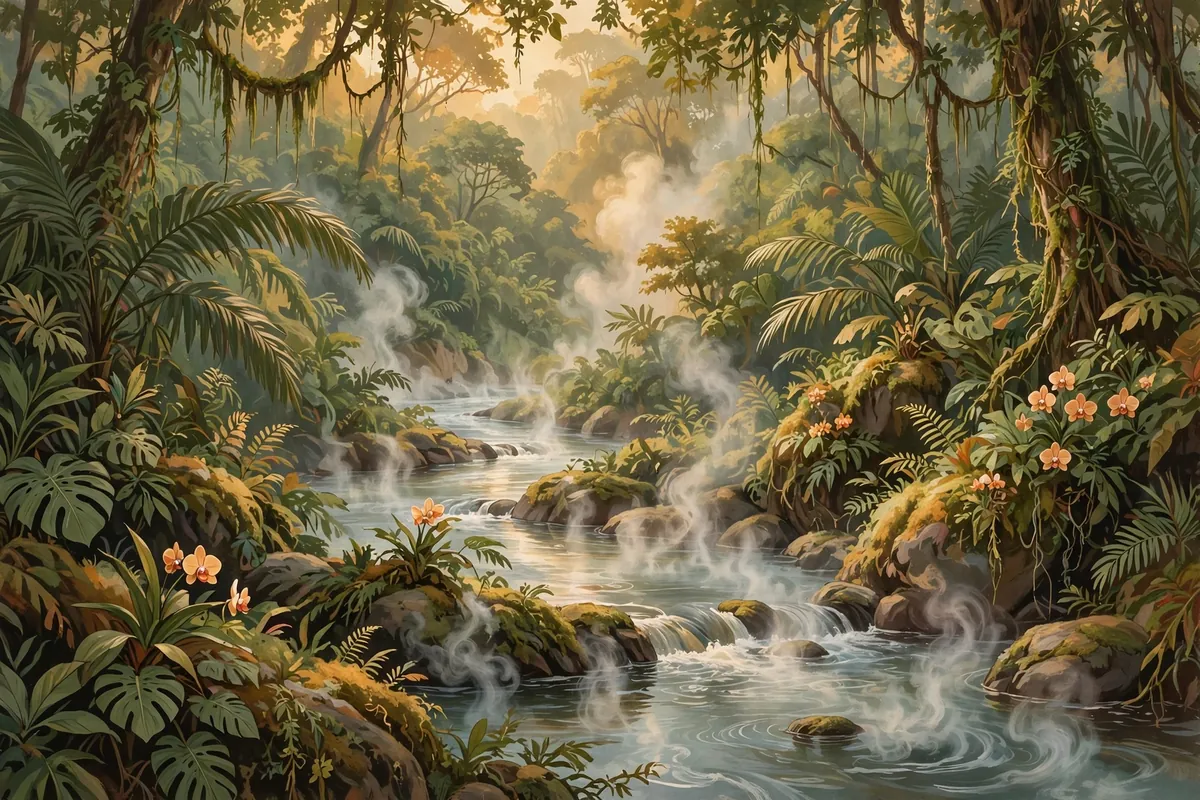
Imagine a jungle stream that starts out pleasantly warm, then grows hotter and hotter until steam rises off its surface. It sounds like something from an adventure novel. But in the Peruvian Amazon, there's a real river like this, and for years many people outside the region assumed it was just a legend.
The river is called Shanay-timpishka, better known as the Boiling River of the Amazon. It doesn't quite boil, but it comes close. Its average temperature has been recorded at nearly 203 degrees Fahrenheit, and one hot spring in the river measured about 210 degrees. The heat comes from deep inside the Earth, even though there's no known active volcano nearby.
A River That Heats Up as It Flows
The river is a small tributary that eventually feeds into the Amazon system. Its whole length is about 5.6 miles, but only the lower 3.9 miles or so is thermal. At its widest it's about 98 feet across, and at its deepest about 15 feet.
At its headwaters, the water is about 81 degrees Fahrenheit, a typical temperature for a jungle stream. As the river flows over cracks in the Earth's crust called fault zones, hot water rises from deep underground and heats it dramatically. That makes it one of the largest documented thermal rivers in the world.
So Where Does the Heat Come From?
Hot springs and hot rivers are usually found near volcanoes, where magma warms the groundwater. That's what makes this river so puzzling. It isn't near any known active volcano or geothermal vent.
The leading theory involves the geothermal gradient, the way rock gets hotter the deeper you go. In continental crust, temperatures typically rise about 25 to 30 degrees Celsius for every kilometer of depth. The idea is that rainwater falling on the rainforest seeps down through deep faults into the crust, where it heats up. It then rushes back to the surface through hot springs along the river, warming the stream as it goes.
National Geographic has described it as an entirely natural, non-volcanic geothermal feature, flowing at unusually high rates. In other words, no hidden volcano is required.
The Scientist and the Legend
Much of what we know comes from Andrés Ruzo, a geoscientist who grew up between Peru, Nicaragua, and the United States. He first heard about the river as a child from his grandfather. In 2011, he became the first scientist granted permission to study it, and he later founded the Boiling River Project to help understand and protect it.
The river's name comes from Quechua and means "boiled by the heat of the sun," even though the heat actually comes from below. One especially hot spring in the river is nicknamed La Bomba, Spanish for "The Pump." Local shamans believe the hot water is born from Yacumama, a giant serpent spirit known as the Mother of the Waters.
A Wonder Under Threat
Three communities sit along the river, in Peru's Huánuco region. The surrounding forest faces pressure from deforestation. According to National Geographic, larger trees are cut and sold for their valuable lumber, and the rest is often cleared by burning.
It's a reminder that our planet still has a few surprises left, even in the age of satellites and smartphones. Sometimes the old stories told by grandparents turn out to be true, steam and all.