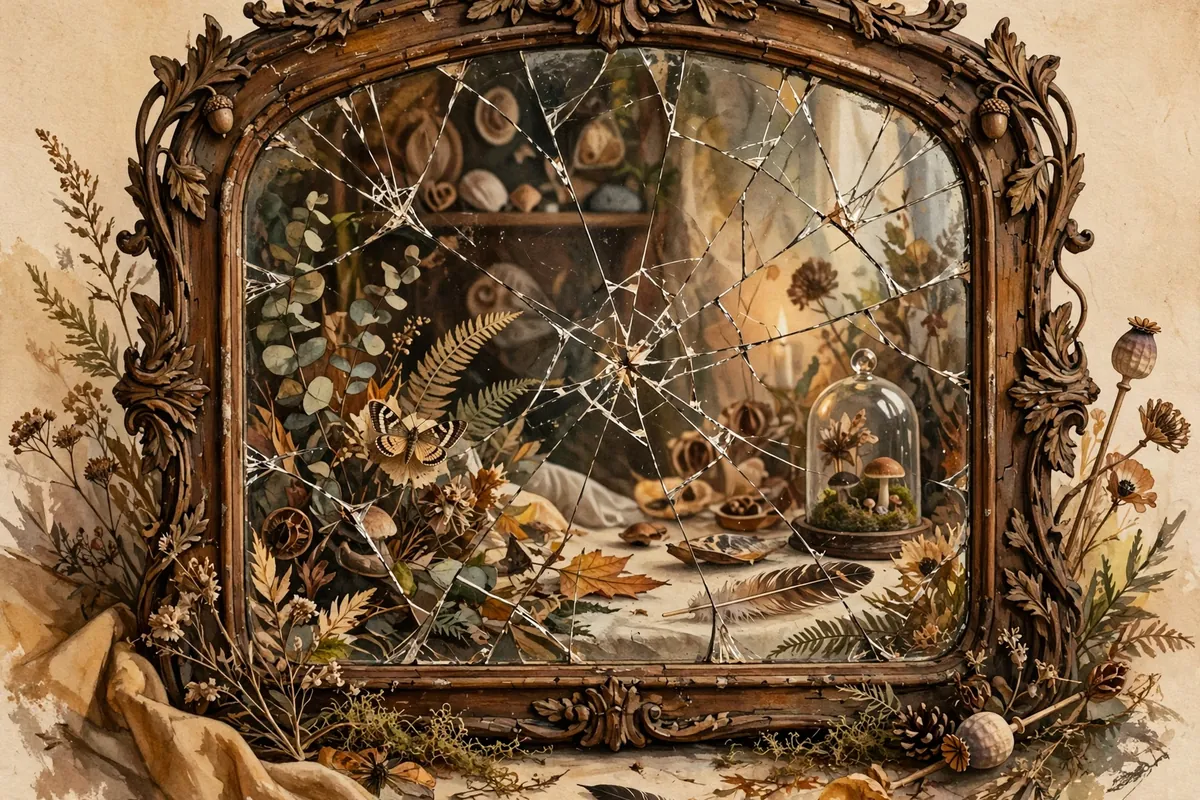
It happens in a split second. The mirror slips, hits the floor, and shatters. Before you even grab the broom, someone says it: well, that's seven years of bad luck. Where did that idea come from, and should you worry?
You can relax. A broken mirror can't bring bad luck. It's a superstition, and a widespread one: breaking a mirror is said to bring seven years of misfortune. Nobody knows for sure where the seven-year part began. But the fear makes more sense once you see how people have treated mirrors through history.
Mirrors as Magic
For thousands of years, mirrors seemed almost supernatural. From ancient Rome to northern India, people handled them with special care, and some avoided them altogether.
Many cultures used mirrors to try to see the future, a practice called catoptromancy. In ancient Greece, at a temple near Patras, a sick person would lower a mirror to the surface of a spring and look into it. A fresh, healthy face meant recovery, and a ghastly one meant death. In ancient Rome, priests called specularii gazed into polished metal mirrors to seek guidance from the gods.
The ancient Egyptians believed mirrors could act as portals to the afterlife, and mirrors have been found in Egyptian tombs. In ancient China, people believed mirrors could reveal the soul and predict the future. With beliefs like these, it's easy to see why smashing one might feel like a terrible omen.
Mirrors have fascinated storytellers, too. In Oscar Wilde's 1890 novel The Picture of Dorian Gray, a portrait works like a magical mirror, showing the true face of the ageless hero and the damage each sinful act does to his soul.
A Very Expensive Accident
There's also a practical reason a broken mirror once felt like a catastrophe. For most of history, mirrors were rare and costly.
The earliest known mirrors were polished pieces of obsidian, a natural volcanic glass, found in Turkey and dating to around 6000 BCE. Later came polished copper mirrors in Mesopotamia and Egypt. Glass mirrors improved over the Middle Ages, and by the 1500s Venice was the center of fine mirror making, using a secret tin and mercury coating.
Venetian mirrors were luxury items for palaces across Europe. In the late 1600s, one French countess reportedly traded an entire wheat farm for a mirror, and considered it a bargain. Mirrors only became affordable after French workshops learned the secret and began mass production.
Superstitions Around the World
Breaking a mirror shows up on unlucky lists in many places. In Greek culture, for example, it's counted alongside entering and leaving a house by different doors as bad luck.
Some superstitions may have practical roots. Opening an umbrella indoors could poke someone in the eye, which might be part of why it's considered unlucky. In the same way, warning people to be careful with an expensive, breakable mirror made good sense.
Your Luck Is Safe
So if a mirror breaks, the only real danger is the sharp glass. Sweep it up carefully, wear shoes, and wrap the pieces before throwing them away.
As for those seven years, you can let that worry go. If anything, a broken mirror is just a good excuse to pick out a new one, and these days it won't cost you a farm.