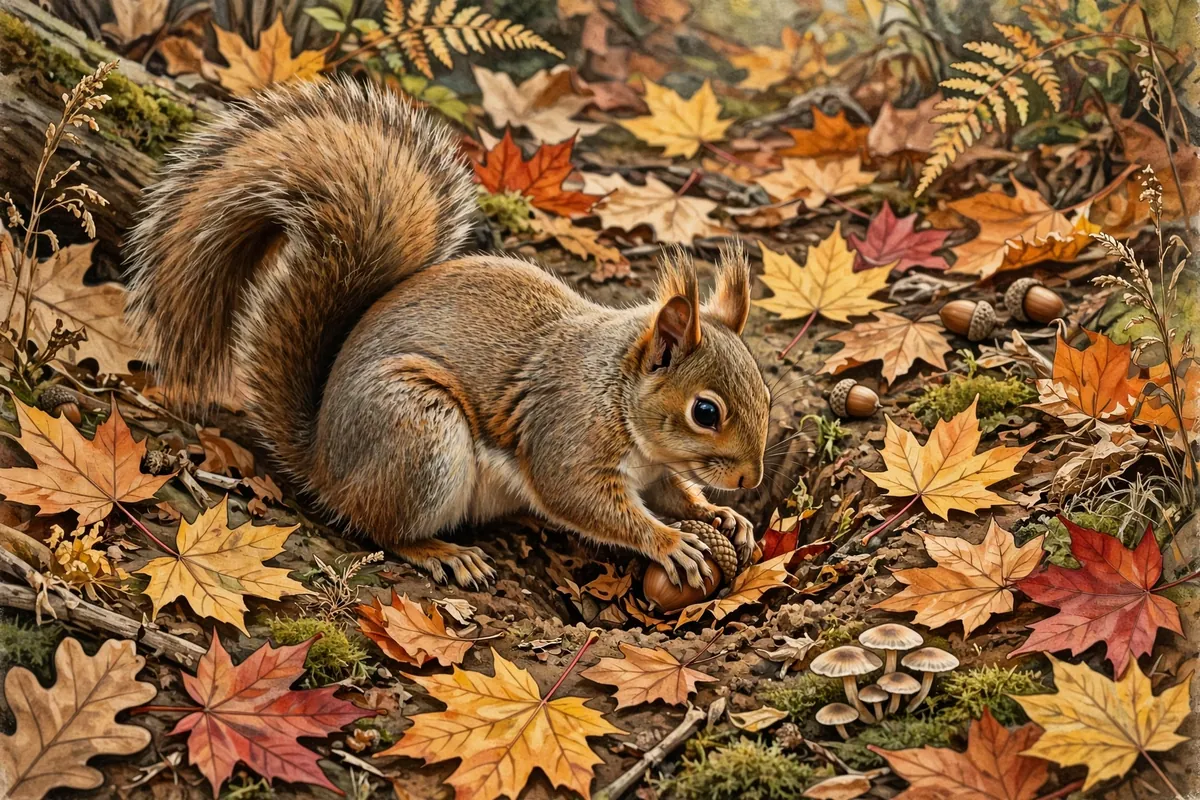
Every fall, the squirrels in your yard go into overdrive. They dash around with acorns in their mouths, dig a quick hole, push the nut in, and pat the dirt down. It's a common joke that they forget most of these hiding spots, and that's how oak trees end up sprouting all over the place.
Here's the surprise: squirrels are actually very good at remembering. Eastern gray squirrels have very accurate spatial memory for their hiding spots and use landmarks to find them again. Forests still benefit, though, because a small share of buried nuts is never dug up, often because it was lost, stolen, or its owner didn't survive the winter.
Thousands of Hiding Spots
Gray squirrels are what scientists call scatter-hoarders. Instead of keeping one big pantry, they spread their food out in many small caches, often one nut per hole. Each squirrel is estimated to make several thousand caches every season.
Spreading things out is a defensive strategy. If a competitor stumbles on one hidden nut, it doesn't find the whole winter supply. Some caches are short-term, dug near a sudden pile of food and moved to a safer spot within hours or days. Others stay put for months.
A Brain Built for Maps
Remembering thousands of spots sounds impossible, but squirrels are built for it. To find their caches again, they rely on both distant and nearby landmarks, like a tree trunk or a rock. Animals that scatter-hoard generally have a larger hippocampus, the part of the brain tied to spatial memory, than animals that don't.
Smell helps too, both for finding their own caches and for raiding other squirrels' stashes. But scent isn't always reliable. When the ground is very dry or covered in snow, the nose doesn't work as well, which is one reason memory matters so much.
Squirrels can even be sneaky. If a squirrel thinks it's being watched, it may dig a hole, pretend to drop a nut in, and cover it up while actually keeping the nut hidden in its mouth. It may also hide behind plants while burying food.
So How Do the Forests Win?
Even with a great memory, not every acorn gets eaten. Some caches are lost, some are raided, and some squirrels simply don't live long enough to eat all their stores. A small number of those leftover acorns germinate, survive, and grow into the next generation of oaks.
That's why scientists call squirrels and jays important seed dispersers. By burying nuts in many different spots, they effectively plant acorns all over the landscape, often in places where the seeds can sprout and thrive. Eastern gray squirrels may even help spread truffle spores when they eat these underground fungi.
Clever Tricks With Acorns
Squirrels don't just bury and forget. Gray squirrels frequently remove the tiny embryo from an acorn before burying it. That stops the acorn from sprouting and using up the nutrients the squirrel wants to eat later.
Timing matters too. Early spring is the hardest season for tree squirrels in cooler regions, because many of their buried nuts are starting to sprout and are no longer good to eat. During those lean weeks, they lean heavily on tree buds instead.
So the next time you watch a squirrel bury an acorn, give it a little more credit. It's not scatterbrained at all. It's running a carefully planned food network, and the few nuts it never gets back are a gift to the trees around you.