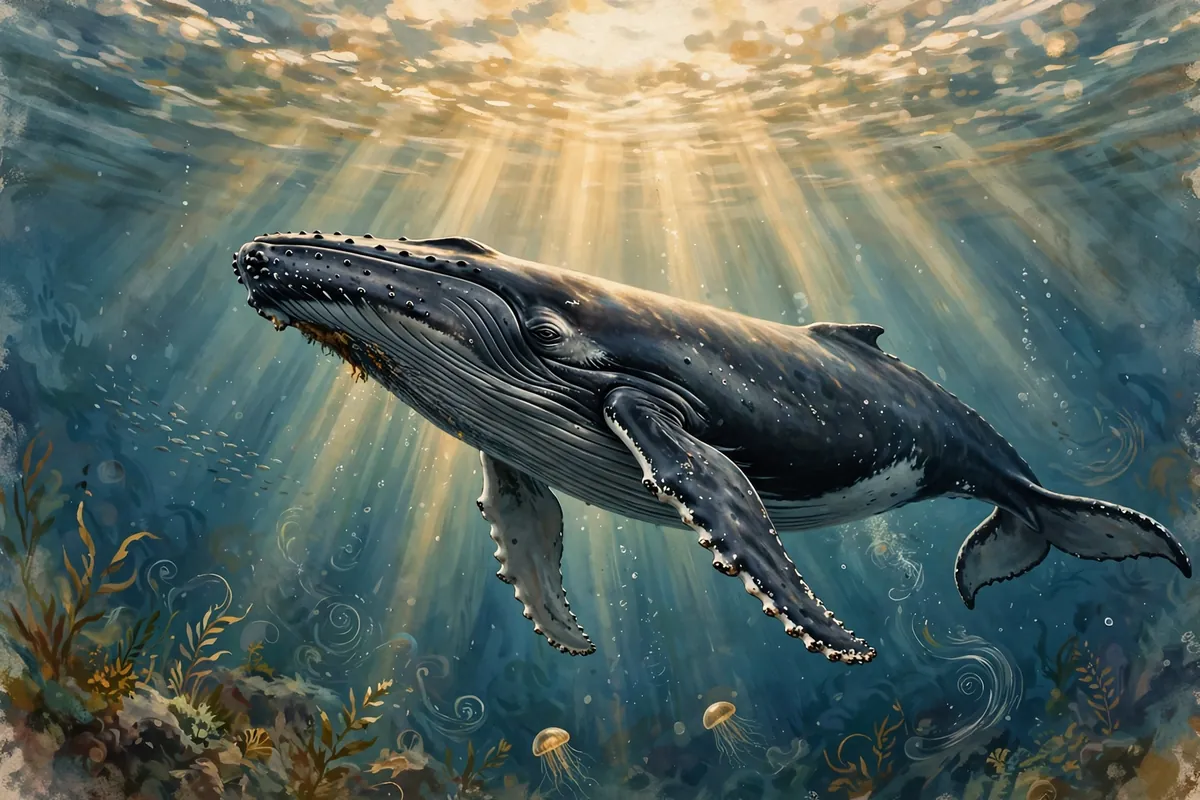
Somewhere out in the ocean right now, a male humpback whale is singing. His song may last 20 minutes, and he may repeat it for hours. What's even stranger is that the other males nearby are singing nearly the same song, and over time they all change it together.
Here's the short answer. Humpback songs aren't fixed. All the whales in an area sing virtually the same song at any moment, but the song is constantly and slowly evolving. When some males alter their song, others in contact with them copy the changes. In some years the song changes quickly, and in others it barely changes at all.
A Song Built Like Music
Marine biologist Philip Clapham has described the humpback's song as probably the most complex in the animal kingdom. It isn't just a string of random noises. It has a structure that fits together like nesting dolls.
The smallest pieces are called units, single sounds that work a bit like musical notes. A handful of units make a sub-phrase, and two sub-phrases make a phrase. A whale repeats the same phrase over and over for two to four minutes, which is called a theme. Several themes strung together make the full song.
Most songs last somewhere between 4 and 33 minutes, depending on the region. In Hawaii, humpbacks have been recorded singing for as long as seven hours.
How the Song Slowly Shifts
The changes are often subtle. Over the course of a month, a sound that started as a rising note might slowly flatten into a steady tone. Another sound might gradually get louder. Little by little, the whole song drifts into something new.
Whales that share the same waters, an area that can be as large as an entire ocean basin, sing similar songs with only slight differences. Whales from regions that don't overlap sing entirely different songs. And songs can spread between neighboring populations over several breeding seasons.
The two halves of the planet seem to do it differently, too. In the northern hemisphere, songs tend to change gradually. In the southern hemisphere, they go through cyclical "revolutions," where the song turns over in a bigger way.
Why Do They Sing at All?
Only males sing, and they do most of it during the winter breeding season. That led scientists to suspect the songs are tied to mating, perhaps as a way of showing off to females. But the evidence is mixed, and the true purpose is still debated.
There is little evidence that songs help males establish dominance over each other. Females don't seem to approach a lone singer, though they may be drawn to gatherings of singing males. Other ideas are that songs help draw whales to breeding grounds, or that they have echolocating properties that help whales locate one another. The songs may well serve several purposes at once.
The Record That Made Whales Famous
People first paid serious attention to these songs thanks to a Bermudian named Frank Watlington. He was working for the U.S. government, listening with underwater microphones for Russian submarines, when he picked up the whales. Researchers Katy and Roger Payne, along with Scott McVay, took a close interest in the recordings.
In 1970 the Paynes released the best-selling album Songs of the Humpback Whale. Musicians including Judy Collins soon worked the songs into their own music, and whale song became part of popular culture.
So the next time you hear a humpback recording, remember you're listening to one moment in a song that's always being rewritten. Somewhere in the ocean, the whales are already singing the next version.