Some vacation photos are hard to believe. A person leans back in the water, legs up, holding a newspaper or a book, perfectly dry and perfectly relaxed. No pool float, no life jacket, no effort at all. Those pictures almost always come from one place: the Dead Sea.
The reason is salt, and lots of it. Dead Sea water is about 34 percent salt, roughly 9.6 times as salty as the ocean. All that dissolved salt makes the water much denser than fresh water, about 1.24 kilograms per liter. Because the water is so much heavier than your body, it pushes you up, and you float with almost no effort.
How Floating Works
Anything placed in water gets pushed upward by a force called buoyancy. The ancient Greek scientist Archimedes figured out the rule: the upward push equals the weight of the water your body moves out of the way.
The human body is roughly as dense as ordinary water, which is why most of us barely float in a pool. In the Dead Sea, each bit of water you displace weighs a lot more, so the push upward is much stronger. You only need to sink a little before the water holds you up. Swimming there feels more like floating on top. It's the same reason many people find it a little easier to float in the ocean than in a lake. Seawater carries salt too, just far less of it.
Why Is It So Salty?
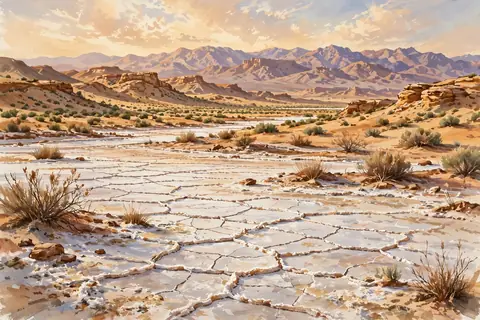
The Dead Sea is a landlocked salt lake bordered by Jordan, the West Bank, and Israel. Water flows in, mainly from the Jordan River, but there's no outlet to the ocean. The only way out is evaporation in the hot, dry climate. When water evaporates, the salt stays behind, and over time it builds up.
Its salt is also unusual. Ordinary seawater salt is mostly sodium chloride, the same as table salt. Dead Sea salt is mostly magnesium chloride, with sodium chloride making up less than a third. Its water also has the highest concentration of bromide of any water on Earth.
The Lowest Place on Land
The Dead Sea holds another record. As of 2025, its surface sits about 1,443 feet below sea level, making its shores the lowest land on Earth. It's also about 997 feet deep, the deepest hypersaline lake in the world.
Its name comes from the fact that fish and water plants can't survive in it. It isn't completely lifeless, though. Tiny amounts of bacteria and microscopic fungi live in the water. In ancient Greek and Roman times, it was called the Asphalt Lake because of lumps of natural tar that floated on its surface.
A Sea That's Shrinking
Sadly, the Dead Sea is disappearing. Since the 1960s, much of the Jordan River's water has been diverted for drinking and irrigation. The lake's level now drops more than three feet a year, and as of 2021 its surface area had shrunk by about a third since the 1960s. As it retreats, sinkholes have opened up along its shores.
If you ever get the chance to visit, take a float while you can. Just keep the water out of your eyes, because all that salt really stings. Then lie back, relax, and let one of nature's strangest lakes do all the work.