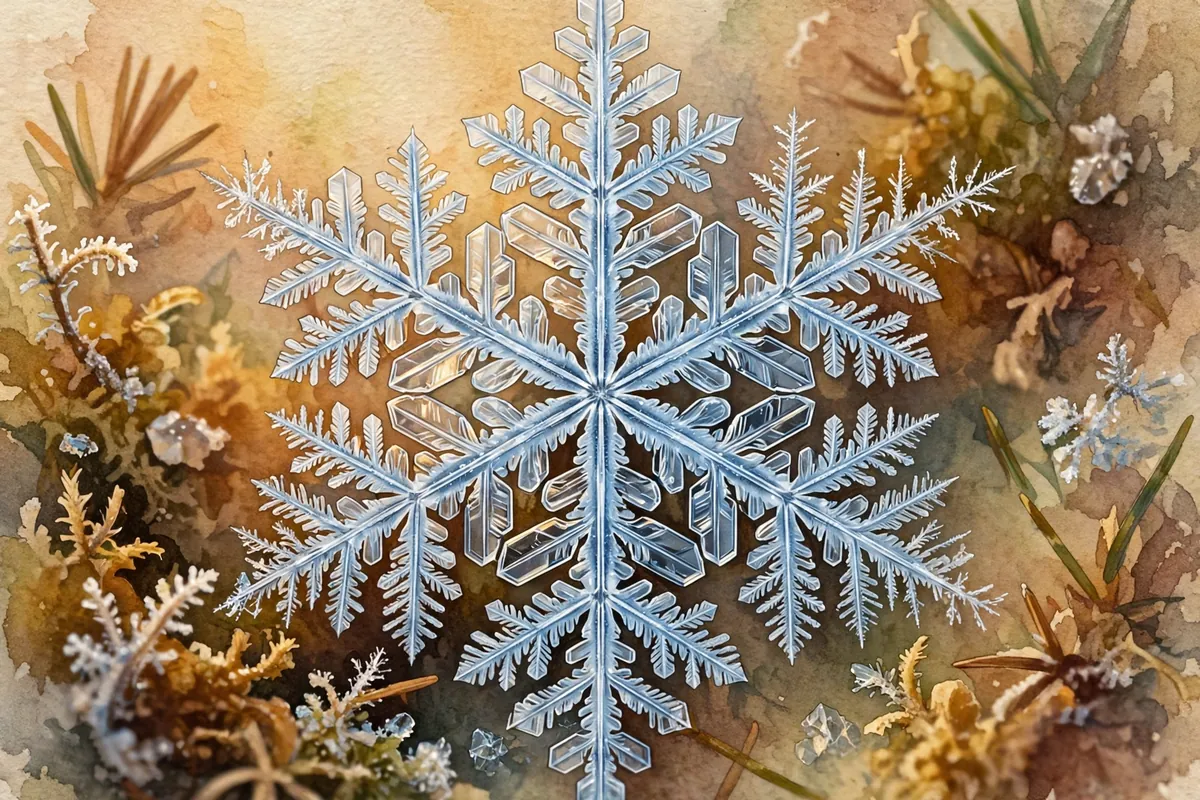
Catch a snowflake on a dark mitten and look closely before it melts. You might see a tiny star with six lacy arms, or a little hexagon, or a needle, or just a ragged clump. How does plain frozen water manage to build such delicate shapes, all on its way down from a cloud?
Here's the short answer. A snowflake starts as a tiny ice crystal around a speck of dust or other particle. Because of how water molecules fit together in ice, the crystal grows in a six-sided pattern. As it falls, the temperature and humidity around it decide whether it grows into flat plates, long columns, needles, or branching star shapes.
It All Starts With a Speck
High in a cold cloud, a water droplet needs something to freeze onto. That seed, called a nucleus, can be a tiny bit of clay, desert dust, or even biological material. Scientists still aren't sure exactly what makes some particles better at this than others.
Once the droplet freezes, the new ice crystal grabs water vapor from the surrounding air. In a cloud full of tiny droplets, the ice crystals grow at the droplets' expense, sometimes reaching a millimeter or more across. At first, the crystal is a minute hexagon. Then six arms begin sprouting from its corners.
The Weather Is the Artist
A scientist named Ukichiro Nakaya made a famous chart showing how snow crystal shapes depend on conditions. Just below freezing, down to about 27°F, crystals tend to grow thin and flat. Colder, down to about 18°F, they grow as hollow columns, prisms, or needles. Colder still, near minus 8°F, they turn flat again, often with branching arms.
Moisture matters too. In drier air, crystals stay simpler and more compact. In very moist air, they grow lacy and ornate, the classic star shape. A crystal that starts as a column and then drifts into warmer air can even sprout plates on each end, forming a capped column.
Because each flake tumbles through its own mix of temperatures and moisture on the way down, every one carries its own little weather history. Scientists sort snow crystals into eight broad classes and at least 80 variants.
Are No Two Really Alike?
A typical snowflake contains around 10 quintillion water molecules, all growing at slightly different rates as conditions change. That makes it extremely unlikely you'd ever find two identical flakes in nature. Scientists have grown nearly identical ones in the lab under carefully controlled conditions, but even those may differ at the molecular level.
Starting in 1885, a man named Wilson Bentley began photographing snowflakes through a microscope, capturing thousands of them in hopes of finding a matching pair. His beautiful images helped make the idea that no two are alike famous.
The Truth About Perfect Snowflakes
Here's the twist. Those perfect six-armed stars are actually rare. Studies suggest fewer than 0.1 percent of snowflakes have the ideal six-fold symmetry. Most snow particles are irregular. Very rarely, around 28°F, snowflakes even form with three-sided symmetry, like little triangles, and once in a while a flake with twelve branches turns up.
And while each flake is made of clear ice, snow looks white because the countless tiny crystal surfaces scatter sunlight in every direction. So the next time snow starts drifting past your window, remember that each flake is a tiny ice sculpture shaped by its journey through the sky, and no two journeys are quite the same.