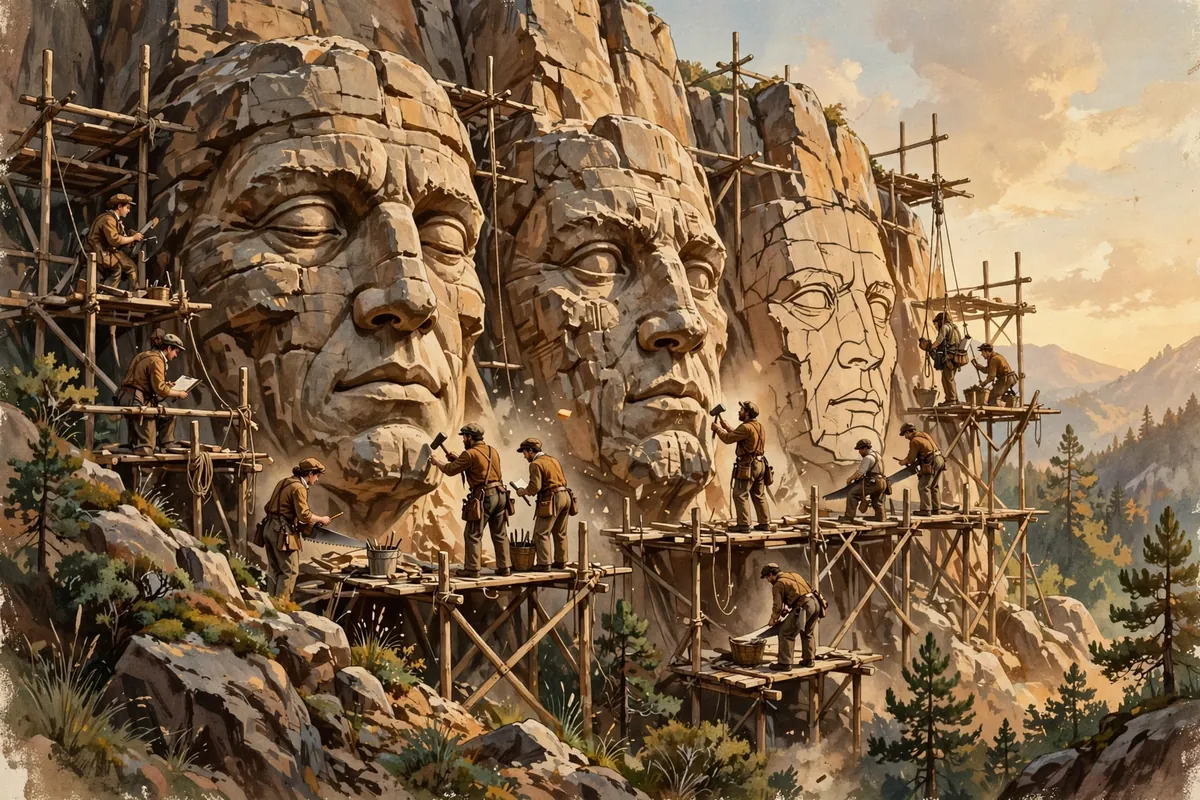
Stand on the Grand View Terrace in the Black Hills of South Dakota and four enormous stone faces stare back: George Washington, Thomas Jefferson, Theodore Roosevelt, and Abraham Lincoln. Each one is about 60 feet tall. It's hard not to wonder how anyone carved them at all.
The short answer: with dynamite first, then drills and hand work. Between 1927 and 1941, sculptor Gutzon Borglum and about 400 workers blasted away roughly 450,000 tons of rock, then used a technique called honeycombing to shape the details. Remarkably, the project was finished without a single fatality.
Choosing the Mountain
The idea came from Doane Robinson, South Dakota's state historian, who first imagined heroes of the American West, such as Lewis and Clark, Sacagawea, and Red Cloud. Borglum argued the sculpture should be national in scope and pushed for four presidents instead, chosen to represent the nation's founding, expansion, development, and preservation.
Borglum picked Mount Rushmore for practical reasons. Its smooth, fine-grained granite erodes only about an inch every 10,000 years. It rises 5,725 feet above sea level, and it faces southeast, giving workers sunlight for most of the day.
The mountain's name came from Charles E. Rushmore, a New York attorney who visited in the 1880s. When he asked his guide what the peak was called, he was told it had no name, but that from then on it would be named after him.
Blast First, Then Honeycomb
Dynamite did the heavy lifting, removing huge amounts of rock to rough out the shapes. Then came honeycombing: workers drilled rows of closely spaced holes into the granite, which let them remove small pieces of rock by hand and refine the surfaces.
Mistakes had to be fixed on a mountain-sized scale. Jefferson was first carved to Washington's left, but the rock there proved unsuitable. Workers dynamited that face and sculpted a new Jefferson on Washington's right.
The faces were dedicated one at a time: Washington in 1934, Jefferson in 1936, Lincoln in 1937, and Roosevelt in 1939. When Borglum died in March 1941, his son Lincoln Borglum took over the project.
Getting workers up the mountain was its own challenge. In 1933, the National Park Service took charge of the memorial, and Julian Spotts helped by upgrading the tram so it could reach the top of Mount Rushmore.
Unfinished Business
The presidents were meant to be shown from head to waist, but funding ran out, and work ended on October 31, 1941. Only Washington has any detail below the chin.
Borglum also began a Hall of Records, a vault in a crag behind Lincoln meant to preserve important documents. Workers cut about 70 feet into the rock before stopping in 1939. In 1998, a time capsule holding 16 enamel panels about the memorial's history was placed at the entrance.
The memorial also carries a painful history. It was carved in the Black Hills, which the Lakota consider sacred, on land taken from the Sioux Nation in the 1870s. In 1980, the U.S. Supreme Court awarded the tribe $102 million, but the Sioux have refused the money and continue to seek the land's return.
Today, more than two million people visit each year to see what dynamite, drills, and patient hands accomplished. Whatever you feel when you look up at those faces, there's no denying the sheer scale of the work it took to put them there.