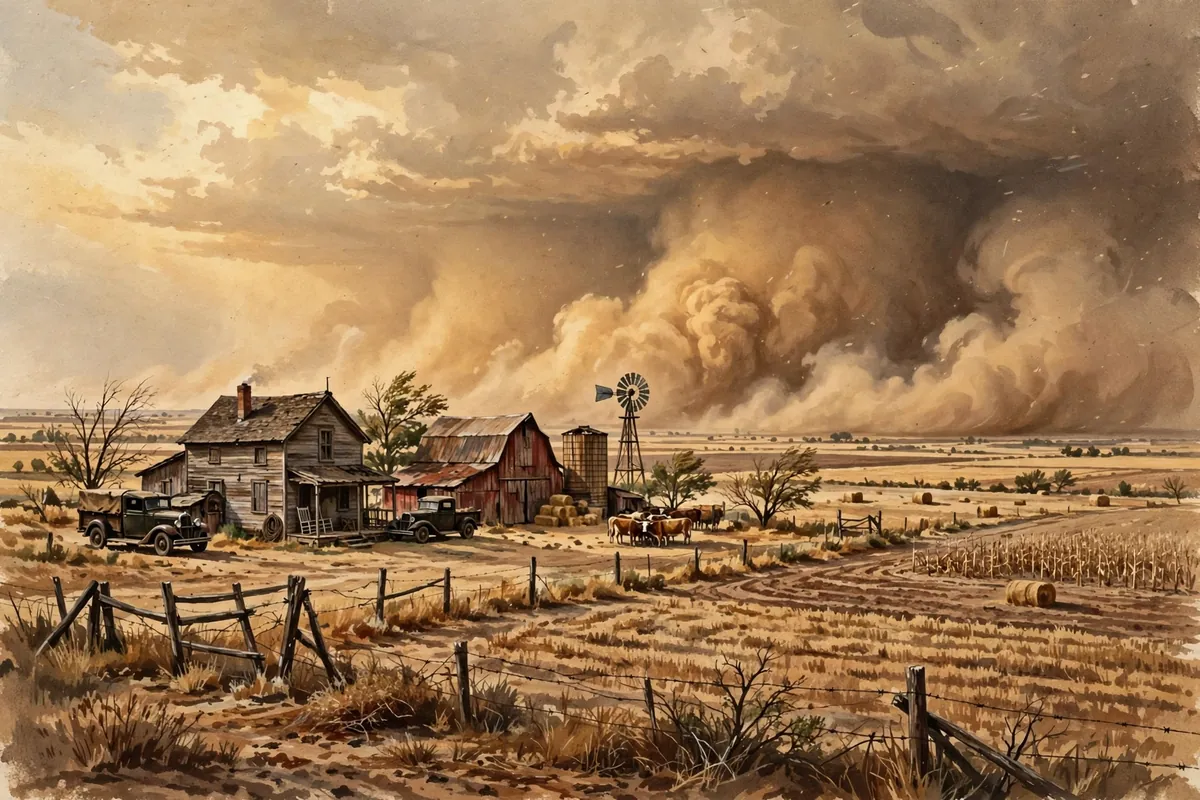
Imagine stepping outside on a calm spring afternoon and seeing a black wall rolling across the prairie toward you. Birds and rabbits race ahead of it. Once it hits, you can barely see a few feet in front of you. For families on the Great Plains in the 1930s, that nightmare happened again and again.
Here's the short answer: the Dust Bowl was caused by severe drought combined with farming methods that stripped the land of its protective grass. When the soil blew away, the federal government stepped in on a huge scale. It created the agency now called the Natural Resources Conservation Service, planted more than 200 million trees as windbreaks, and taught farmers soil-saving methods like crop rotation, strip farming, contour plowing, and terracing. Soil conservation became a permanent part of American farming.
How the Plains Lost Their Grip
The trouble started with hope. The Homestead Act of 1862 offered settlers 160-acre plots, and after the transcontinental railroad was finished in 1869, newcomers poured onto the Plains. An unusually wet period convinced many people that "rain follows the plow," a popular slogan among land promoters.
In the 1920s, small gasoline tractors and combine harvesters let farmers plow far more land than ever before. Much of it was dry grassland that got no more than about 10 inches of rain a year. Deep plowing tore out the native, deep-rooted grasses that had held the soil and moisture in place for ages, even through droughts and high winds.
Black Blizzards
When drought struck in the 1930s, the loose soil turned to dust, and the wind carried it off in enormous clouds called black blizzards. Some reached all the way to New York City and Washington, D.C. Out on the Plains, visibility could drop to three feet or less.
The worst came on April 14, 1935, a day remembered as Black Sunday. A cold front from Canada kicked up mountains of dust and drove it south across the Plains at 60 miles per hour. An Associated Press editor named Edward Stanley, rewriting a reporter's story about that storm, coined the term "Dust Bowl."
The hardest-hit area covered about 16 million acres in the Texas and Oklahoma panhandles. Between 1930 and 1940, about 3.5 million people moved out of the Plains states, many heading west to California.
A New Way to Farm
During President Franklin D. Roosevelt's first 100 days in 1933, his administration launched programs to protect the soil. That year, the Soil Erosion Service was created under Hugh Hammond Bennett. In 1935, it became the Soil Conservation Service, today's Natural Resources Conservation Service.
The Civilian Conservation Corps planted the Great Plains Shelterbelt, a huge band of trees stretching from Canada to Abilene, Texas, to slow the wind and hold the soil. Officials made detailed soil maps and photographed the land from the air. In 1937, the government even paid reluctant farmers a dollar an acre to try the new methods.
The Lasting Lesson
It worked. By 1938, the amount of blowing soil had dropped by 65 percent. The drought finally broke in the fall of 1939 when regular rain returned. Even then, the government kept encouraging farmers to stick with conservation.
Today, when you drive past rows of trees lining a field or crops planted in curving strips along a hillside, you may be looking at the Dust Bowl's legacy. It was a hard lesson, but it taught a nation to treat its soil as something precious.