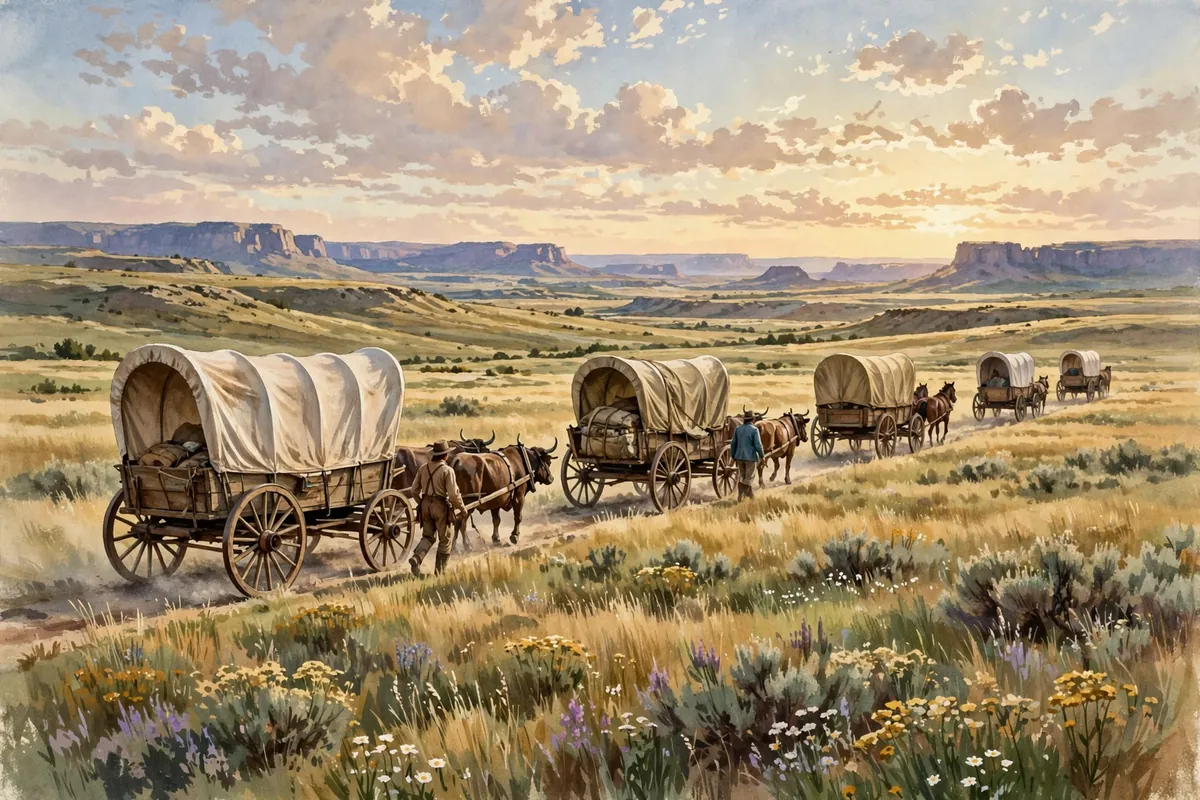
Covered wagons, wide-open prairie, and families heading west toward a new life. The Oregon Trail is one of the great American adventures, and plenty of us first learned about it from a computer game in school. But the real journey was bigger, harder, and stranger than most of us imagine.
Here's the big picture. The Oregon Trail ran about 2,170 miles, from the Missouri River to the valleys of Oregon. About 400,000 settlers, farmers, miners, ranchers, and their families used it and its offshoots, with traffic heaviest from 1846 to 1869. And despite the movies, hardly anyone actually rode in the wagons.
2,170 Miles of Prairie and Mountains
The trail began as paths used by fur traders and trappers from about 1811 to 1840, passable only on foot or horseback. The first migrant wagon train was organized in Independence, Missouri, in 1836, and wagon roads were gradually pushed farther west until they reached Oregon's Willamette Valley.
The eastern part crossed what are now Kansas, Nebraska, and Wyoming, and the western half crossed Idaho and Oregon. Travelers forded rivers again and again. In Wyoming alone, the Sweetwater River might have to be crossed up to nine times before the trail reached South Pass on the Continental Divide.
Walking Beside the Wagon
Most pioneers walked the whole way. The wagons had no springs, so the ride was rough and dusty, and extra weight was hard on the animals. Wagons averaged only 2 to 3 miles per hour.
By 1842, many emigrants preferred oxen to pull their wagons. Oxen were calm, generally healthy, could keep going through mud and snow, and could live on prairie grass, unlike horses, which needed feed. They were cheaper, too. One downside: oxen hated being shod, often lying down and tucking their feet under themselves, so several men had to lift and hold one up.
Supplies weren't cheap. In 1855, food for four people for six months cost about $150, nearly $5,000 in today's money.
The Real Dangers
Nobody knows exactly how many people died on the trail, but one estimate is about 4 percent, or roughly 16,000 of the 400,000 pioneers on all the western trails. Many were buried in unmarked graves, sometimes right in the middle of the trail so wagons and livestock would hide them.
The biggest killer was disease. Cholera alone killed up to 3 percent of all travelers in the epidemic years from 1849 to 1855. Dysentery and typhoid fever took lives too, so the computer game line "You have died of dysentery," now popular on T-shirts, wasn't far off.
Accidents were common as well. People drowned at river crossings, since surprisingly few knew how to swim. Being run over by a wagon was a major cause of death, often when children tried to hop on or off while it was moving. Accidental gunshots happened too, though they dropped off as travelers got tired of hauling a ten-pound rifle around and left it in the wagon.
The End of the Trail
Traffic on the trail faded after the first transcontinental railroad was finished in 1869, making the trip west faster, cheaper, and safer. Today, highways like Interstate 80 and Interstate 84 follow parts of the old route, passing through towns first built to serve the pioneers.
The trail lives on in memory, too. In 1971, three Minnesota college students created The Oregon Trail computer game to teach schoolchildren about pioneer life. So the next time you hear someone joke about dysentery, remember the real families who walked 2,170 miles to start over.