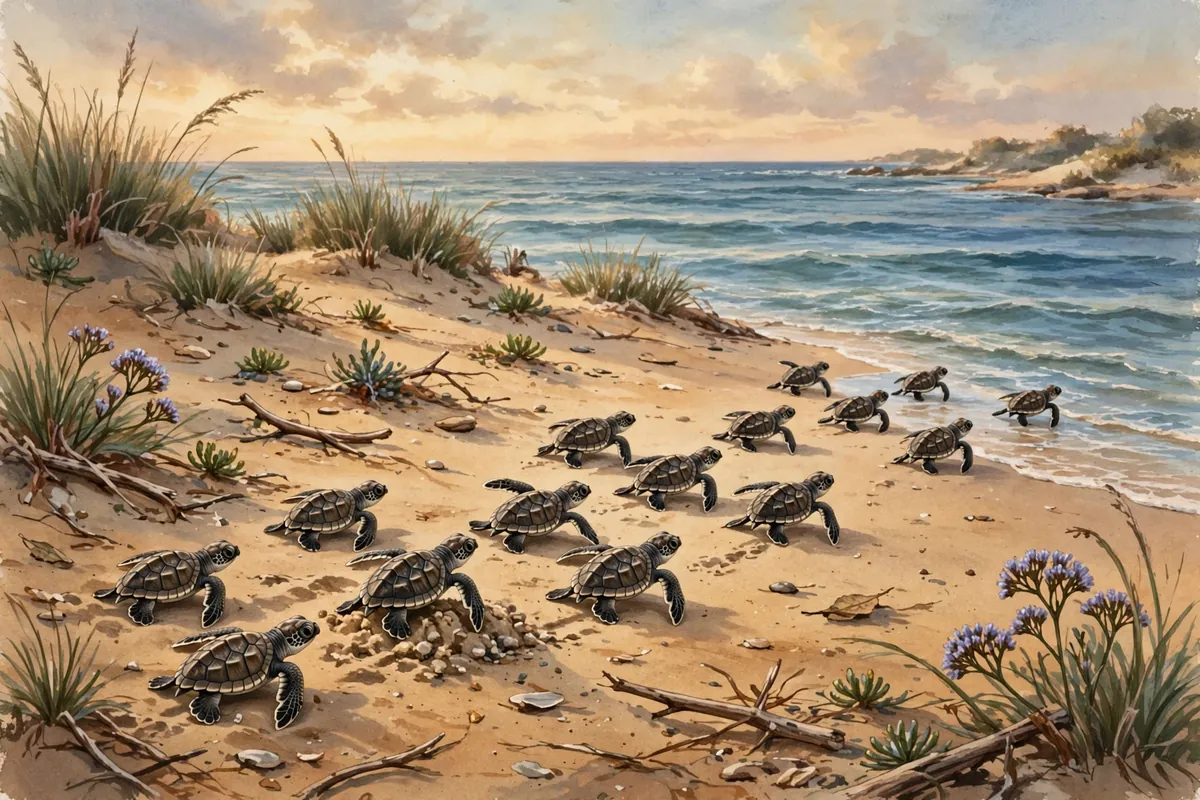
It's one of nature's most touching scenes. On a warm night, dozens of baby sea turtles pop out of the sand and scramble toward the waves. Then they're gone, swept out into a vast ocean. Many won't see that beach again for years, yet somehow a lot of them find their way back.
This return trip is called natal homing. Many female sea turtles come back to nest near the beach where they hatched, and some return to the very same beach. Scientists think their main tool is Earth's magnetic field, which they may memorize like an invisible address. The exact mechanism, though, is still a mystery.
The First Dash to the Sea
The journey starts with a sprint. After about 50 to 60 days in the nest, the eggs hatch together. The babies dig up through the sand and crawl toward the water. Most species hatch at night.
How do they know which way to go? Hatchlings instinctively head toward the brightest horizon. Normally that's the ocean, glowing with reflected moonlight and starlight. Bright artificial lights on the shore can confuse them, which is why some beaches use special red or amber lights that sea turtles can't see.
Even the temperature of the sand matters. Warmer nests produce more females, while cooler nests produce more males.
Years Out at Sea
Once they reach the water, young turtles are carried away by tides and currents. Many green and loggerhead youngsters spend time sheltering in floating mats of seaweed. Green sea turtle hatchlings spend their first three to five years out in the open ocean before moving to coastal seagrass meadows.
Sea turtles are thought to reach adulthood at roughly 10 to 20 years old, though it's hard to know for sure. By then, many have traveled enormous distances. Loggerheads in the North Atlantic can cover more than 9,000 miles on a round trip to lay eggs on North American shores.
An Invisible Map in Their Heads
So how do they find their way home? The leading idea is that sea turtles sense Earth's magnetic field. Every stretch of coastline has its own magnetic signature, and scientists think hatchlings may learn the signature of their home beach. Researchers call this geomagnetic imprinting.
There's some intriguing evidence. Genetic studies show that turtles nesting at beaches with similar magnetic fields are more closely related than turtles at beaches that are simply close together. Nesting sites have even been recorded shifting along with gradual changes in Earth's magnetic field. In experiments, scientists have also moved turtle populations by relocating them before they hatched.
Other theories suggest turtles may inherit some magnetic information or learn routes by following other turtles. The truth may be a mix, and researchers are still working it out.
Not the Only Ones Who Come Home
Sea turtles aren't alone. Salmon spend years in the ocean, then return to the very streams where they were born, likely guided partly by smell. Atlantic bluefin tuna return to spawn on the side of the Atlantic where they hatched, and Atlantic puffins come back to the colonies where they were raised.
Females that do return usually nest every two to four years. So when you see hatchlings racing to the sea, wish them luck. If they make it, some may come back one day to the very same sand.