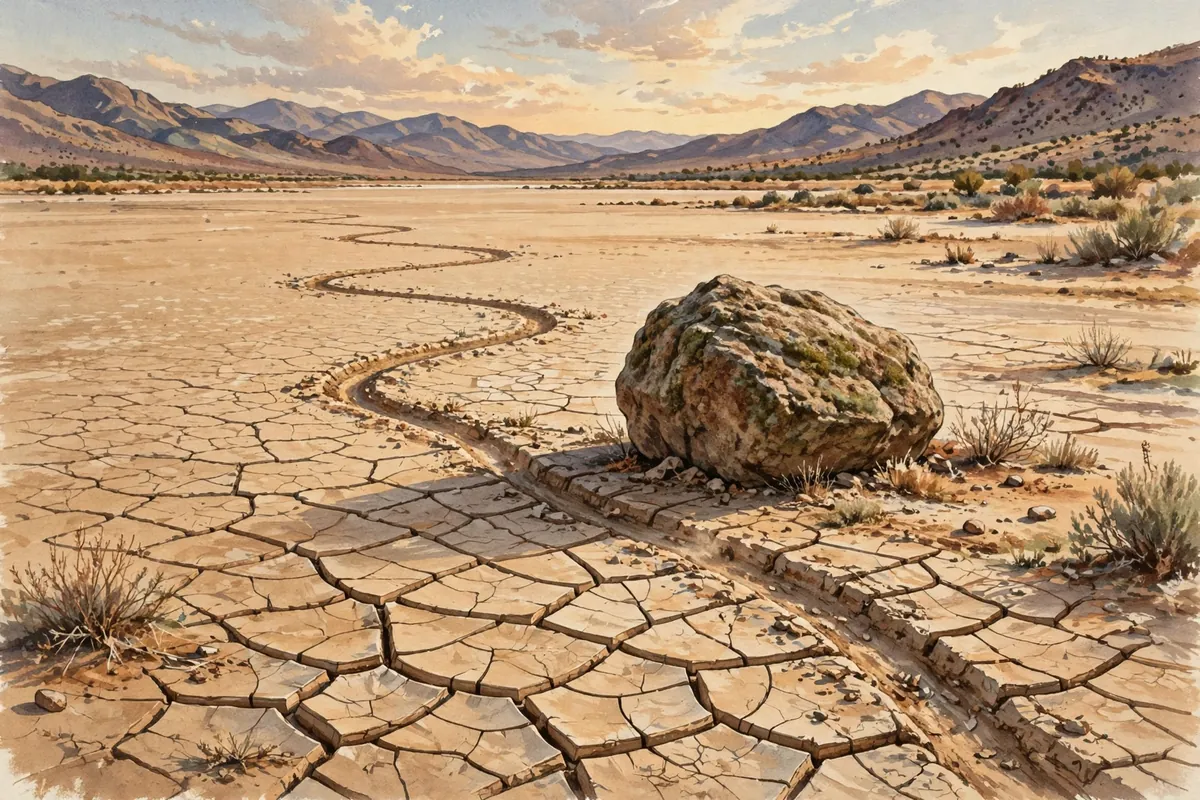
Out in a remote corner of Death Valley lies a flat, dry lakebed called the Racetrack Playa. Scattered across it are rocks, some of them hundreds of pounds, and behind each one stretches a long groove, as if someone dragged it across the ground. There are no footprints and no tire tracks. For most of the 20th century, nobody had ever seen one of these rocks move.
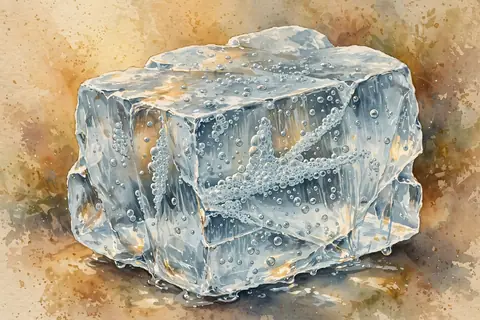
The mystery was finally cracked in 2014. Researchers used GPS trackers and time-lapse cameras to catch the rocks in motion. The answer was ice. On winter mornings, thin sheets of ice floating on a shallow temporary pond break up, and light winds push those ice panels into the rocks, shoving them slowly across the mud.
A Strange Place for Sliding Stones
The Racetrack Playa is about 3 miles long and 1.2 miles wide, sitting at about 3,700 feet in Death Valley National Park, California. It gets only about 3 inches of rain a year. Its surface is mostly dried clay, making a hard, smooth, flat pavement.
The trails are impressive. They're often up to 330 feet long, a few inches to about a foot wide, and usually less than an inch deep. Rocks with rough bottoms leave straight, scratched tracks, while smooth-bottomed ones tend to wander. Two rocks that start side by side may travel together, then one suddenly veers off in a different direction.
Decades of Guessing
The first documented account dates to 1915, when a prospector named Joseph Crook visited the site. In 1948, geologists published the first scientific report, suggesting that strong, gusty winds pushed the rocks across a muddy surface.
In 1968, Bob Sharp and Dwight Carey began a monitoring program. They labeled 30 rocks, gave each one a name, and tracked their positions for seven years. They even built a corral of metal bars around one stone to test whether ice was involved. The stone slipped right out of the corral, barely missing a bar, which made the ice idea look shaky at the time.
Caught in the Act
The breakthrough came with modern technology. Researchers set up a weather station, time-lapse cameras, and rocks fitted with GPS. On December 20, 2013, they documented more than 60 rocks moving, and some traveled up to 245 yards over the following weeks in several separate moves.
What they saw surprised them. The ice wasn't thick, and the winds weren't fierce. Instead, ice sheets just a few millimeters thick, frozen during cold winter nights, began breaking up on sunny mornings. Light winds drove these thin panels into the rocks, pushing them at up to about 16 feet per minute. Some moves lasted as long as 16 minutes.
So the rocks don't really move by themselves. They need a very specific recipe: a flooded surface, a thin layer of clay, ice, wind, and warming temperatures that break the ice apart. That rare combination explains why the rocks sit still for years at a time.
Still a Few Questions
Scientists say a few details about the tracks remain a puzzle. One idea is that ice can freeze to the base of certain rocks, letting the ice sheet carry rock and mud along together. Sliding rocks have also been seen in other places, including Nevada, the Tunisian Sahara, and South Africa.
It's a nice reminder that even in one of the hottest, driest places in America, a little winter ice can do something remarkable, as long as you're patient enough to watch.