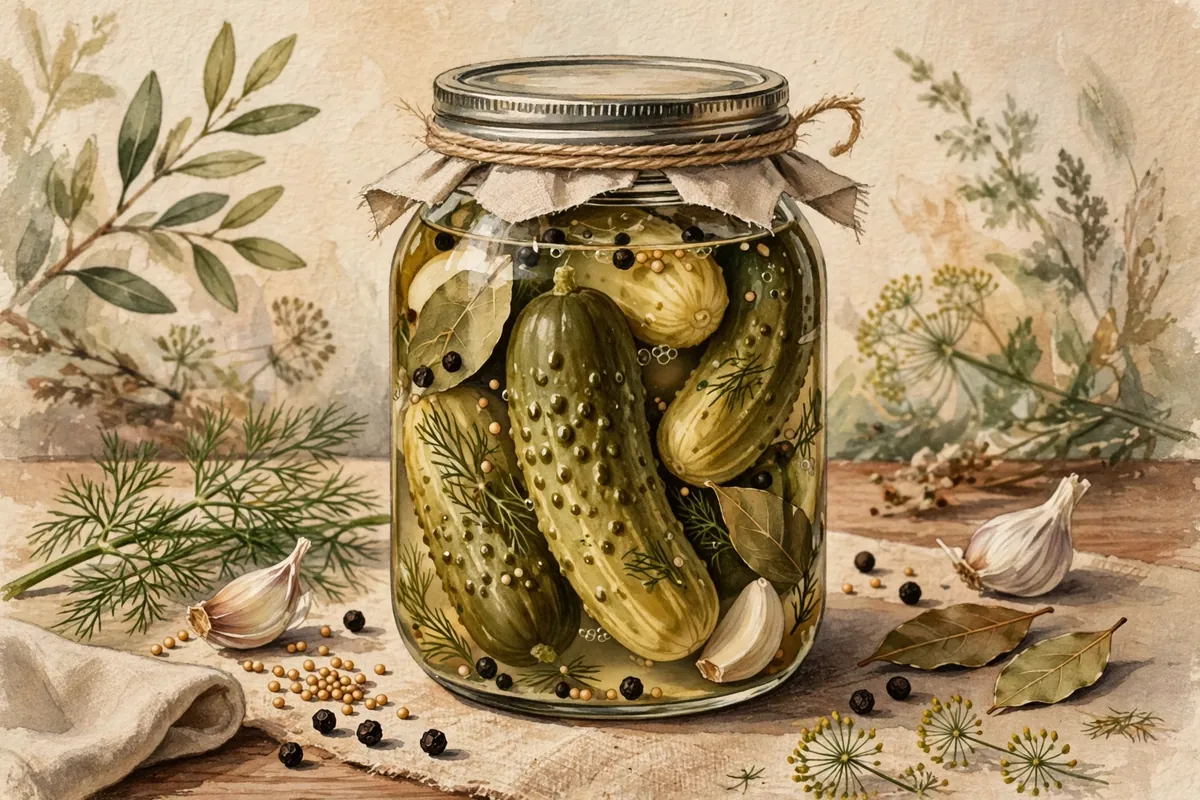
Reach into a jar of pickles and you'll notice they come in different shades. Some are bright, crisp green, almost like a fresh cucumber. Others have a softer olive or khaki color. Why the difference, and where does that green come from in the first place?
The short answer: pickles are green because cucumbers are green. Their color comes from chlorophyll, the green pigment found in plants. But pickling involves acid, and acid slowly changes chlorophyll into a duller, dusky pigment. That's why a quick pickle stays bright green while one that's been sitting in brine for a long time looks more muted.
Chlorophyll Meets Acid
Chlorophyll is what lets plants capture energy from sunlight. Its name comes from Greek words meaning pale green and leaf. At the center of each chlorophyll molecule sits a single atom of magnesium.
When chlorophyll is treated with a weak acid, it can lose that magnesium. The result is a different pigment called pheophytin. Its name roughly means dusky vegetation, which is a pretty good description of an older pickle's color.
Pickling is all about acid. Cucumbers are either soaked in an acidic solution, like vinegar, or soured through fermentation in salty brine. Either way, the longer they sit, the more time that acid has to work on the chlorophyll.
In the traditional method, small cucumbers go into a glass or ceramic jar or a wooden barrel with spices and plenty of salt. The container is filled with cooled, boiled water and loosely covered for several weeks. Cooks often set clean stones on top to keep the cucumbers under the brine. Interestingly, saltier cucumbers tend to turn out sourer.
Half-Sours and Full-Sours
New York deli pickles show this off perfectly. A half-sour gets a shorter stay in the brine and is still crisp and bright green. A full-sour is fully fermented, which gives the acid much more time to work on its color.
You may also have seen kosher dills. Despite the name, a kosher dill isn't necessarily made according to Jewish dietary law. It's a pickle made in the traditional style of Jewish pickle makers in New York City, with plenty of garlic and dill in a natural salt brine.
The Dangerous Green of the 1800s
Here's where pickle history gets a little alarming. In the 1800s, some pickles got their color the wrong way. Pickling at the time raised health concerns linked to copper salts.
A mid-19th-century cookbook described evidence from a commissioner for the medical journal The Lancet and from a member of the well-known food firm Crosse and Blackwell. Their evidence suggested that pickles sold in shops were nearly always artificially colored, making them unwholesome, if not actually poisonous.
A Very Old Snack
People have been pickling cucumbers for a long time. One popular claim says pickles were first made for workers building the Great Wall of China. Another idea holds that they date back as far as 2030 BC in the Tigris Valley of Mesopotamia, using cucumbers brought from India. Historians can't say for sure which is right.
Pickles go by different names around the world. In the United States and Canada, they're pickles. In Britain, Ireland, Australia, New Zealand, and South Africa, they're often called gherkins.
So the next time you crunch into a bright green dill, you can thank the cucumber's own chlorophyll. And if your pickle looks a little more olive, that's just the brine doing what it's done for centuries.