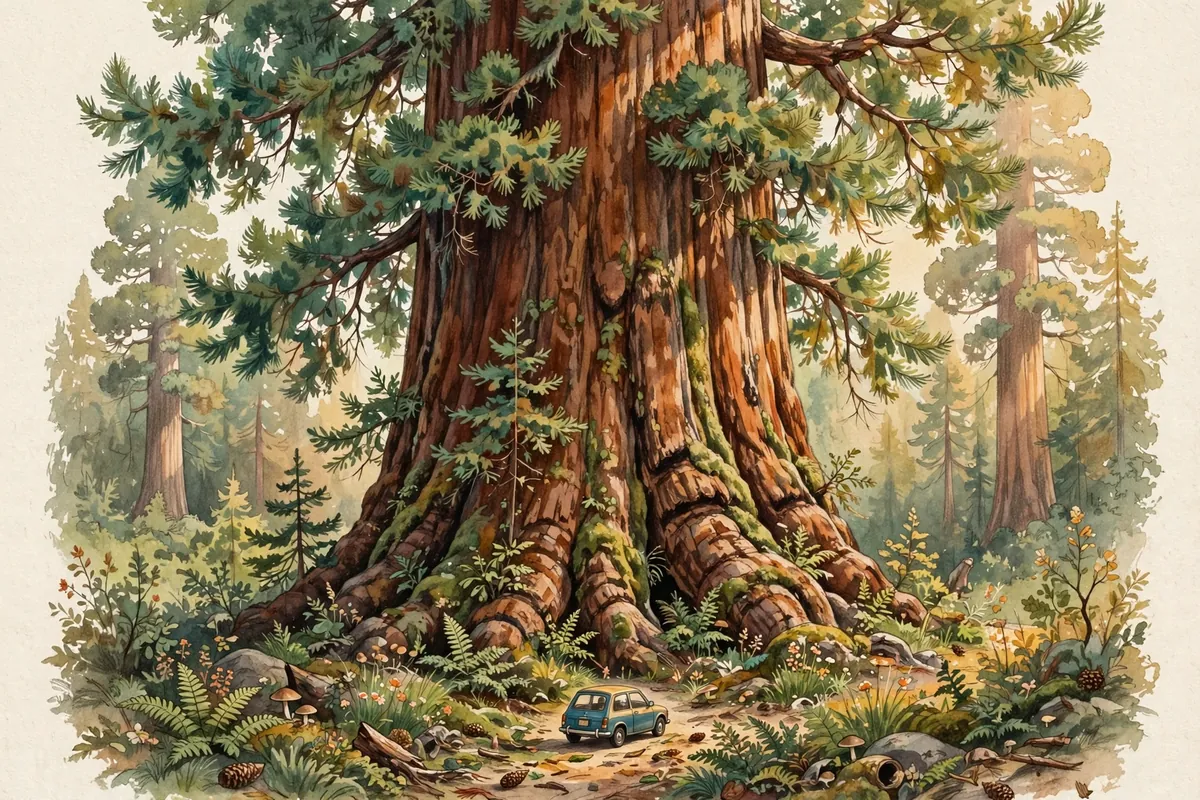
Some trees are big. Then there's General Sherman. Stand at its base in Sequoia National Park in California and you have to tip your head all the way back, and you still can't really take it all in. Calling it bigger than a house is almost an understatement.
Here's the headline: by volume, the General Sherman Tree is the largest known living single-stem tree on Earth. It's a giant sequoia about 275 feet tall and 25 feet across at the base, with a trunk estimated at more than 52,000 cubic feet. It's also thought to be roughly 2,300 to 2,700 years old.
Biggest, But Not Tallest
General Sherman wins on total size, not on any single measurement. A coast redwood called Hyperion is taller. Some cypress and baobab trees are wider. And other trees are older.
What makes General Sherman special is how all that height and width add up. The tree was declared the largest in the world in 1931, after comparisons with the nearby General Grant Tree. That contest helped make wood volume the standard way to compare the size of trees.
It may not be the biggest tree that ever lived, though. The Crannell Creek Giant, a coast redwood cut down in the mid-1940s near Trinidad, California, is estimated to have been 15 to 25 percent larger by volume.
A Branch Bigger Than a Tree
If you want a sense of scale, consider what happened in January 2006. The tree's largest branch broke off, with no one around to see it fall. That single branch was over 6 feet thick and more than 98 feet long, larger than most tree trunks.
It smashed part of the fence around the tree and left a crater in the paved walkway. Experts didn't think the break meant the tree was unhealthy. Shedding a branch may even be a natural defense against bad weather.
A Tree With a Colorful Name History
The tree is named after Civil War general William Tecumseh Sherman. The official story, which may not be entirely true, says naturalist James Wolverton named it in 1879. He had served under Sherman as a cavalry lieutenant.
In 1886, a utopian socialist group called the Kaweah Colony took control of the land and renamed the tree after Karl Marx. The colony broke up in 1892, largely because Sequoia National Park was created, and the tree got its old name back.
Why Fire Is a Sequoia's Friend
Giant sequoias grow naturally only in groves on the western slopes of California's Sierra Nevada. They are remarkably tough. Their bark can be up to 3 feet thick at the base, and their sap contains tannic acid, which helps protect them from fire.
Fire actually helps them reproduce. The heat dries and opens their cones, releasing seeds onto freshly cleared, ash-covered ground where young trees can get the sunlight they need. Without fire, other trees crowd the seedlings out.
Even so, big fires can be dangerous. A 2003 fire badly damaged the Washington Tree, then the world's second-largest tree, and over half its trunk collapsed in a snowstorm two years later. In 2021, when a wildfire threatened General Sherman, crews wrapped its base in protective foil. The tree came through unharmed.
So if you ever stand beneath General Sherman, take a moment. That trunk was already growing long before the Roman Empire, and with a little luck, it'll still be standing tall long after all of us.