Picture a place so dry that rain gauges sit year after year without collecting a single drop. It sounds like something from another planet, and in a way it is. Scientists have actually used this place to test equipment meant for Mars.
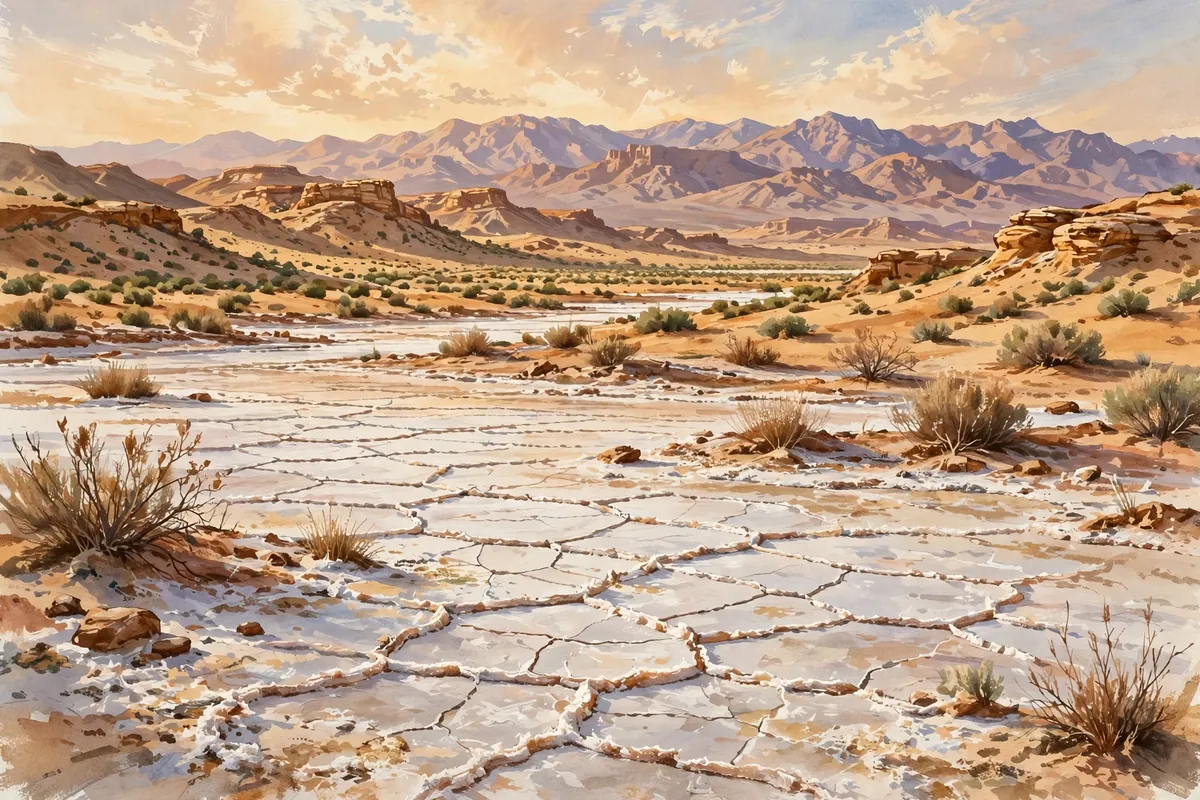
That place is the Atacama Desert in northern Chile, the driest non-polar desert in the world. The idea that it never rains there isn't quite right, though. The desert averages about 0.6 inches of rain a year. But some weather stations in the Atacama have never recorded rain, and evidence suggests parts of it may have gone without significant rainfall from 1570 to 1971.
Trapped Between Two Mountain Ranges
The Atacama's extreme dryness comes from its location. It sits between two tall mountain chains, the Andes to the east and the Chilean Coast Range to the west. Together they block moisture from both the Pacific and Atlantic oceans, creating what scientists call a two-sided rain shadow.
The ocean next door helps keep it dry too. The cold, north-flowing Humboldt Current and a large high-pressure system over the South Pacific reinforce the effect. Some spots get only 0.04 to 0.12 inches of rain in a year, and the central region has gone as long as four years with none at all.
When the Rain Finally Comes
Rain does fall, rarely, and when it does, it can be dangerous. In June 1991, unusual rainfall around the city of Antofagasta set off mudflows that killed 91 people. In March 2015, heavy rain in the southern Atacama triggered floods and mudflows that took more than 100 lives.
Rain can bring beauty too. In years with enough moisture, the desert bursts into bloom between September and November, an event known in Spanish as the desierto florido, or flowering desert. It happened in 2015. More than 500 plant species have been found in the Atacama.
A Stand-In for Mars
Some of the Atacama's soil is so lifeless that it has been compared to the soil of Mars. In 2003, researchers repeated the life-detection tests used by NASA's Viking Mars landers in the Atacama. In the soil near the abandoned mining town of Yungay, often called the driest spot in the desert, they couldn't detect any sign of life. That region may be unique on Earth in this way.
Because of that, the desert has become a testing ground for Mars mission instruments. Its otherworldly look has also made it a filming location for Mars scenes, most notably in the 2004 television series Space Odyssey: Voyage to the Planets.
The Best Seat for Stargazing
All that dryness has a wonderful side effect. With high altitude, almost no clouds, very dry air and little light pollution, the Atacama is one of the best places on Earth to study the sky. It hosts several major observatories, including the Atacama Large Millimeter Array, known as ALMA, and the Very Large Telescope. With more than 200 cloudless nights each year, it's a dream for astronomers from around the globe.
Life finds a way here, too. Humboldt penguins nest on desert cliffs above the ocean, and Andean flamingos wade in the high-altitude salt flats. So while it's not quite true that it never rains in the Atacama, it's close enough to make this one of the most remarkable places on the planet.