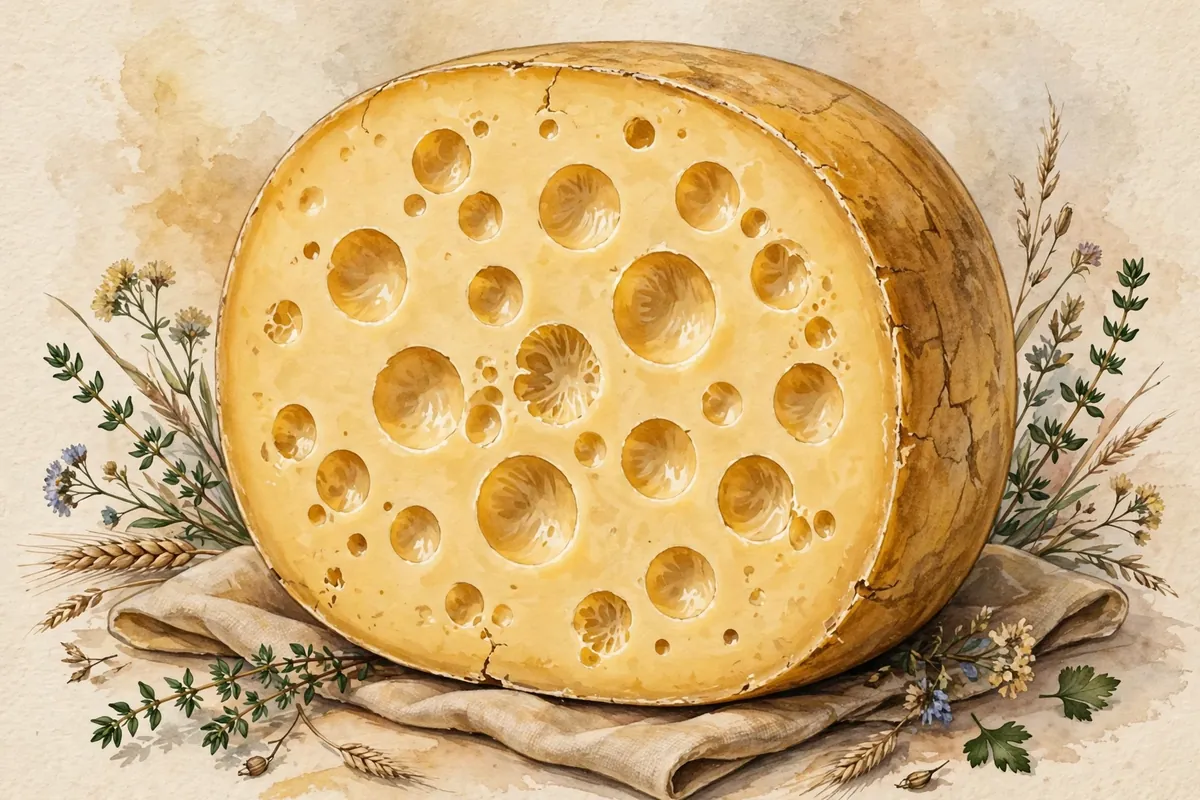
Few foods are as instantly recognizable as Swiss cheese. Those round holes are so famous that cartoon mice wouldn't know what to do without them. But how do the holes get there? Nobody pokes them in, and the cheese doesn't start out that way.
The holes, which cheesemakers call "eyes," are made by bacteria. As the cheese ages, one type of bacteria eats the lactic acid made by other bacteria and releases carbon dioxide gas. The gas slowly forms bubbles inside the cheese, and those bubbles become the eyes. Researchers have also found that tiny bits of hay dust in the milk help the bubbles get started.
Three Bacteria, One Cheese
Emmental, the Swiss cheese that inspired American "Swiss," takes three kinds of bacteria to make. Two of them turn milk sugar into lactic acid. The third, called Propionibacterium, does the hole-making work in a later stage of production.
That third bacterium gives off carbon dioxide, which forms the bubbles, plus two other substances, acetate and propionic acid. Those are what give Swiss cheese its nutty, slightly sweet flavor. So the holes and the taste come from the same busy microbes, working quietly while the wheels of cheese age.
In general, the bigger the eyes, the stronger the flavor, because a longer fermentation gives the bacteria more time to work.
The Hay Dust Surprise
For a long time, the bacteria got all the credit. Then, in 2015, Swiss researchers proposed that something else plays a role: microscopic particles of hay dust that fall into the milk during milking. Bacteria gather around these tiny specks, and the gas they make collects there, forming holes.
That idea solved a puzzle. Cheesemakers had noticed that Swiss cheeses were developing fewer and smaller holes than they used to. Modern milking machines and cleaner barns keep hay dust out of the milk, so the gas has fewer places to gather. Some cheese even ends up with no holes at all, which is called "blind" cheese.
There's even an old clue that fits. Emmental made from summer milk was said to have smaller holes than winter cheese. In winter the cows ate dusty hay, while in summer they grazed on fresh grass with far less dust.
From Flaw to Trademark
Here's the funny part. Holes used to be considered a flaw, and early cheesemakers tried to avoid them by pressing the cheese. In the 1800s, Emmental makers began encouraging them, and the look turned out to be a marketing hit.
Today, eye formation is seen as a sign of quality and proper aging, and some producers even use sound waves to check the holes inside a wheel. In Germany and France, cheesemakers can add hay flower powder to the milk to bring the big holes back, though such additives are forbidden in Swiss cheeses.
Too Holey to Slice
Big holes do have a downside. Cheese with very large eyes doesn't slice well and can fall apart in commercial slicers. Because of that, U.S. regulators have actually reduced the minimum eye size Swiss cheese needs to earn a Grade A stamp.
So the next time you make a ham and Swiss sandwich, take a peek through one of those holes. You're looking at a tiny gas bubble made by bacteria, possibly with a little help from a dairy barn.