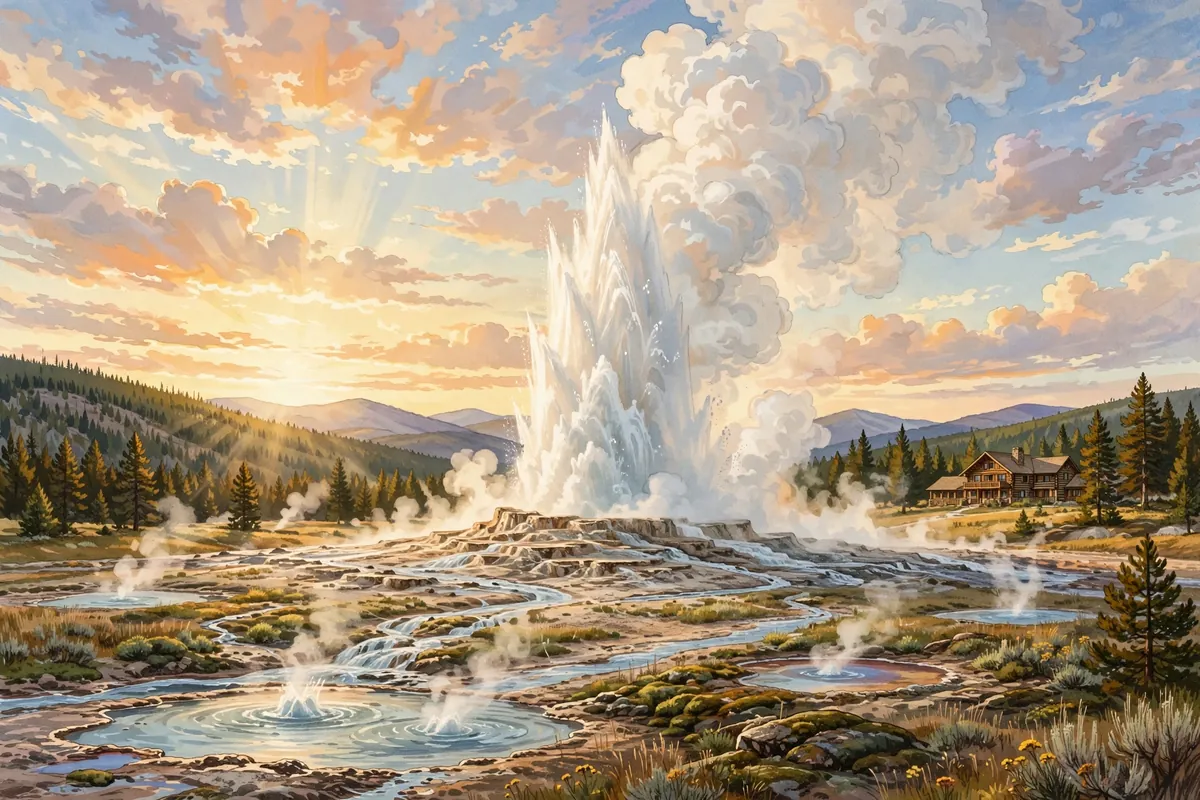
Crowds gather on the boardwalk, cameras ready. The ground hisses, a little water splashes, and then a column of boiling water and steam roars over 100 feet into the air. Old Faithful does this again and again, day and night. But what's actually happening underground?
Here's the short answer: a geyser is a hot spring with a pressure problem. Water seeps down until it meets rock heated by volcanic activity. Narrow underground channels trap it, and the cooler water above presses down on the hot water below, like the lid of a pressure cooker. That lets the deep water get hotter than its normal boiling point. When the pressure finally slips, that water flashes into steam all at once and blasts out of the ground.
The Pressure Cooker Underground
Geysers need three things: heat, water, and underground plumbing with just the right shape. In an ordinary hot spring, heated water simply rises and flows out. In a geyser, tight spots in the plumbing hold the water back and let pressure build.
Because the channel is so narrow, the hot water deep down can't easily mix and cool off. The weight of the water above keeps it liquid at temperatures well above the usual boiling point. Scientists call this superheated water.
The Moment of Eruption
Eventually, the water near the bottom gets hot enough to start boiling anyway. Steam bubbles rise and push some water out of the vent. That small spill lightens the load on the water below, lowering the pressure.
With the lid suddenly loosened, the superheated water flashes into steam throughout the column. The expanding froth of steam and hot water shoots skyward. When the remaining water cools back below boiling, the eruption stops, groundwater seeps back in, and the whole cycle starts over.
Old Faithful, Right on Cue
Old Faithful sits in Yellowstone National Park in Wyoming. It was named in 1870 by members of an exploring expedition, who watched it spout nine times during their visit. It was the first geyser in the park to get a name.
Today it erupts on average about every 90 minutes, sending 3,700 to 8,400 gallons of boiling water as high as 185 feet. More than a million eruptions have been recorded. Its reliability comes partly from the fact that it isn't connected to the other hot features around it. Earthquakes can still shift its rhythm. After a major Idaho earthquake in 1983, the gaps between eruptions noticeably grew longer.
In the park's early days, people even used Old Faithful as a laundry. Probes lowered into it later measured water at 244 degrees Fahrenheit about 72 feet down.
Rare, Fragile, and Not Just on Earth
Geysers are surprisingly rare. Many volcanic areas have hot springs and mud pots, but very few have the right conditions for erupting geysers. Yellowstone holds about half of all the geysers in the world, roughly 300 to 500 of them. It's also home to Grand Geyser, the tallest predictable geyser on Earth.
They're fragile, too. Many geysers have been ruined by people throwing debris into them. And the name itself comes from Geysir, a famous geyser in Iceland whose name means gusher.
So the next time you watch Old Faithful let loose, you're seeing a pressure cooker the size of a hillside reach its limit. It's one of nature's most dependable shows, and it never needs a ticket.