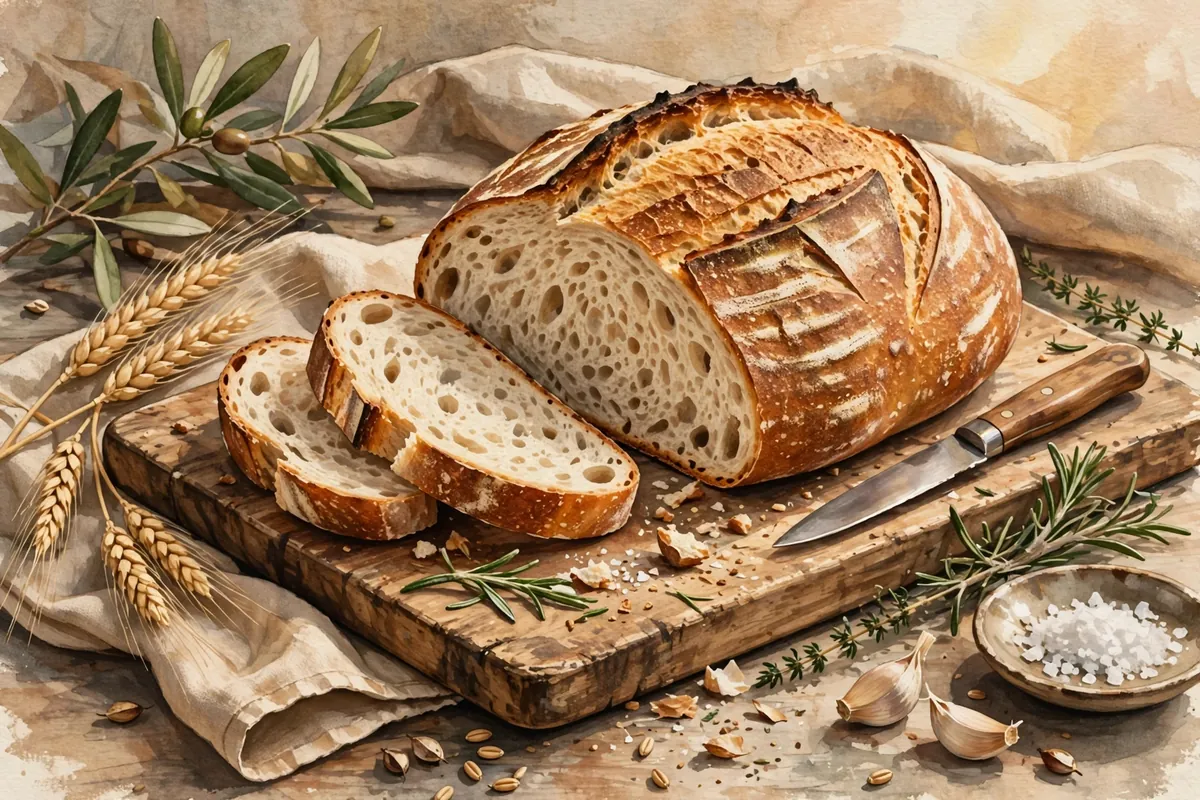
A fresh loaf is one of life's simple pleasures: crisp crust, soft and springy inside. A few days later, that same bread is hard, crumbly, and leathery. It seems obvious that it just dried out. But that's only a small part of the story.
Here's the short answer. Staling is mainly a change in the bread's starch, not simple drying. When bread bakes, its starch soaks up water and softens. As the bread cools and sits, moisture moves out of the starch, and the starch molecules slowly line back up into a stiffer, more crystal-like structure. That's what makes stale bread hard.
What Happens Inside the Loaf
Flour is full of starch, made of two kinds of molecules called amylose and amylopectin. Raw starch is packed into tight, orderly granules. In a hot, moist oven, those granules absorb water, swell, and lose their orderly structure. This is called gelatinization, and it's a big part of what gives fresh bread its soft texture.
Once the bread cools, the process starts creeping in reverse. Moisture migrates out of the starch granules into the spaces around them, and the starch chains realign and recrystallize. Scientists call this retrogradation. Amylose crystallizes quickly and is behind the first firming as starch cools, while amylopectin changes more slowly over time. The result is that leathery, hard texture we recognize as stale.
Here's proof it isn't just about drying. Bread will go stale even when it's kept in a moist environment.
Why the Fridge Is a Bad Idea
Many people store bread in the refrigerator, hoping to keep it fresh. Unfortunately, bread stales fastest at temperatures just above freezing. Starch recrystallizes especially quickly between about 18 and 46 degrees Fahrenheit, and that range includes the inside of a typical fridge.
Freezing is a different story. Bread frozen while it's still fresh can be thawed with acceptable results. So if you won't finish a loaf in time, the freezer is usually the better bet.
There is one thing the fridge does help with: mold. Staling by itself doesn't make bread unsafe, but mold can, and cold temperatures slow mold growth. Moldy bread belongs in the trash.
How to Bring It Back
Here's the good news. Staling can be partly reversed. Heating stale bread to about 140 degrees Fahrenheit, in a regular oven or a microwave, can make it partially fresh again. The science backs this up. Amylopectin, the starch molecule behind the slow, long-term stiffening, forms crystals that melt at roughly 122 to 140 degrees Fahrenheit. Gentle reheating undoes some of that damage, at least for a while.
Commercial bakers fight staling from the start. Modern breads often include anti-staling ingredients, such as extra wheat gluten, enzymes, and fat-based additives called monoglycerides and diglycerides.
Stale Bread's Delicious Second Life
Cooks around the world have long turned stale bread into something wonderful. Bread pudding, croutons, and stuffing all make good use of it. French toast is known in French as pain perdu, which means lost bread. Traditional Spanish gazpacho is thickened with stale bread, and Italian ribollita is a hearty bread soup.
In medieval times, thick slices of stale bread called trenchers were even used as plates. So the next time your loaf turns hard, don't give up on it. Warm it up, or give it a tasty new job.