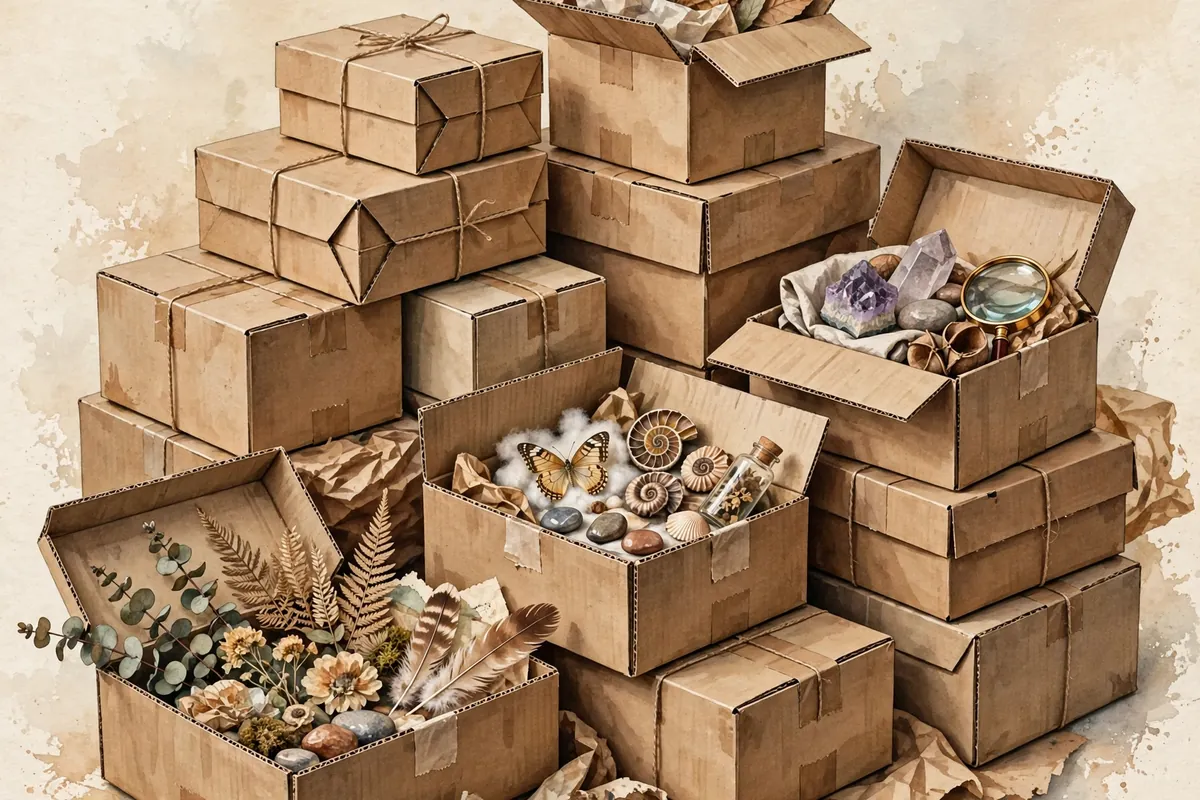
Cardboard boxes are so ordinary that we barely notice them. They show up on doorsteps, fill moving trucks, and pile up in garages after every holiday. Kids turn them into forts, rocket ships, and race cars. But the handy box that folds flat and pops into shape owes a lot to a small mishap in a 19th-century print shop.
Here's the short answer: paperboard boxes already existed, but the pre-cut folding box came from an accident. Robert Gair, a Scottish-born printer and paper-bag maker in Brooklyn, was printing seed bags in the 1870s when a metal ruler used to crease the bags slipped and cut them instead. Gair realized that cutting and creasing in a single step could produce flat box pieces in bulk, ready to fold into shape.
Boxes Before the Accident
Gair didn't invent the very first cardboard box. The first commercial paperboard box is sometimes credited to an English firm, M. Treverton & Son, in 1817, and cardboard packaging was made in Germany that same year.
What made Gair's idea special was speed. Cutting and creasing together made it possible to mass-produce flat pieces that could be folded into boxes quickly. He introduced his pre-cut paperboard box in 1890.
The Rise of Corrugated Cardboard
Meanwhile, another key ingredient was taking shape. Corrugated, or pleated, paper was patented in England in 1856. Its first job wasn't shipping at all. It was used as a liner inside tall hats.
In 1871, Albert Jones of New York City patented single-sided corrugated board, which he used to wrap bottles and glass lantern chimneys. In 1874, Oliver Long improved it by adding flat liner sheets on both sides, creating corrugated board as we know it today. The wavy layer in the middle gives corrugated boxes much of their strength.
Once corrugated board became widely available around 1900, applying Gair's cut-and-crease method to it was a natural next step. The modern shipping box was born.
Breakfast Gets a Box
Lightweight flaked cereals gave cardboard boxes another big boost. The Kellogg Company was the first to package cereal in cardboard cartons, and today folding cartons hold everything from cereal to cosmetics to medicine.
Packaging experts usually avoid the word "cardboard," since it can mean several different materials. In the industry, you'll hear paperboard for thinner boxes and corrugated fiberboard for sturdy shipping cartons.
Each type has its own job. Folding cartons fold flat when empty, saving space in storage and on trucks. Drink boxes are made from layered paperboard and help keep juice, milk, and even wine fresh.
A Hall of Fame Plaything
Every parent knows the old joke about a child ignoring an expensive gift to play with the box it came in. The box's reputation as a toy is so strong that in 2005 the cardboard box was inducted into the National Toy Hall of Fame. It's one of very few toys honored without a brand name attached. To mark the honor, a toy house made from a large cardboard box, actually built as a log cabin, joined the Hall's collection.
Cardboard boxes can also be readily recycled, so their story doesn't have to end in the trash. That's not bad at all for an invention that started with a slipped ruler and a printer clever enough to see an opportunity in a mistake.