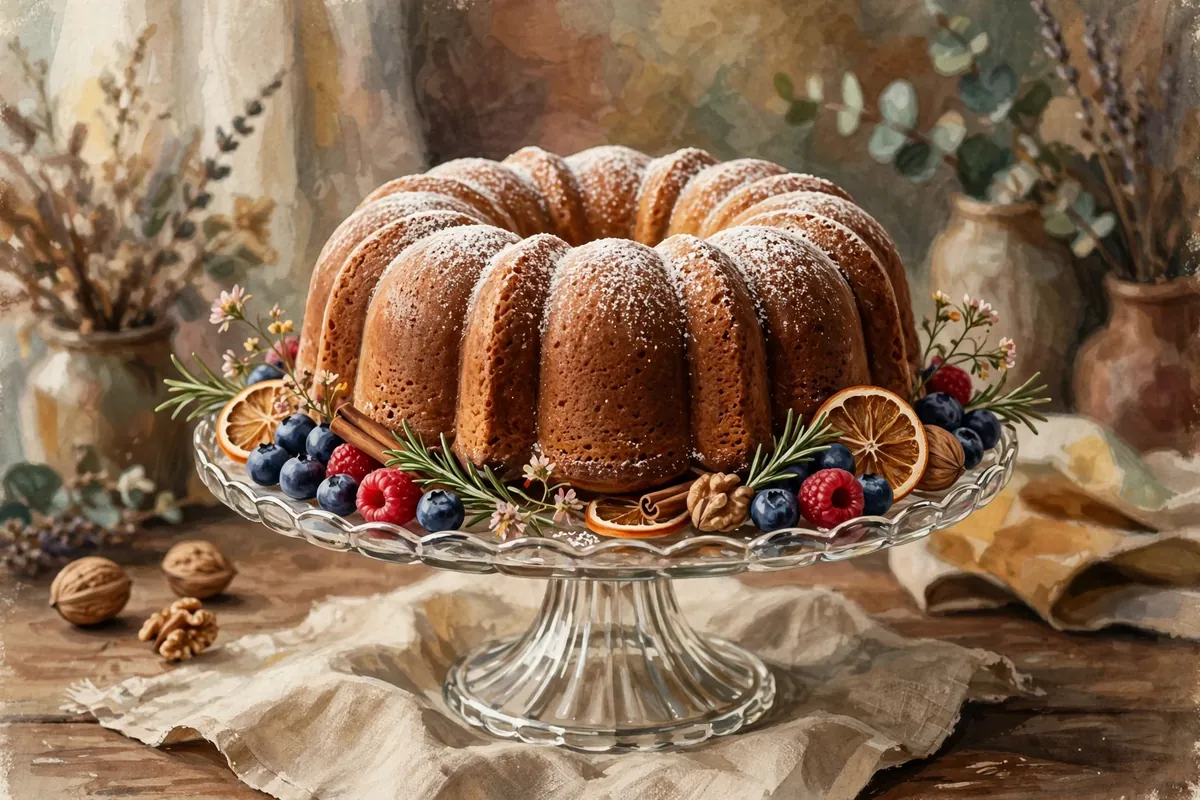
Few kitchen tools are as instantly recognizable as the Bundt pan. Those curving, fluted sides and the hole in the middle turn a simple pound cake into something that looks bakery-fancy. Millions of American kitchens have one tucked in a cabinet. But the story of how it came to be starts with two women and an old-fashioned family recipe.
Here's how it happened. In the late 1940s, Rose Joshua and Fannie Schanfield, friends and members of the Minneapolis chapter of Hadassah, a Jewish women's organization, approached businessman H. David Dalquist. They asked if his company could make a modern version of a heavy, traditional cast-iron cake mold. His company, Nordic Ware, made a cast aluminum version in 1950, and the Bundt pan was born.
An Old World Cake
The shape came from Europe. A brioche-like cake called Gugelhupf was traditionally baked in a fluted ring mold. In parts of Germany, the cake is known as Bundkuchen.
Nobody is quite sure what "Bund" means in this case. It may mean a bunch or bundle, describing how the batter wraps around the center tube. It may describe the banded look of the fluted sides, a bit like a tied bundle of wheat. Or it may refer to a group of people, since the cake is perfect for gatherings.
Jewish-American cooks had been making it for generations. The oldest surviving Jewish-American cookbook, Aunt Babette's Cookbook, published in Cincinnati in 1889, includes a recipe for "Plain bund." But the old pans were heavy and hard to use, which is why the women went looking for something better.
Adding a "T"
Dalquist and company engineer Don Nygren designed the new aluminum pan, and Nordic Ware made a small production run in 1950. To be able to trademark the name, they added a "t" to "Bund," creating "Bundt." Some of the original pans are now part of the Smithsonian collection. Nordic Ware itself was a young company, founded in 1946 by Dalquist, his wife Dorothy, his brother Mark, and their friend Nygren. Lightweight cast aluminum pans with non-stick coatings later became hugely popular in the 1960s and 1970s.
A Slow Start, Then a Fudge Tunnel
At first, the Bundt pan sold so poorly that Nordic Ware thought about dropping it. It got a small boost from a mention in a Good Housekeeping cookbook in 1963. The real breakthrough came in 1966.
That year, a baker named Ella Helfrich entered a Bundt cake called the "Tunnel of Fudge" in the Pillsbury Bake-Off. It took second place and won her $5,000. The publicity set off more than 200,000 requests to Pillsbury for Bundt pans. Soon the Bundt pan passed the tin Jell-O mold to become the best-selling pan in the United States.
A Kitchen Classic
Interestingly, a Bundt cake isn't one specific recipe. What makes it a Bundt is its shape. The design isn't just pretty, either. Like other ring pans, the center tube lets heat reach the batter faster and more evenly, so deep cakes bake through without a raw middle. Bundt pans are also used for monkey bread, gelatin salads, and even meatloaf.
Nordic Ware has sold more than 70 million Bundt pans across North America, and the company remains family-owned. To mark the pan's 60th anniversary, it named November 15 National Bundt Day. Not bad for an idea that began with two friends who simply wanted an easier way to bake a beloved family cake.