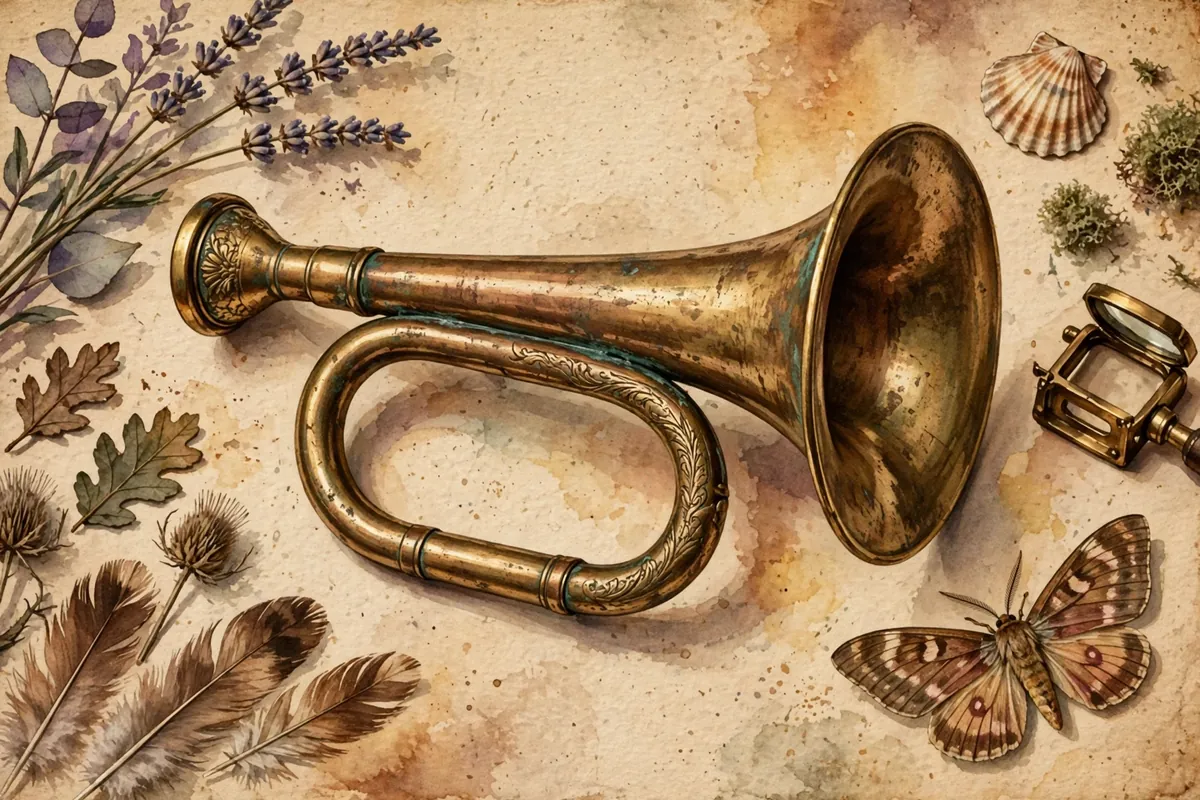
Modern hearing aids can be so small that many people never notice them. But for hundreds of years, help for hearing loss looked very different. It was a horn, sometimes a big one, that you held up to your ear to catch the sounds around you.
These devices were called ear trumpets. They were tube- or funnel-shaped tools that collected sound waves and channeled them into the ear. People made them from sheet metal, silver, wood, snail shells, and even animal horns. They didn't actually create any new sound. Instead, they gathered sound from a wide opening and concentrated it into a small one, so it reached the eardrum more strongly.
A 17th-Century Idea
People with partial hearing loss have used ear trumpets since at least the 1600s. The earliest known description comes from a French Jesuit priest and mathematician, Jean Leurechon, in a book published in 1634. The scholar Athanasius Kircher described a similar device in 1650.
By the late 1700s, ear trumpets were becoming more common. Instrument makers built collapsible cone-shaped trumpets one at a time for individual customers. One well-known model was made especially for the English painter Joshua Reynolds.
Bulky, Clever, and Royal
The first company to manufacture ear trumpets commercially was founded in London in 1800 by Frederick C. Rein. Along with trumpets, the firm sold hearing fans and speaking tubes. Many of these devices were bulky and had to be supported from below while in use.
Rein even built a special acoustic throne for the ailing King John VI of Portugal in 1819. Its carved arms looked like the open mouths of lions. Those openings collected sound and sent it through a speaking tube in the back of the chair to the king's ear.
Around the same time, Johann Nepomuk Mälzel made ear trumpets for the composer Ludwig van Beethoven, who was losing his hearing. Those trumpets are now kept in the Beethoven museum in Bonn, Germany.
In the late 1800s, the acoustic horn took shape as a tube with two ends: a cone to capture sound and a tip that was eventually made to fit right in the ear. Later, smaller hand-held trumpets and cones also became common.
Hiding the Horn
Toward the late 1800s, hidden hearing aids grew popular. Rein designed acoustic headbands that tucked sound collectors into the hair or headgear. Hearing devices were also hidden in couches, clothing, and accessories.
Much of that drive to conceal them was about hiding a person's hearing loss from the public rather than simply helping them hear better.
From Horns to Electronics
Electricity changed everything. In 1898, Miller Reese Hutchison created the first electric hearing aid, called the Akouphone. It used a carbon transmitter to turn a weak signal into a stronger one, which made a portable device possible.
Then came the transistor, developed in 1948 at Bell Laboratories. Transistors were smaller, used less battery power, and ran cooler than the fragile vacuum tubes they replaced. That opened the door to much smaller hearing aids. The rush was so fast, though, that early transistor models weren't properly tested, and moisture could ruin them within weeks until makers added a protective coating.
Remarkably, the old trumpet hung on for a long time. F. C. Rein and Son, the first company to make ear trumpets, didn't stop until 1963, as both the first and the last firm of its kind. If you're noticing changes in your own hearing, talk to your doctor. Today's options are a long way from a horn held to the ear.