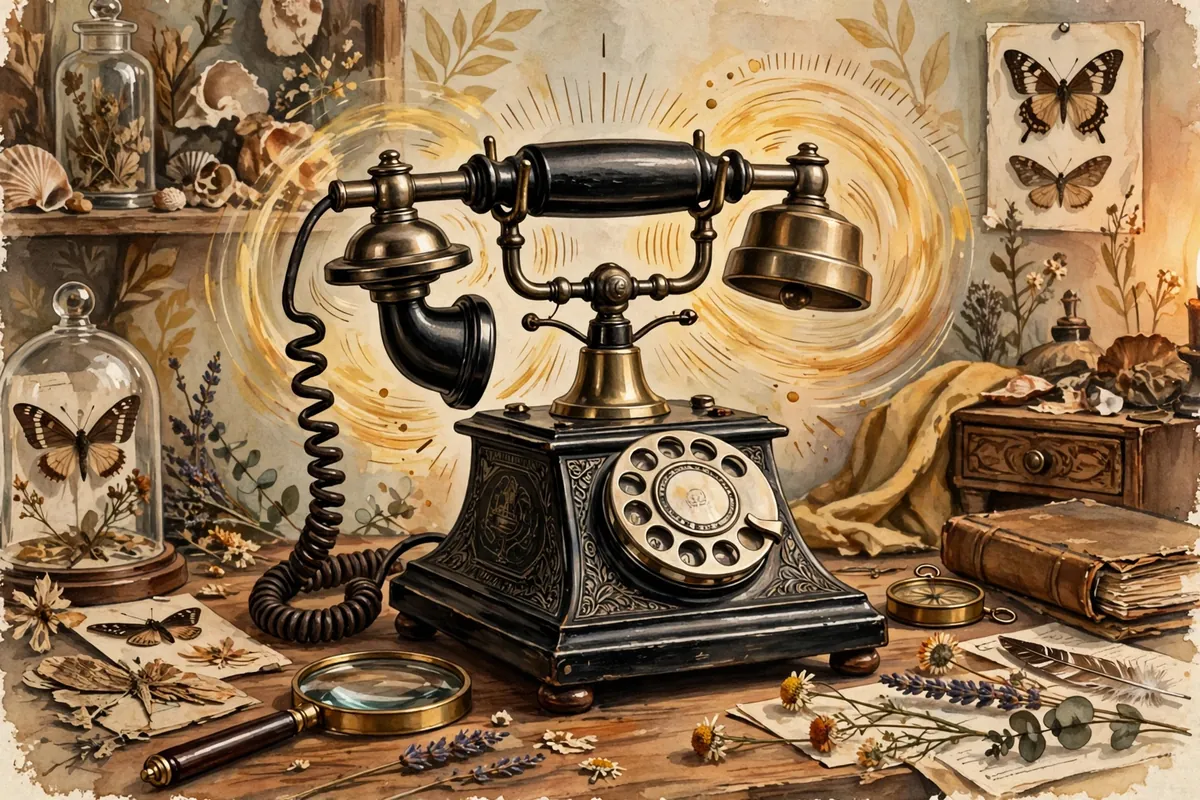
The phone rings, you pick it up, and the word comes out automatically: "Hello?" We never think about it. But when the telephone was brand new, nobody knew how to start a call. There was no rule, and two famous inventors had very different ideas.
Here's the short answer. Alexander Graham Bell, who invented the telephone, liked to answer calls with "ahoy," a word borrowed from ships. Thomas Edison suggested "hello" instead, in 1877. Edison's word caught on, and by 1889 telephone operators were even nicknamed "hello-girls."
Ahoy, Ahoy
Shortly after inventing the telephone, Bell answered calls by saying "ahoy ahoy," the same hail sailors used between ships. He suggested it as the standard greeting for the new device.
There's no evidence it ever caught on with the public. Today, Bell's greeting mostly lives on as a joke. On the TV show The Simpsons, the old-fashioned Mr. Burns answers the phone with "ahoy-hoy."
Edison's Letter
Edison had a practical reason for his choice. On August 15, 1877, he wrote to T. B. A. David, the president of a telegraph company in Pittsburgh. He told his friend he didn't think they'd need a call bell, because "Hello!" could be heard 10 to 20 feet away.
He added a cheerful postscript too, noting that the first cost of making a sender and receiver was only $7. It reads less like a moment in history and more like a friendly business note, which is part of its charm.
Edison is credited with popularizing the word as a phone greeting. According to one account, "halloo" was even the first word he yelled into his early phonograph when he discovered how to record sound in 1877.
The word spread quickly. At the first telephone operators' convention, held at Niagara Falls in 1880, name tags may have included "Hello." Within about a decade, the women who connected calls at telephone exchanges were known as hello-girls.
A Word With a Past
"Hello" wasn't brand new. With that spelling, it appeared in an American newspaper, the Norwich Courier of Connecticut, in January 1826. Another early use came in an 1833 book about the frontiersman Davy Crockett. By the 1860s, the word was widely used in literature.
Before that, it had cousins: hullo, hallo, halloo, and holla. Hullo was used as an exclamation of surprise, and halloo was shouted at ferry operators by people wanting a ride. Hunters used hollo as a shout when they spotted their quarry. The Oxford English Dictionary traces the family back to Old High German words used especially for hailing a ferryman. Because of all its variants, the word can be spelled with any of the five vowels.
Why the Phone Changed Greetings
Before the telephone, greetings often included the time of day, like "good morning" or "good evening." Once phones began connecting people in different time zones, a greeting that didn't depend on the clock made more sense. "Hello" worked any hour, anywhere.
It was also short, loud, and impossible to mistake. That's exactly what you need when you're shouting into a crackly new machine and hoping someone on the other end can hear you.
So the next time you pick up and say hello, you're echoing an Edison suggestion that's more than 140 years old. And if you're feeling bold, try answering with "ahoy." Alexander Graham Bell would be delighted.