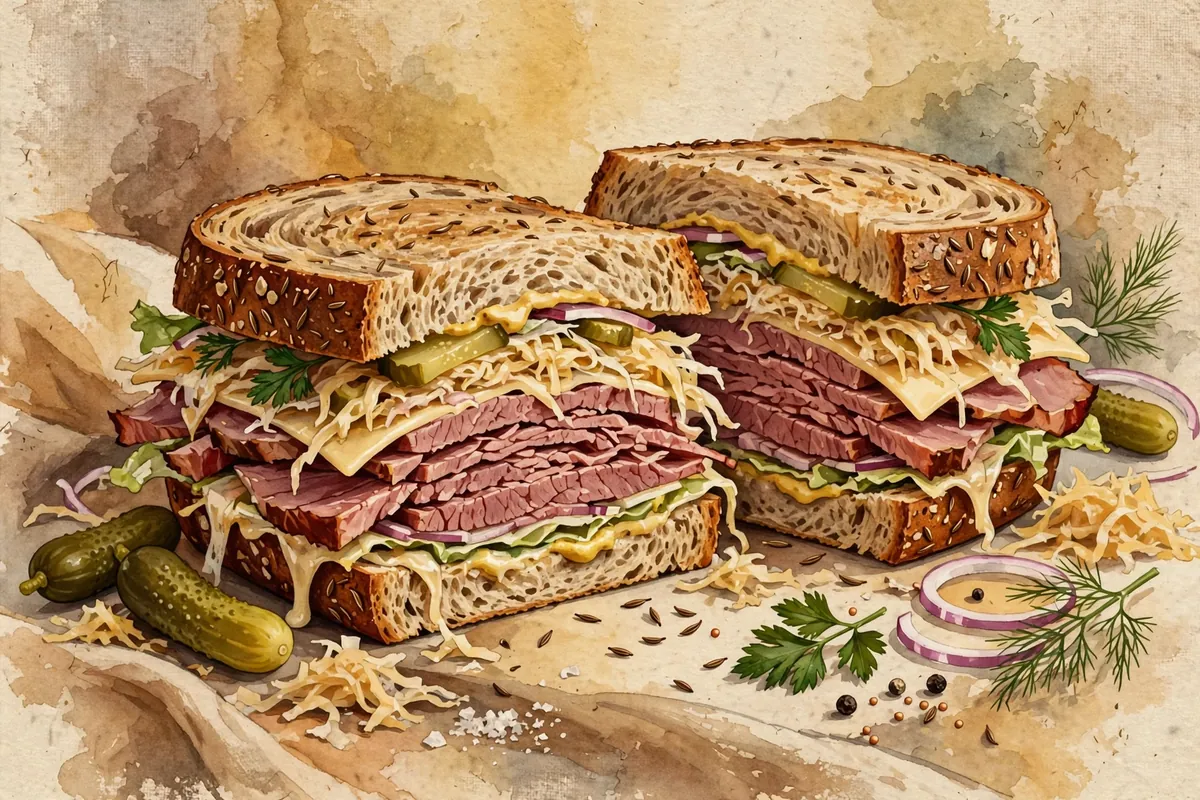
Few sandwiches inspire as much loyalty as the Reuben. Warm corned beef, melted Swiss cheese, tangy sauerkraut, and creamy dressing, all grilled between slices of rye until crisp. It's a deli legend. But ask who invented it, and you'll start a friendly argument.
Here's the short answer. Nobody knows for certain. The two main claims point to Reuben Kulakofsky, a grocer in Omaha, Nebraska, who is said to have asked for the sandwich at a poker game in the 1920s, and to Arnold Reuben, owner of Reuben's Delicatessen in New York City, said to have created it around 1914. Both stories have their fans.
The Omaha Poker Game
The Nebraska story centers on Reuben Kulakofsky, a Lithuanian-born Jewish grocer. From around 1920 through 1935, he played in a weekly poker game at Omaha's Blackstone Hotel. The players jokingly called themselves "the committee."
One of the players was the hotel's owner, Charles Schimmel. As the story goes, Kulakofsky asked for a sandwich of corned beef and sauerkraut. Schimmel's son, who worked in the kitchen, added Swiss cheese and Thousand Island dressing and put it all on rye bread.
The sandwich became a local hit when it went on the Blackstone's lunch menu. Its fame spread further when a former hotel employee entered the recipe in a national sandwich contest and won. Omaha has proclaimed March 14 as Reuben Sandwich Day.
The New York Deli Claim
The other story belongs to Arnold Reuben, the German-Jewish owner of Reuben's Delicatessen in New York, which operated from 1908 until 2001. In an interview with food writer Craig Claiborne, Arnold Reuben said he created the "Reuben Special" around 1914.
A press agent's 1953 memoir added a showbiz twist. It said the sandwich was made on the spot for Broadway actress Marjorie Rambeau, who came in one night when the cupboards were nearly bare. Still another version credits Alfred Scheuing, a chef at the deli, with creating it in the 1930s for Reuben's son.
What's in a Reuben, Anyway?
Corned beef doesn't contain corn. The name comes from the large grains of rock salt, called "corns" of salt, used to cure the beef. Outside the U.S., it's often called salt beef.
The dressing has its own story. Russian dressing is an American creation, a mix of mayonnaise and ketchup with extras like horseradish and spices. It was likely called "Russian" because the original recipe included caviar. Thousand Island dressing is a common substitute.
Russian dressing shows up in American sources as early as 1900. Local historians in Nashua, New Hampshire, credit a man named James E. Colburn with the mayonnaise-based version in the 1910s. So even the sauce on a Reuben comes with its own hometown claim.
Though the Reuben is a fixture of kosher-style delis, it isn't actually kosher under traditional Jewish dietary law, because it mixes meat and dairy.
Cousins of the Classic
The Reuben has inspired plenty of spin-offs. The Rachel swaps in pastrami or turkey and uses coleslaw instead of sauerkraut. Its name may come from the 1871 song "Reuben and Rachel." Florida restaurants serve a grouper Reuben, and a Milwaukee chef created Reuben egg rolls around 1990.
So was it Omaha or New York? The jury's still out. Perhaps the best way to settle it is the delicious way: order one, grab a pickle, and decide for yourself.