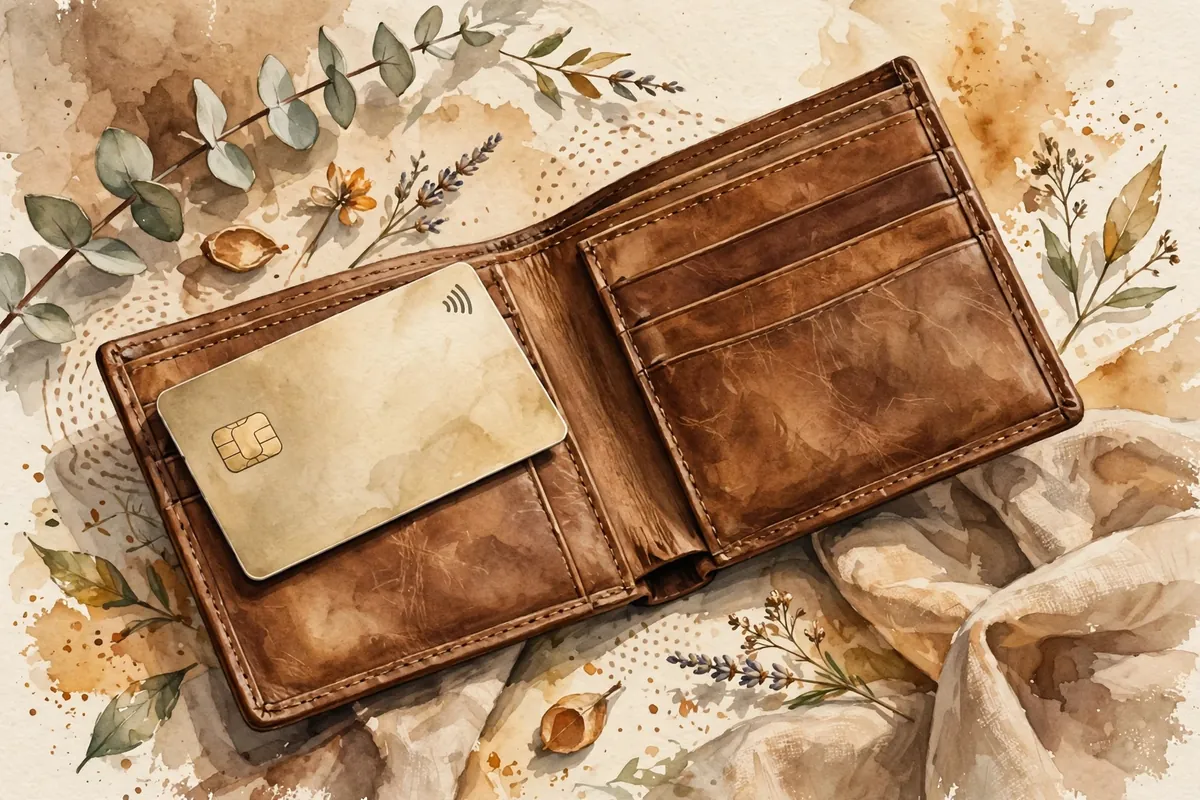
Open your wallet and line up your cards: credit card, debit card, library card, maybe your driver's license. Chances are they match almost perfectly, right down to the rounded corners. It's so normal that most of us never stop to wonder why.
They match because of an international standard called ISO/IEC 7810. Its ID-1 format sets the size at 85.60 by 53.98 millimeters, or 3⅜ by 2⅛ inches, with rounded corners. The design was originally drawn up in inches, which is why the metric numbers look so oddly precise. Exactly why that size was picked in the first place isn't well documented, but once it became the standard, card machines everywhere were built to match.
One Size, Many Jobs
The ID-1 size, also called CR-80, is used for ATM, credit, and debit cards. It's also used for driver's licenses and identity cards in many countries, transit fare cards, store loyalty cards, and even airline crew certificates. As of 2024, all European standard identity cards are issued in this size.
The standard covers more than size. It also sets rules for resistance to bending, chemicals, heat, and humidity, and even for toxicity. Every card size it defines is about 0.76 millimeters thick, roughly three-hundredths of an inch. It even warns that its inch and metric figures are rounded, so the two systems shouldn't be mixed or converted back and forth.
Old cell phone SIM cards belonged to the same family. A smaller size called ID-000 was often issued inside a full-size ID-1 card, ready to be popped out as a mini-SIM.
Before Plastic: Metal Plates
Cards didn't start out plastic. The Charga-Plate, developed by the Farrington Manufacturing Company in 1928, was an early ancestor of the credit card, used in the US from the 1930s until the late 1950s. It was a small sheet-metal rectangle, about 2½ by 1¼ inches, embossed with the customer's name, city, and state.
To record a sale, a clerk laid the plate into an imprinter with a paper slip and an inked ribbon on top, then pressed them together. In some stores, the plates never left the building. Clerks pulled them from the files whenever a customer shopped.
From Diners Club to the Magnetic Stripe
In 1950, the founders of Diners Club created the first general-purpose charge card, which could be used at many different merchants, though the whole bill had to be paid with each statement. American Express followed in 1958. That same year, Bank of America mailed its BankAmericard to 60,000 people in Fresno, California, at once, launching the first successful modern credit card. Mailing them all at once solved a chicken-and-egg problem: shoppers didn't want a card few stores accepted, and stores didn't want a card few shoppers carried. In 1976 it became Visa.
The magnetic stripe has a homey origin. IBM engineer Forrest Parry struggled to attach magnetic tape to plastic cards because the tape warped and glue spoiled it. At home, his wife Dorothea was ironing clothes and suggested he melt the stripe on with the iron. He tried it, and it worked.
So the size of your credit card is less about magic and more about agreement. Once the world settled on one shape, every reader, slot, and wallet could count on it, and that small rectangle quietly became one of the most familiar objects in modern life.