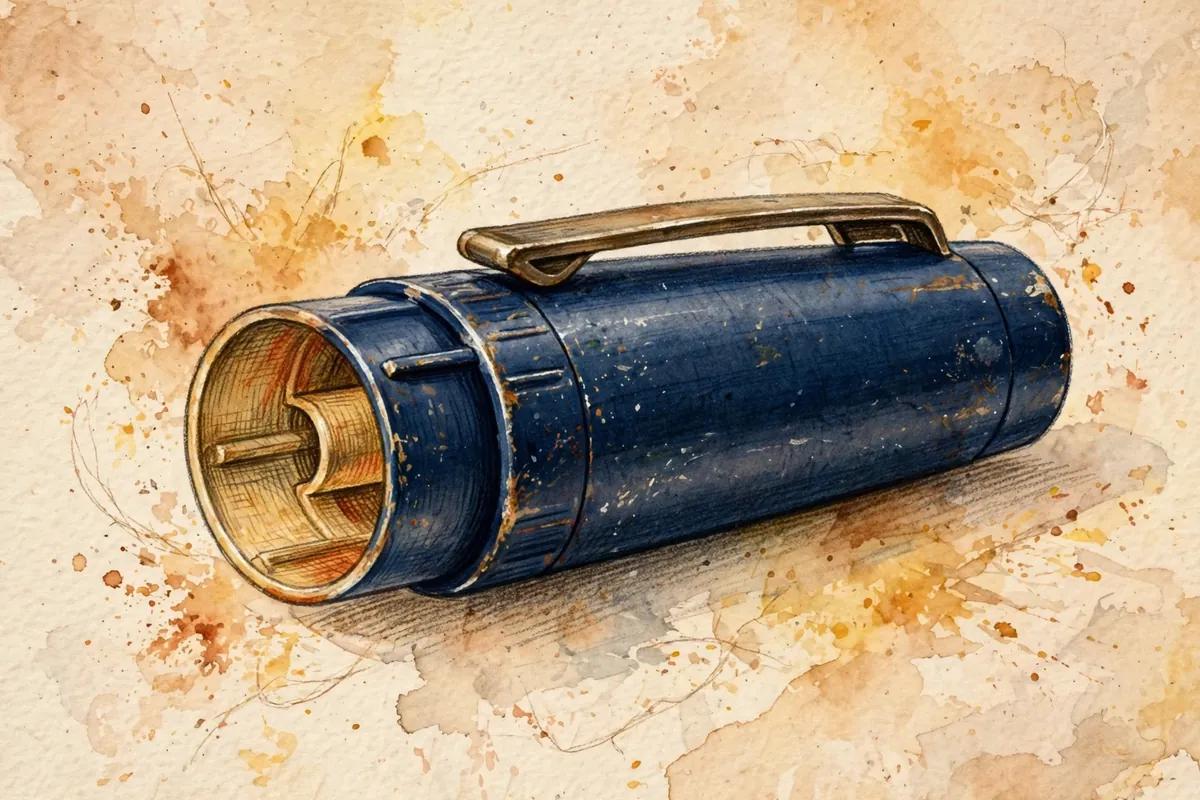
Grab the nearest cheap ballpoint pen and look closely at the cap. Chances are there's a small hole poking through the top. It's easy to miss, and most of us have never given it a moment's thought. But that little opening wasn't added by accident.
Here's the short answer: the hole in many pen caps is there for safety. If someone, especially a child, accidentally sucks a cap into their throat, the hole can let a little air pass through and help prevent suffocation. The famous Bic Cristal has had a hole in its cap since 1991, and the modern design was changed to meet safety standards.
The Other Hole, the One for the Ink
There's a reason people get confused. Some pens have a second tiny hole, this one in the side of the barrel. On the Bic Cristal, that hole keeps the air pressure the same inside and outside the pen, which helps the ink flow properly.
So both ideas are partly right. The hole in the barrel is about the ink. The hole in the cap is about people. If you've ever chewed on a cap during a long meeting or a tough crossword, it's a quiet reminder that someone was thinking about safety.
The Pen in Almost Every Junk Drawer
The Bic Cristal is probably the pen you're picturing. Introduced in France in 1950, it's the best-selling pen in the world. The 100 billionth one was sold in September 2006. It's so iconic that the Museum of Modern Art has added it to its permanent collection.
Its six-sided barrel was designed to mimic a wooden pencil, giving your fingers three steady grip points. The clear barrel lets you see how much ink is left. Its cap is made of a plastic called polypropylene, which absorbs impact better and makes the pen less likely to crack if you drop it.
The tiny ball in the tip is no afterthought either. To make the Cristal, Bich invested in Swiss machinery that could shape metal to within a hundredth of a millimeter, producing a steel ball just one millimeter across.
How the Ballpoint Was Born
The ballpoint pen itself has a fun backstory. László Bíró, a Hungarian newspaper editor, was tired of refilling fountain pens and cleaning up smudged pages. He noticed that newspaper printing ink dried quickly, and he wanted a pen that used the same kind of ink.
With help from his brother György, he paired thick ink with a tiny ball that rolls in a socket, letting ink flow evenly while keeping it from drying out inside the pen. Bíró filed a British patent in 1938, then moved to Argentina, where ballpoint pens are still called "biromes." Britain's Royal Air Force crews used them because fountain pens tended to leak in airplanes.
In France, entrepreneur Marcel Bich licensed Bíró's patent and launched the Cristal in December 1950. He even dropped the "h" from his last name for the company brand, Bic.
One More Pen Puzzle
Ever tried writing upside down with a ballpoint? Most won't cooperate, because gravity pulls the ink away from the tip. In space, though, a regular ballpoint can work pointed in any direction, since the ink's capillary forces aren't fighting gravity. The next time you click, cap, or chew a pen, you'll know there's a lot of clever thinking packed into that humble tube.