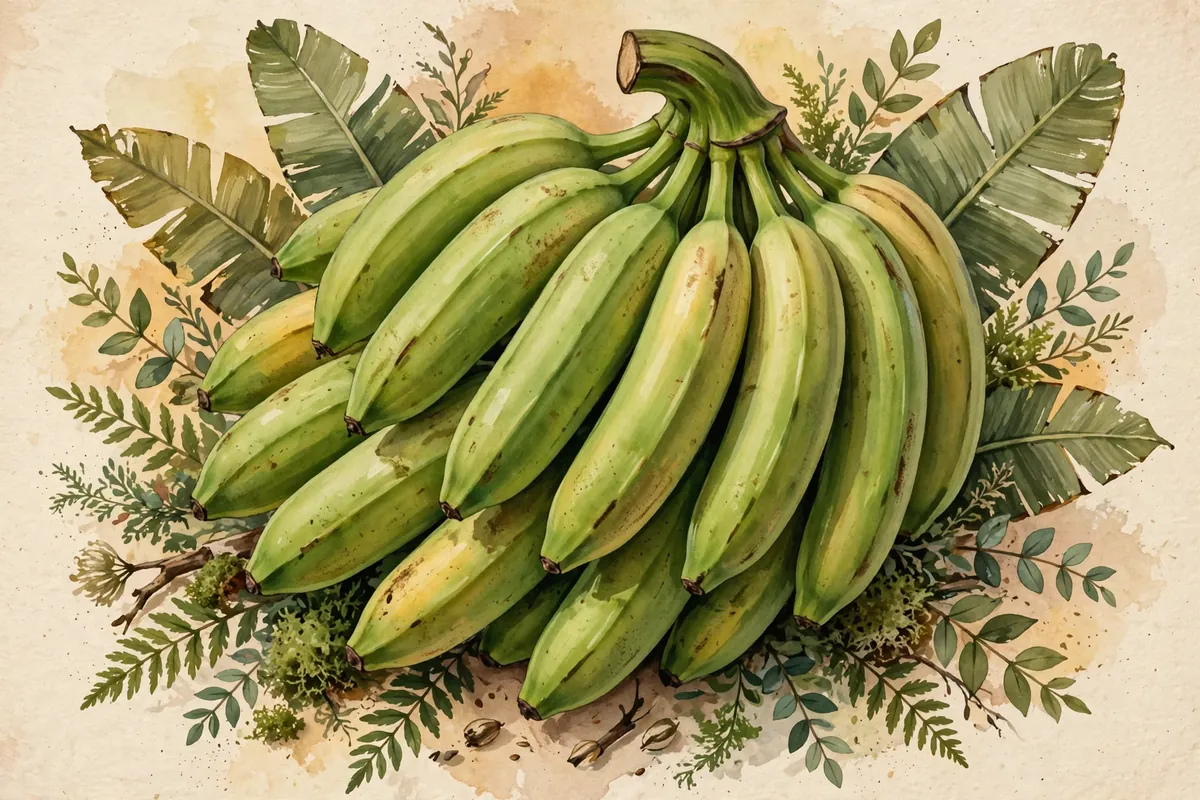
Most of us wait patiently for bananas to turn yellow, maybe with a few brown freckles. But some people prefer them a little green, firm, and not too sweet. Is there anything to the idea that green bananas are better for you?
Here's the short answer: green bananas are rich in something called resistant starch. As the name suggests, it resists digestion in the small intestine and travels on to the large intestine, where gut bacteria ferment it. In that way it behaves a lot like dietary fiber. As a banana ripens, much of that starch turns into sugar. Research on the health effects is promising but still limited, so green bananas are an interesting choice rather than a miracle food.
Starch That Plays Hard to Get
Most starch breaks down quickly into glucose, a sugar your body absorbs. Resistant starch is different. In green bananas and raw potatoes, the starch granules have a crystal-like covering that digestive enzymes can't easily get through. Scientists sort starch into three broad types: rapidly digested, slowly digested, and resistant. All three can affect blood sugar levels.
Scientists started paying attention to this kind of starch in the 1970s. There's one catch for cooks: the resistant starch in green bananas stays resistant only as long as the food is eaten raw and unheated. Once it's heated or baked, that starch becomes digestible.
What Happens in Your Gut
Because resistant starch doesn't release glucose in the small intestine, it reaches the large intestine mostly intact. There, your gut bacteria feast on it. As they ferment it, they produce short-chain fatty acids, including acetate, propionate, and butyrate. Resistant starch produces more butyrate than other types of dietary fiber.
There is a side effect worth knowing about. Like fiber, resistant starch can act as a mild laxative, and fermentation produces some gas. Studies have found it is generally well tolerated, but a big change in diet can surprise your stomach.
What the Evidence Says
Researchers have found limited evidence that some types of resistant starch can improve blood sugar and insulin measures, especially in people who are diabetic or overweight. In 2016, the U.S. Food and Drug Administration allowed a carefully worded claim that a type of resistant starch from corn may reduce the risk of type 2 diabetes, while noting that the scientific evidence is limited.
In 2011, European regulators approved a claim that replacing digestible starch with resistant starch in a meal reduces the rise in blood sugar after that meal. If you're managing blood sugar or thinking about big changes to your diet, talk to your doctor first.
How a Green Banana Turns Sweet
Bananas ripen thanks to ethylene, a natural gas the fruit produces as a ripening hormone. Ethylene triggers an enzyme called amylase, which breaks starch down into sugar, and another enzyme that breaks down the material between cells, making the fruit soft.
Bananas sold in stores are usually picked green and ripened later in airtight rooms filled with ethylene. Want to speed things up at home? Put green bananas in a brown paper bag with an apple or a tomato overnight.
So whether you like your bananas firm and green or soft and spotty, you're getting a different snack depending on when you peel it. A little green means more starch for your gut bacteria. A lot of yellow means more sweetness for you.