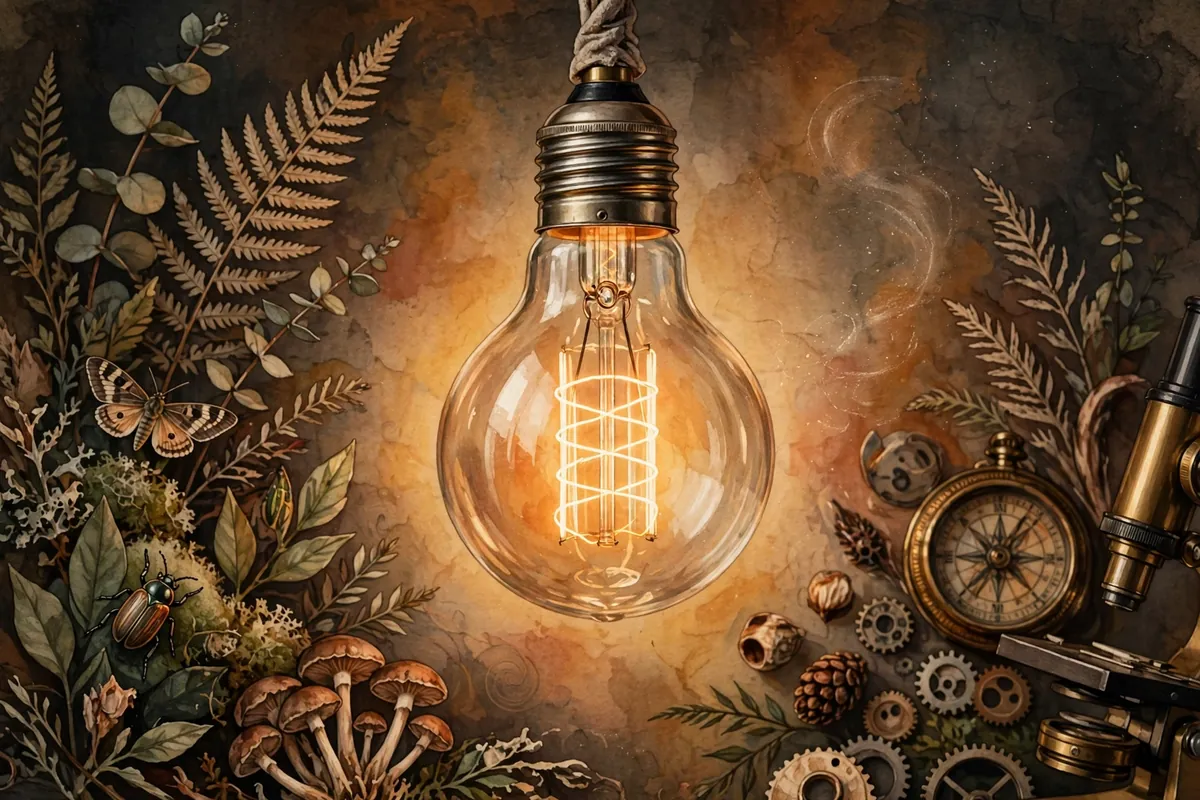
Thomas Edison and the light bulb go together like peanut butter and jelly. Schoolbooks, cartoons, and even the classic idea bubble all link the glowing bulb to his name. But the real story of how electric light came into our homes is a lot more crowded, and a lot more interesting.
Here's the short answer. Many inventors built incandescent lamps before Edison, and Britain's Joseph Swan developed a working bulb at about the same time. Historians conclude that Edison's version was the first truly practical one, mainly because he combined a good filament, a better vacuum, and a whole system for delivering electricity. So Edison deserves big credit, just not all of it.
The Long Road Before Edison
The idea goes back to 1802. In the basement of the Royal Institution in London, Humphry Davy used a battery of 2,000 cells to send current through a thin strip of platinum until it glowed. It wasn't bright enough or long-lasting enough to be useful, but it inspired scores of experimenters over the next 75 years.
In 1874, two Canadians, Henry Woodward and Mathew Evans, filed a patent for a lamp with carbon rods inside a glass cylinder filled with nitrogen. They couldn't make it a commercial success and sold their patent rights to Edison in 1879. To this day, the government of Canada maintains that Woodward and Evans invented the light bulb.
Joseph Swan's Rival Bulb
Across the Atlantic, British chemist Joseph Swan had been working with carbon filaments in glass bulbs since 1850. Weak vacuums and poor electricity supplies held him back for years. With better pumps, he returned to the problem, and in early 1879 he successfully demonstrated an electric lamp in Newcastle.
Swan's house in Gateshead became the first in the world lit by a light bulb. In 1880, Mosley Street in Newcastle became the first street lit by incandescent lamps. And in 1881, London's Savoy Theatre became the first public building in the world lit entirely by electricity, using Swan's bulbs.
What Edison Added
Edison started serious research in 1878. After many experiments, his team's first successful test came on October 22, 1879, with a carbon filament that glowed for 13.5 hours. They kept improving, and later found that carbonized Japanese bamboo could last more than 1,200 hours.
Edison's real genius was thinking bigger than the bulb. He designed a high-resistance lamp that made it practical to send power from a central station, plus all the parts needed for a large lighting system. In Britain, the Edison and Swan companies eventually merged into one, known as Ediswan.
The Inventors Who Came After
Improvement didn't stop there. In 1882, Lewis Latimer, an American inventor and patent draftsman, patented a better way of making carbon filaments that reduced breakage. Two years later he went to work for Edison's own electric light company. In 1904, Hungarian Sándor Just and Croatian Franjo Hanaman patented a tungsten filament that lasted longer and shone brighter. And by 1911, General Electric was selling bulbs with a sturdier tungsten wire developed by William Coolidge.
So the light bulb wasn't one flash of genius. It was a relay race, with each inventor passing the glow to the next. The next time you flip a switch, you can thank Edison, and a whole crowd of tinkerers who helped light up the world.