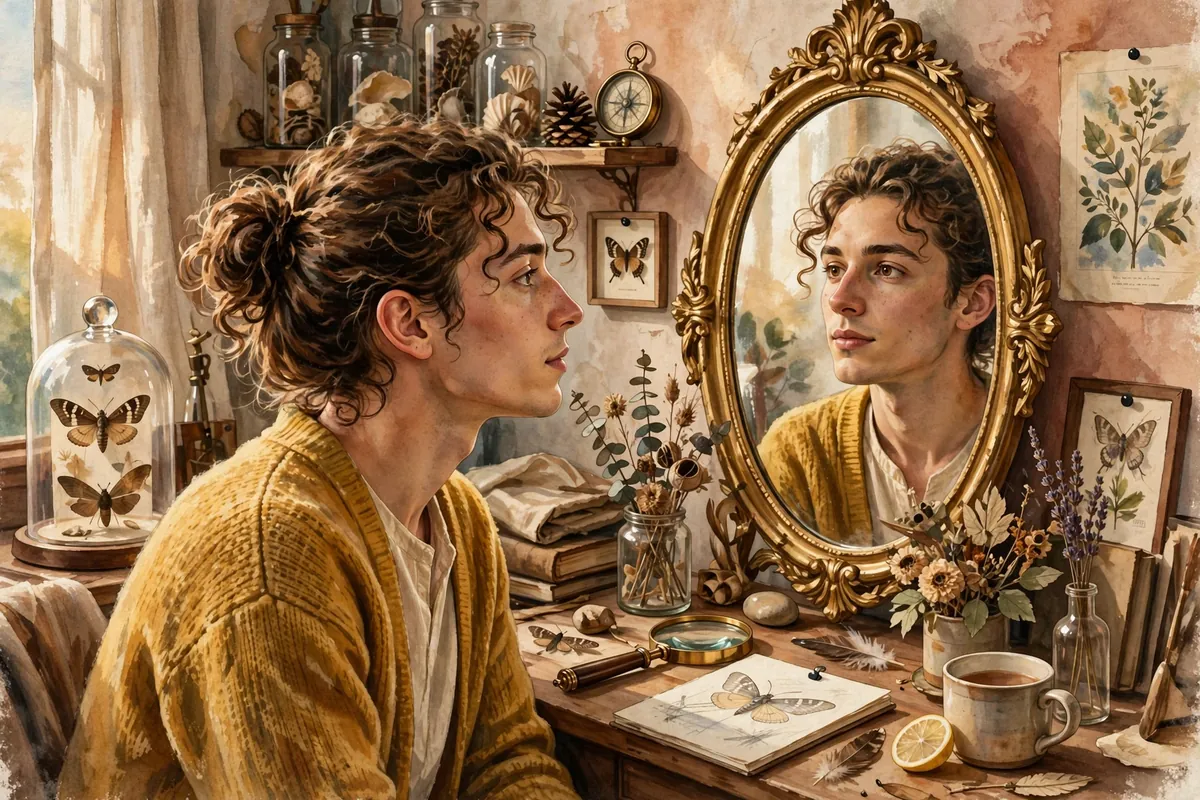
Hold up a book to the mirror and the title appears backward. Raise your right hand and the person in the glass raises what looks like their left. It seems obvious that mirrors swap left and right. But then why don't they swap top and bottom, too?
Here's the surprising truth: a flat mirror doesn't really flip left and right. It reverses things front to back, in the direction straight into the mirror. Your reflection's up and down match yours, and its left and right sides line up with yours too. What gets flipped is the direction pointing toward and away from the glass. Our brains then interpret that as a left-right swap.
Front to Back, Not Side to Side
Try this. Stand facing a mirror and point your right hand toward the right wall. Your reflection's hand points toward the same wall. Point up, and the reflection points up. Now point straight at the mirror. Your reflection points back at you. That's the only direction that actually reversed.
Scientists describe it this way: in a mirror, the up-down and left-right directions line up with yours, but the front-back direction is reversed. That turns the whole image inside out, a bit like peeling a glove off your left hand so it becomes a right-hand glove.
So Why Does It Feel Like Left and Right?
One popular explanation is about how we imagine ourselves. When you look at your reflection, you may compare it to a real person who has turned around to face you. Since people usually turn around by spinning sideways, it seems as though left and right have switched.
With a book or card, something similar happens. To show it to the mirror, you turn it around to face the glass. That turn is what reverses the writing. As experts put it, in cases like these it's the change in orientation, not the mirror itself, that causes the reversal. Even so, psychologists still debate exactly how our minds process it.
Here's another test. Stand sideways to the mirror, so your left and right point toward and away from it. Now the mirror really does reverse left and right directly, because that's the direction perpendicular to the glass.
Putting Mirror Images to Work
People use this quirk on purpose. Ambulances and fire engines often have their name printed backward on the front. That way, drivers ahead can read it the right way around in their rear-view mirrors.
You can even build a mirror that shows you the way others see you. Placing two mirrors at a right angle to each other creates a non-reversing mirror, where raising your right hand looks like raising your right hand.
Leonardo da Vinci wrote most of his personal notes in mirror writing, using normal writing only when he expected others to read it. Nobody knows exactly why. One suggestion is practical: for a left-hander writing left to right, fresh ink would smudge, and writing in reverse would avoid that.
An Ancient Puzzle
Humans have been staring into mirrors for a very long time. Some of the earliest manufactured mirrors were polished pieces of obsidian, a natural volcanic glass, found in what is now Turkey and dated to around 6000 BCE.
So the next time you wave at your reflection, remember that it's not really switching sides with you. It's just facing the other way, and letting your brain fill in the rest.