Picture a busy kitchen in New Jersey about a century ago. A young wife is chopping, stirring, and handling hot pans, and she keeps getting little cuts and burns. Every time, she has to stop and wrap her fingers in gauze and tape, and it slips right off. Her husband decides there has to be a better way.
Here's the short answer: in 1920, Earle Dickson, a cotton buyer at Johnson & Johnson, made a simple homemade bandage for his wife, Josephine. He placed small squares of gauze at intervals along a strip of tape so she could bandage herself without help. His employer turned the idea into the Band-Aid.
A Homemade Solution
Josephine often cut herself while doing housework and cooking. Dickson noticed that gauze held on with tape just didn't stay put on her busy fingers. And dressing a wound on your own hand with separate pieces of gauze and tape is tricky.
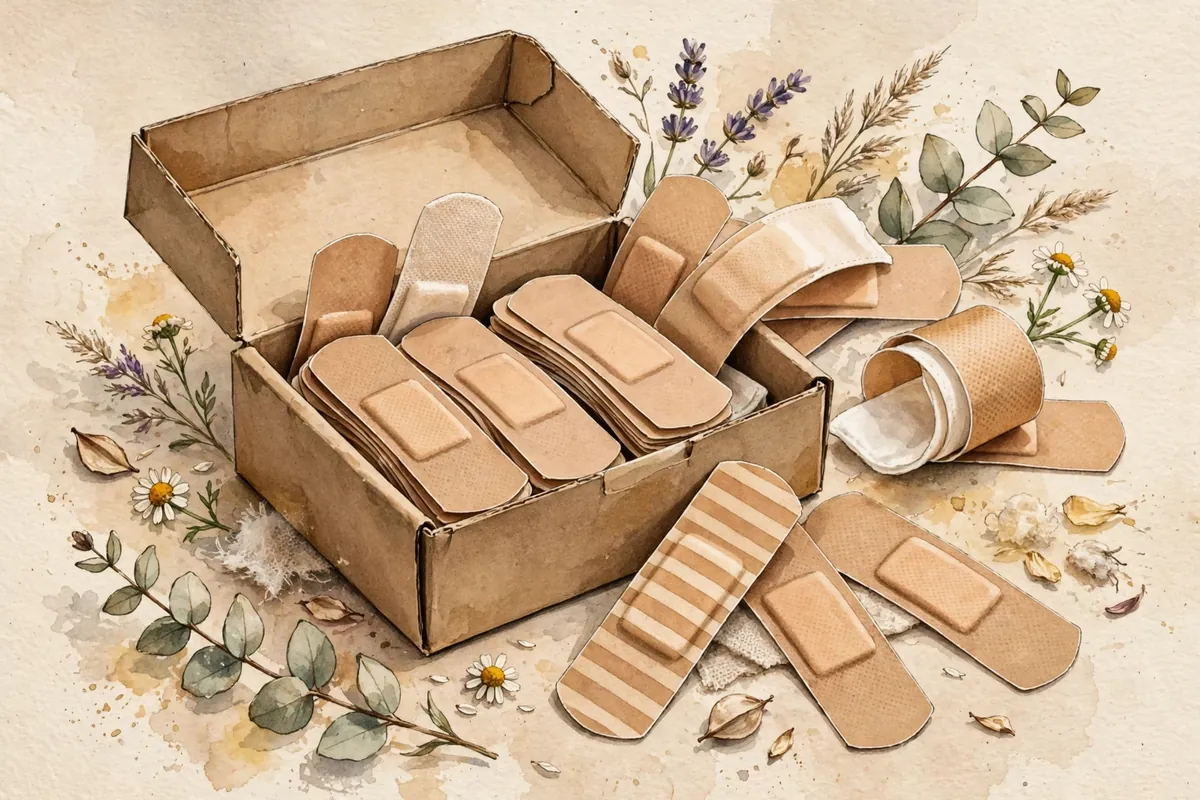
So he prepared them ahead of time. He laid pads of gauze along a roll of surgical tape and covered them with crinoline to keep them clean. Whenever Josephine needed one, she could simply cut off a piece and put it on herself.
Dickson shared the idea with his boss, James Wood Johnson, who liked it and put it into production. Dickson went on to have a long career at the company, rising to vice president and later serving on the board of directors until his death in 1961.
A Slow Start
Success didn't come overnight. The first Band-Aids were handmade strips 18 inches long and 2.5 inches wide, and they were very unpopular. In 1921, the product brought in just $3,000. Part of the problem was that people didn't know how to use them.
The company got creative. It sent salespeople out to demonstrate the bandages and handed out free Band-Aids to the Boy Scouts of America. By 1924, machines were making them, and sales began to climb.
From Wartime to Your Medicine Cabinet
Over the years, the little bandage kept improving. Sterilized Band-Aids went on sale in 1939, and a red pull string was added in 1940 to help open the wrapper. That string lasted until 1992.
World War II gave the product a huge boost, as millions were shipped overseas. Johnson & Johnson has estimated that more than 100 billion Band-Aids have been sold worldwide.
The fun designs arrived later. The first decorative Band-Aids, with a Stars 'n Strips pattern, appeared in 1956, and cartoon and superhero themes followed. In 1975, the company launched a famous jingle about being stuck on Band-Aid brand. It was written by Barry Manilow.
A Name That Became a Word
Band-Aid is so familiar that many people use the name for any adhesive bandage, a classic example of a brand name becoming an everyday word. In 2022, it was even named the most trusted brand in the United States. Johnson & Johnson has registered the name as a trademark and has tried, through its marketing, to keep it from becoming just another word. In Europe, a comparable brand, Elastoplast, has had the same thing happen to it.
So the next time you reach for a bandage after a kitchen mishap, you can thank Josephine Dickson's busy fingers and a husband who wanted to help. Sometimes the best inventions start with a small problem at home.