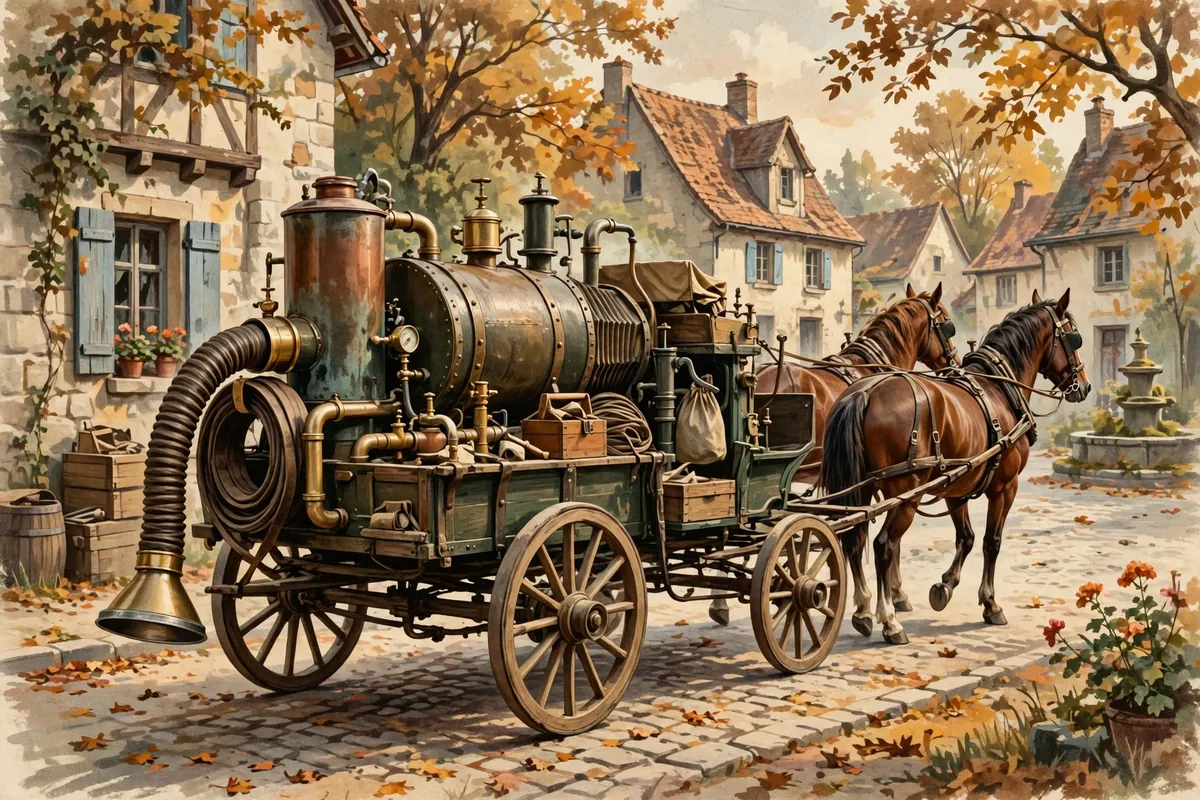
Today a vacuum cleaner fits in a closet, and some even roll around the house on their own. But one of the first powered vacuum cleaners was so enormous it couldn't fit through the front door. It had to be parked outside on the street, and horses pulled it from job to job.
Here's the story. In 1901, British engineer Hubert Cecil Booth built a powerful suction machine nicknamed the "Puffing Billy." It ran on a gasoline engine and was horse-drawn. Instead of selling it, Booth sold cleaning services, sending the machine to buildings and snaking long hoses inside to suck up the dust.
An Idea From a Dusty Chair
Before Booth, most cleaning machines blew or brushed dirt away rather than sucking it up. Booth later recalled watching a demonstration of an American machine in London in 1901 that blew dust off chairs. He thought the idea should be reversed: suck the dust in and trap it with a filter.
He tested the idea in a memorably odd way. He laid a handkerchief on the seat of a restaurant chair, put his mouth to it, and sucked as hard as he could. When he saw the dirt collected on the underside of the cloth, he knew he was onto something.
The Puffing Billy
Booth's machine pulled air through a cloth filter with a piston pump. It had no brushes at all. All the cleaning was done by suction through long tubes with nozzles on the ends, which is basically how vacuums still work today.
It was just far too big for a home, and too bulky even to be brought inside the buildings it cleaned. Booth later built an electric version, but both designs were extremely bulky and had to be moved around by horse and carriage. The company set up to market his invention first used the term "vacuum cleaner" in 1901.
Cleaning for Kings
Booth's British Vacuum Cleaner Company sent out bright red vans. Uniformed workers hauled hoses off the van and ran them through the windows to reach every room inside a building. The noise brought plenty of complaints, and Booth was even fined for frightening horses.
Still, his machine won royal approval. It cleaned the carpets of Westminster Abbey before the coronation of King Edward VII. The Royal Navy used it to clean barracks, and theaters and shops hired it, too.
One job didn't end so smoothly. After cleaning the Royal Mint, Booth was arrested on his way out. His machine had sucked up a large amount of silver dust from the coins, and he'd forgotten to empty it. He was quickly released.
Not the Very First, But a Giant Leap
To be fair, Booth wasn't the only inventor at work. Hand-powered vacuum cleaners using bellows appeared in the 1860s. And in the same year as Booth, American inventor David T. Kenney independently created a powered suction system, a 4,000-pound steam-engine machine installed in a building with pipes running to every room.
The vacuum didn't truly come home until 1907, when Ohio janitor James Murray Spangler invented a portable electric model. He sold the patent to William Henry Hoover, whose company made the vacuum a household name. So the next time you push a vacuum across the rug, picture the roaring red wagon and the patient horses that got the whole idea rolling.