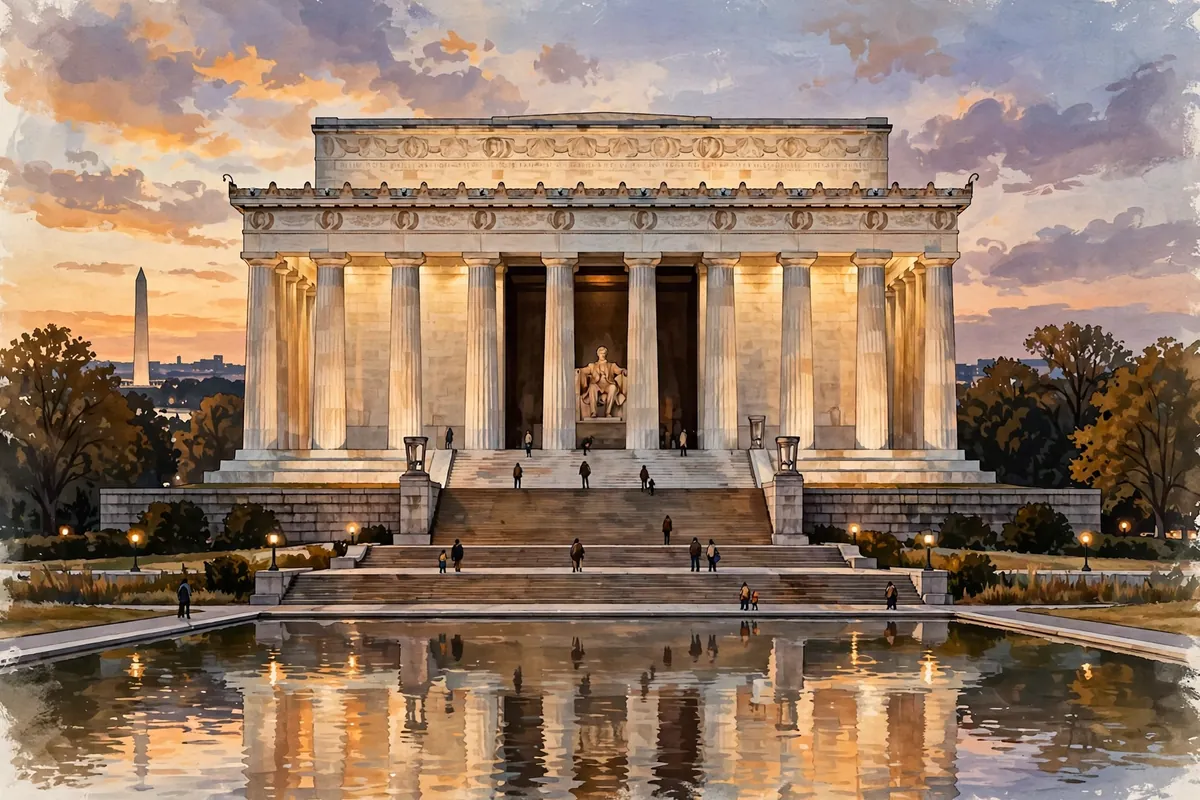
Walk up the steps of the Lincoln Memorial and you'll find Abraham Lincoln waiting for you, enormous and calm, seated in a great marble chair. He seems perfectly sized for that grand hall, as if it had always been meant to be that way. But it very nearly wasn't.
Here's the story. Early plans called for a much smaller statue, only about 10 to 12 feet tall, and at one point it was imagined in bronze. But sculptor Daniel Chester French and architect Henry Bacon realized a figure that size would look small inside the memorial's vast interior. So they made it far bigger. The final seated Lincoln measures 19 feet, carved from white Georgia marble. If he stood up, he'd be about 28 feet tall.
Testing the Size With Photographs
French was chosen for the job in 1914. He was already famous for The Minute Man statue in Concord, Massachusetts, and he had worked with Bacon for nearly 25 years. He started with small clay studies and several plaster models, adjusting Lincoln's pose bit by bit.
One of his plaster models, made in 1916, became the basis for the final statue. To decide how big it should be, French and Bacon took photographic enlargements of the model to the memorial while it was still being built, testing how different sizes would look in the actual space. The answer was clear: it had to be much larger.
Carved in 28 Pieces
The carving was done by the Piccirilli Brothers, a family firm French had worked with for years, using marble from a quarry near Tate, Georgia. Transferring French's design to the giant blocks took a year.
The finished statue is made of 28 blocks of marble and weighs about 170 tons. Including its 11-foot pedestal, it rises 30 feet from the floor. French added the finishing touches himself, both in the carvers' studio in the Bronx and after the statue was assembled in Washington in 1920.
French paid special attention to Lincoln's hands, which rest on the arms of the chair. He even used casts of his own fingers to get them just right.
A Lighting Disaster
Size wasn't the only problem. French had expected a large skylight to light the statue from above, but it wasn't included in the final plans. Light coming in sideways from the east flattened Lincoln's face, making him seem to stare blankly, and it lit up his shins instead. French considered it a disaster.
The fix was a system of electric lights designed to light the statue properly. The memorial was formally dedicated on May 30, 1922.
A Stage for History
The memorial became much more than a monument. In 1939, singer Marian Anderson, after being refused a performance at Constitution Hall because of her race, sang on its steps to a live crowd of 75,000. On August 28, 1963, Martin Luther King Jr. delivered his 'I Have a Dream' speech there to an estimated 250,000 people.
There's even a popular legend that Lincoln's hands are forming the letters 'A' and 'L' in sign language. French had a deaf son, but the National Park Service says it takes some imagination to see signs in Lincoln's hands.
So the next time you see the memorial, picture the much smaller Lincoln that almost was, and the sculptor who took one look at the empty hall and decided that Lincoln deserved more room.