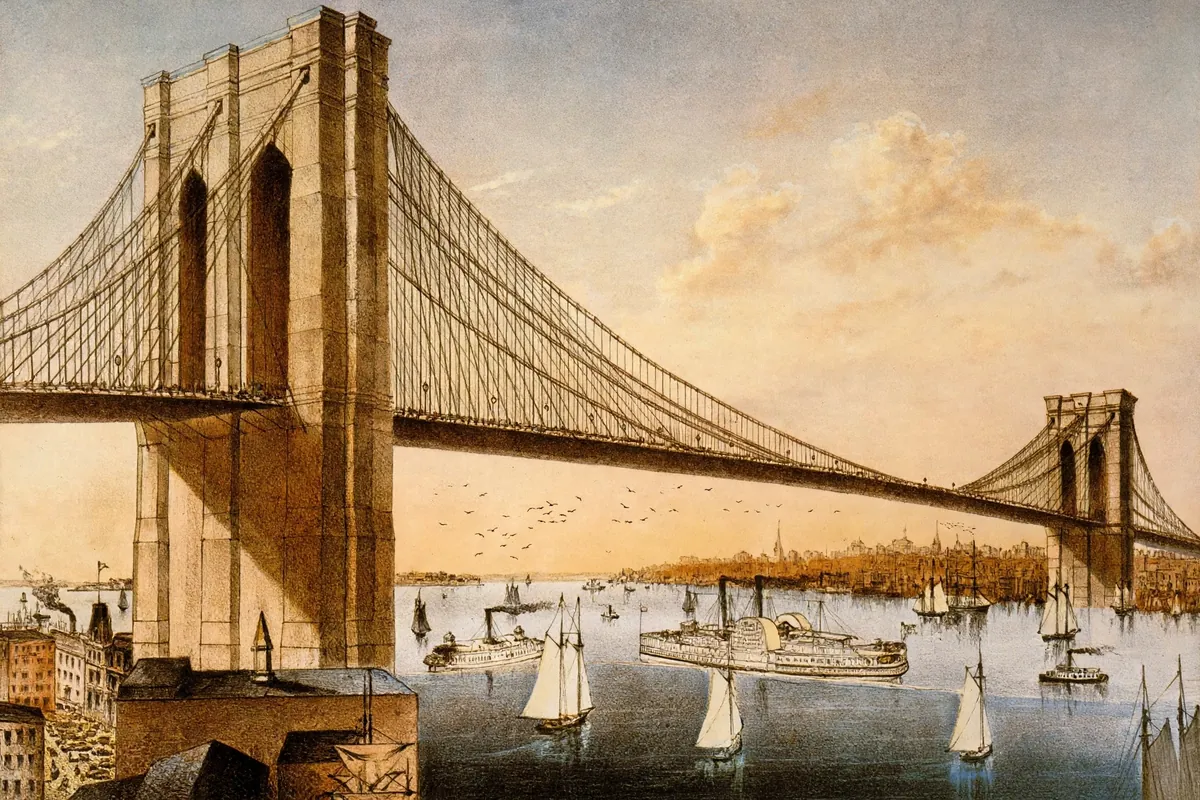
When the Brooklyn Bridge opened in 1883, it was the longest suspension bridge in the world, a soaring stone-and-steel marvel across New York's East River. History books usually credit the father-and-son team who designed and built it. But for more than a decade, much of the day-to-day work ran through someone else entirely. So who really saw the bridge through?
The short answer is Emily Warren Roebling, the chief engineer's wife. When her husband, Washington Roebling, became bedridden with decompression sickness, she became his link to the construction site. She carried his instructions to the engineers and workers, reported progress back to him, and took over much of the daily supervision and project management. She didn't build it alone, but the bridge might not have been finished without her.
A Family Project Struck by Tragedy
The bridge was designed by John A. Roebling. In 1869, before construction got far, he died of tetanus after an accident at the bridge site. His son Washington, also a civil engineer, took over as chief engineer.
Washington threw himself into the work. To build the bridge's foundations, workers labored inside caissons, huge chambers sunk deep under the river. Washington went down to study them, and by not rising at the proper speed, he developed what was then called caisson disease, known today as decompression sickness. It left him so ill that he was confined to bed.
The Woman in the Middle
Emily had met Washington during the Civil War at a soldiers' ball while visiting her brother, a general. After they married, the couple traveled to Europe to study how caissons were used, so she already knew a good deal about the project.
Now, as the only person visiting her husband during his illness, she became the bridge's messenger and manager. Through Washington's teaching, she built extensive knowledge of the strength of materials, stress analysis, cable construction, and the math of the curving cables. She dealt with politicians, rival engineers, and everyone else involved, so much that some people believed she was the one designing the bridge.
In 1882, Washington's job was in danger because of his long illness. Emily met with engineers and politicians to defend his work, and they allowed him to stay on as chief engineer.
First Across, With a Rooster
The bridge opened on May 24, 1883, becoming the first fixed crossing of the East River. Thousands attended the ceremony, including President Chester A. Arthur. Before the official opening, Emily Roebling rode across by carriage, carrying a rooster as a symbol of victory, becoming the first to cross. At the ceremony, speaker Abram Hewitt called the bridge an everlasting monument to the sacrificing devotion of a woman.
The next year, P.T. Barnum's famous elephant Jumbo led a parade of 21 elephants over the bridge, helping to ease public doubts about its strength.
A Life Beyond the Bridge
Emily didn't stop there. She earned a law certificate from New York University, championed women's causes, and in 1899 wrote a widely praised essay arguing for women's rights. She traveled widely too, and in 1896 she was presented to Queen Victoria. Today, a plaque on the Brooklyn Bridge honors her alongside her husband and father-in-law. So the next time you see that famous bridge, remember the woman who kept it rising, one message at a time.