The Moon has always been there for us, lighting up the night and pulling the tides. But where did it come from? For a long time, nobody could say. Today, scientists have a leading answer, and it involves one of the most violent events in Earth's history.
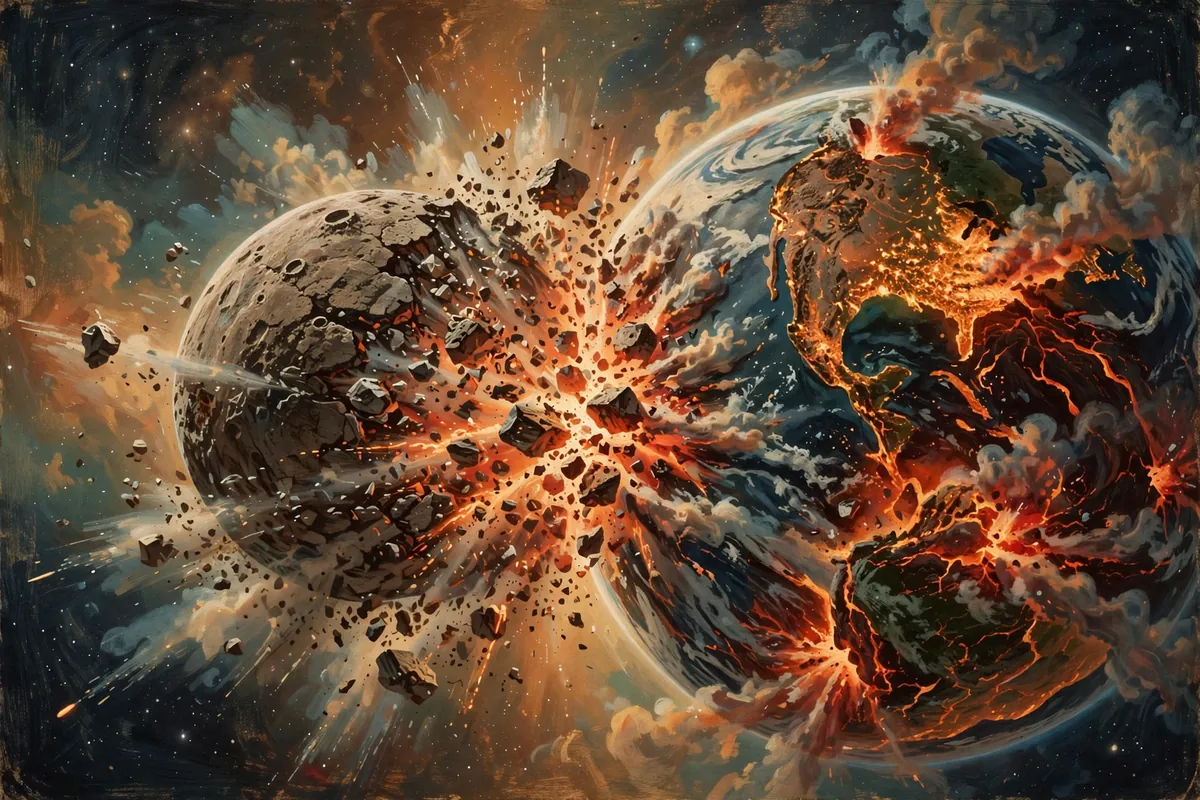
Here's the short answer. The most widely accepted idea is the giant-impact hypothesis. It suggests that about 4.5 billion years ago, the young Earth collided with a Mars-sized body. Some of the debris thrown into space then clumped together to form the Moon. It's still a hypothesis, but it explains the evidence better than any rival so far.
Meet Theia
The world that hit Earth is often called Theia, after the Titan in Greek mythology who was the mother of Selene, the goddess of the Moon. The name was proposed in 2000 by geochemist Alex Halliday and has caught on among scientists.
In the early solar system, Theia was likely one of several Mars-sized bodies. Scientists think it struck Earth at an angle when our planet was nearly fully formed. Theia's iron core would have sunk into Earth's core, while a large amount of rocky material from both worlds was blasted into orbit. That material eventually gathered into the Moon.
Clues From Moon Rocks
The Apollo astronauts brought back the most important evidence. In 2001, a team reported that Moon rocks carried an isotope signature, a kind of chemical fingerprint, identical to rocks from Earth and unlike almost every other body in the solar system. That suggests the Moon and Earth share a lot of material.
The Moon's makeup offers more clues. Its crust suggests that much of the Moon was once molten, and a giant impact could easily have supplied that heat. The Moon also has only a small iron core, less than about a quarter of its radius. That fits a Moon built mostly from the rocky outer layers of the two colliding worlds.
There's still a puzzle. If Theia came from elsewhere, why do Moon rocks match Earth so closely? Some researchers think the debris and the molten Earth mixed thoroughly for a time. A 2014 study found a slight difference in the rocks, which might mean Theia formed near Earth.
How the Idea Won Over Scientists
In 1898, George Darwin suggested the Moon was spun off from a molten Earth. He also calculated that the Moon once orbited closer and has been drifting away, which laser experiments using reflectors left on the Moon later confirmed.
In 1946, Reginald Daly of Harvard proposed that an impact, not spinning, created the Moon. Few paid attention until 1975, when William Hartmann and Donald Davis revived the idea. At a 1984 conference in Kona, Hawaii, the giant-impact hypothesis emerged as the favorite.
Other Ideas Still in Play
Scientists have weighed other explanations: that Earth captured a passing Moon, or that both formed side by side from the same cloud. None of these can explain how much spin the Earth-Moon system has. Newer variations suggest a later impact, or a collision between two bodies each larger than Mars.
So the next time you see the full Moon rise, consider its dramatic beginnings. That calm, silver face may be the peaceful result of a cosmic collision, a reminder that even beautiful things can come from chaos.