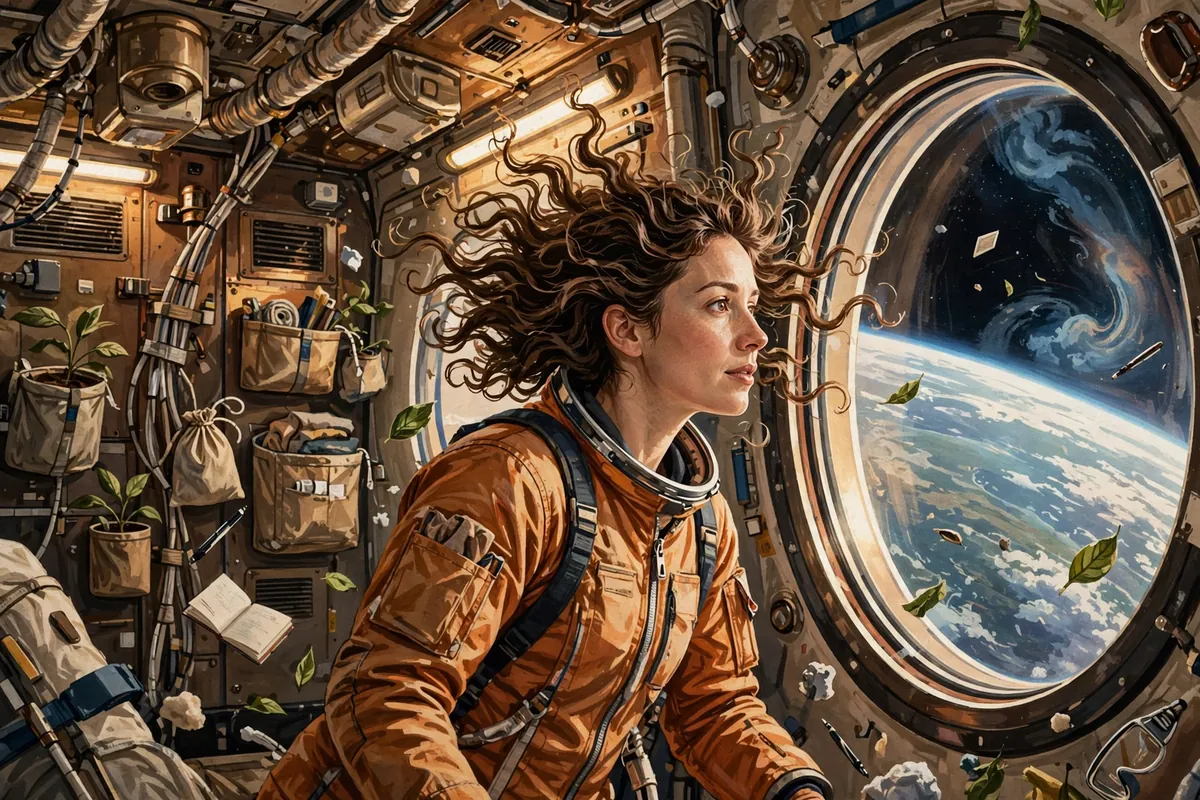
It's one of the most charming sights from space. An astronaut floats into view on the International Space Station, and her long hair drifts up and out in every direction, like a halo or a jellyfish. On Earth, hair simply hangs down. So what's different up there?
The short answer is that everything on the space station, including the astronauts and their hair, is falling around Earth together. Gravity is still pulling on them, but because they're all in free fall at the same rate, nothing pulls hair down toward the floor. Scientists call this weightlessness or microgravity, not zero gravity.
Gravity Is Still There
Here's the surprise: gravity doesn't vanish in orbit. If it did, satellites and space stations would fly off into deep space. Gravity is exactly what keeps them circling the planet. That's why scientists say the phrase zero gravity is misleading. A better term is microgravity, because the forces are tiny but never exactly zero.
Space journalist James Oberg put it well. What keeps satellites up is their tremendous sideways speed. They're constantly being pulled toward Earth, but they're moving so fast that they keep falling over the horizon. The curve of the planet drops away beneath them just as fast as they fall.
Why Falling Makes Hair Float
On Earth, you feel weight because the floor or a chair pushes back up on you. Your hair hangs down because nothing is holding it up against gravity's pull.
In orbit, the station, the astronaut, and every strand of hair are all falling together at the same speed. Nothing pushes back, so nothing feels any weight. Without that steady downward tug, hair is free to spread out, drift, and stand up in all directions. It's the same reason a dropped pen just hangs in the air beside you.
You can get a taste of this on Earth. Since 1959, special airplanes have flown up-and-down arcs that give passengers short bursts of weightlessness, for training, research, and even movie scenes. Their nickname, the Vomit Comet, tells you how some riders feel about it.
Bad Hair Days in Orbit
Floating hair creates some real housekeeping problems. There are no showers on the space station. Astronauts take sponge baths and use special shampoos that don't need rinsing. Because water and soap bubbles cling to the skin, very little water is needed. Astronauts even use one cloth to wash and a second one to rinse.
Haircuts are even trickier. On Earth, clippings fall to the floor. In orbit, they would float around and could get into equipment or someone's eyes. So astronauts use vacuum hair clippers, similar to the Flowbee sold on TV, that suck the cut hair into a container as they trim.
It's Not Just Hair
Weightlessness affects the whole body. Normally, gravity pulls our body fluids toward our legs. In space, those fluids shift upward, which gives many astronauts a puffy, moon-faced look in photos, along with stuffy noses.
Over long missions, astronauts also lose bone and muscle, so exercise is a big part of their routine. When they return, Earth's gravity takes some getting used to again.
So the next time you see an astronaut with a cloud of floating hair, you'll know the secret. They haven't escaped gravity at all. They're just falling around the world, very fast, with a great hairdo to show for it.