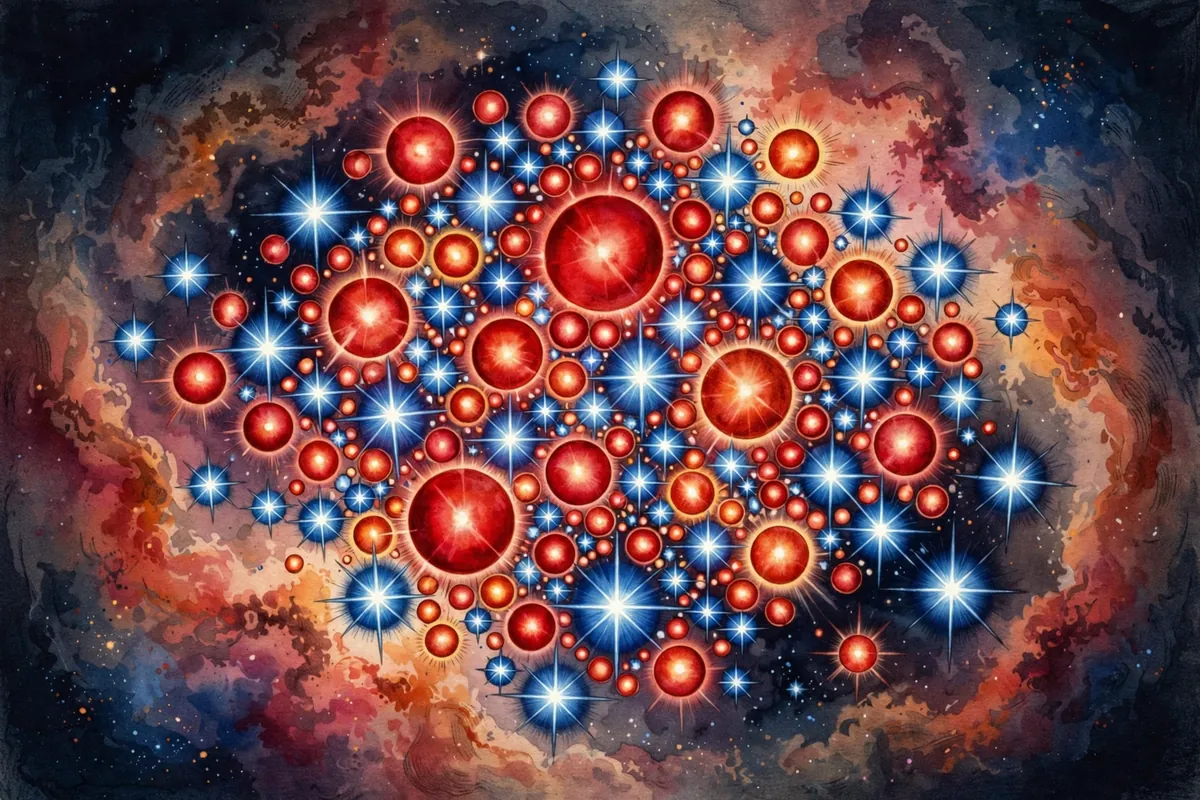
At first glance, the night sky looks like a scatter of plain white dots. But give your eyes a few minutes in the dark, and colors start to appear. Some stars glow a warm reddish orange. Others shine a crisp, icy blue-white. So why aren't all stars the same color?
The short answer is temperature. A star's color depends mainly on how hot its surface is. The coolest stars glow red, middle-temperature stars like our Sun look white to yellowish, and the hottest stars blaze blue-white. It may seem backward, since we think of red as hot and blue as cold, but for stars it's the other way around.
Red-Hot Isn't the Hottest
You can see the same effect with ordinary objects. As something heats past about 930°F, it starts giving off visible light. At first it glows dull red. As it gets hotter, the glow turns yellow, and at very high temperatures it becomes a dazzling bluish white.
Stars follow the same rule. Their light is spread across many colors, but the peak of that glow shifts toward bluer light as the temperature rises. So a blue star is actually much hotter than a red one.
Orion's Colorful Pair
The constellation Orion shows off this difference beautifully. Betelgeuse, at Orion's shoulder, is a distinctly reddish supergiant and usually the tenth-brightest star in the night sky. It's so big that if it took the Sun's place, its surface would reach past the orbit of Mars.
Rigel, at Orion's foot, is a blue supergiant with a surface temperature of about 21,000°F. What looks like a single blue-white point is actually a system of at least four stars, with Rigel the brightest of them. Seen together on a dark night, the pair makes the temperature difference easy to spot.
Our Sun sits in between. Its surface is roughly 5,800 kelvins, or about 10,000°F, and its light peaks in the yellow-green part of the spectrum. Overall, the Sun's light is actually white.
Sorting Stars by the Alphabet
Astronomers sort stars into classes using letters, listed from hottest to coolest: O, B, A, F, G, K, and M. Students have long remembered the order with the mnemonic "Oh, Be A Fine Girl, Kiss Me!" or "Oh, Be A Fine Guy, Kiss Me!"
This system was shaped by astronomer Annie Jump Cannon at Harvard, who reordered and simplified an earlier alphabetical scheme. At the time, scientists didn't fully understand that the classes reflected temperature. That became clearer in the early 20th century. Ordinary stars range from roughly 3,000°F to about 90,000°F at the surface.
Hot Stars Live Fast
Color also hints at a star's lifestyle. The hot blue O and B stars are so energetic that they burn out in a relatively short time. Because they don't live long, they usually don't travel far from where they were born.
Cool red dwarfs are the opposite. They're by far the most common stars, making up about three out of four ordinary stars near the Sun. Yet they're so dim that, under normal conditions, not a single one can be seen without a telescope.
So the next time you're out on a clear night, look for the colors. That faint orange glow and that sharp blue sparkle are messages about temperature, sent across hundreds of light-years. The sky has been color-coded all along.