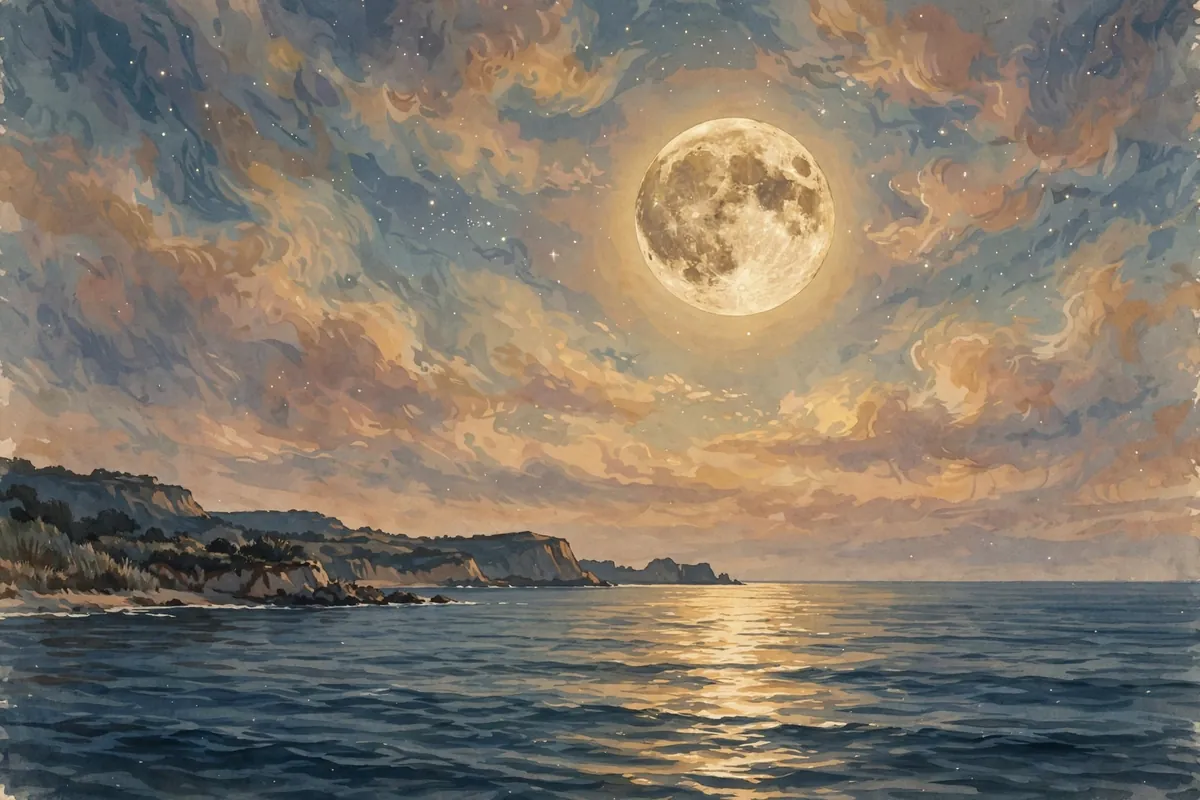
A full Moon rising over the water is one of nature's loveliest sights. It glows silvery white, bright enough to cast shadows and light up a path across the sea. So it's natural to imagine the Moon's surface as pale and shiny. The truth is almost the opposite.
Here's the short answer: the Moon is actually quite dark. It reflects only about 12 percent of the sunlight that hits it, which makes its surface about as reflective as asphalt. Its true color is a muted brownish-gray. It looks so bright to us because it's big in our sky, it's lit by full, direct sunlight, and it hangs against the blackness of space.
As Dark as a Parking Lot
Scientists measure how much light a surface reflects with a number called albedo. The Moon's albedo is about 0.12, which means it bounces back 12 percent of the light that reaches it. That's similar to many asteroids, and comparable to a stretch of asphalt road.
Even so, the Moon is the brightest object in our night sky. That's mainly because it looks so large from Earth. A big, sunlit disk against a pitch-black background stands out dramatically, even if its surface is fairly dark.
What the Moon Is Really Made Of
The Moon is covered with a mostly gray layer of broken-up rock and dust called regolith. It formed as meteor impacts and charged particles from space ground the rock into ever finer bits over billions of years, quite unlike soil on Earth, which forms with help from air, water, wind, and living things. The layer runs about 33 to 49 feet thick in the highlands. The finest lunar soil is made of glassy material. It has a texture resembling snow and a smell resembling spent gunpowder.
The dark patches you can see with your naked eye are called maria, Latin for seas, because people once thought they held water. They're really vast pools of ancient lava that hardened into basalt. Elements such as iron and titanium in the surface absorb light, which is why the maria look darker than the Moon's bright highlands.
Red Moons and Blue Moons
The Moon's color can seem to change, but that's mostly Earth's air at work. During a lunar eclipse, Earth's atmosphere bends red sunlight onto the Moon, turning it a coppery red. That's why eclipses are sometimes called blood moons. A Moon low on the horizon can also look reddish, because its light passes through a thick layer of air.
Certain particles in the air, such as those from volcanoes, can even make the Moon look blue. Just remember that the phrases blood moon and blue moon are also used as names for particular full moons, so they don't always mean the Moon has changed color.
A Bright Earth in the Lunar Sky
Here's a fun reversal. On the Moon's near side, nights are lit by sunlight reflecting off Earth, called earthshine. It makes a lunar night about 43 times brighter, and sometimes even 55 times brighter, than a night on Earth under a full Moon.
So the next time you admire a silver full Moon, remember that you're looking at a dusty, dark gray world doing its very best in the sunshine. It just happens to have the perfect stage: a big, black night sky.