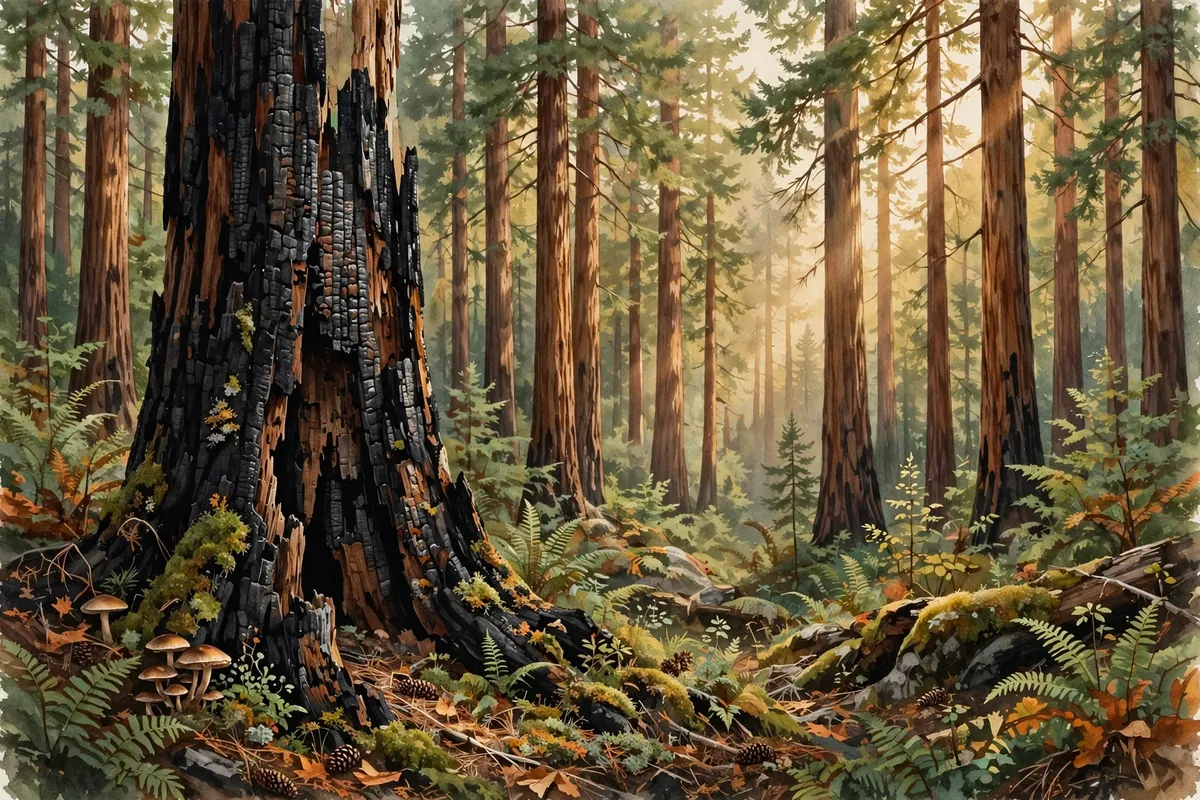
Walk through a coast redwood forest and you may notice something surprising. Some of the biggest trees have trunks charred black, sometimes high up the bark, from fires long past. And yet they're still standing tall and green overhead. How do trees this enormous survive fire again and again?
Redwoods are built to resist it. Their thick, fibrous bark grows to at least a foot thick and is extremely fire-resistant, protecting mature trees from damage. Redwoods also contain little of the flammable pitch or resin found in many other conifers. On top of that, they can sprout back after a fire, which helps them recover even when they are damaged.
A Foot of Armor
That bark works like insulation. A low-burning ground fire can lick at the outside of a mature redwood without reaching the living tissue inside. Many other trees, with thinner bark and more resin, simply can't take that kind of heat.
Redwoods have another clever defense. As they grow taller, they shed their lower limbs. Without low branches acting like a ladder, ground fires have a hard time climbing up into the canopy, where the bark on branches is thin and the leaves are vulnerable.
Fire Can Actually Help
Here's the twist: fire often works in the redwood's favor. Fires tend to kill many of the trees that compete with redwoods while doing only minor harm to the redwoods themselves. Burned ground is also a good place for redwood seeds to sprout.
A 2010 study, the first to compare how redwoods and nearby species survive and regrow after wildfire, found that fires of every severity increased the share of redwoods in the forest. Higher-severity fires gave redwoods the biggest boost.
Redwoods can also sprout from burls, woody knobs that usually form below the soil line. When the tree is damaged, dormant buds in the burls send up new shoots and roots. Scientists studying fossils have even suggested that without this remarkable ability to sprout after fire, many southern redwood forests might have disappeared long ago.
Not Completely Fireproof
Redwoods aren't invincible. For thousands of years, Indigenous people set seasonal ground fires in redwood country, and the trees thrived. After European settlement, those practices were banned. Later, policies tried to stop every fire, even natural ones.
Without regular small fires, brush and young trees piled up. Clearcut logging added to the problem. Now even a natural ground fire can climb that built-up fuel into the canopy and become a much more dangerous fire.
Giants of the Coast
Coast redwoods grow in a narrow strip about 470 miles long along the Pacific coast, from Monterey County, California, to southwestern Oregon. The tallest and oldest grow in deep, foggy valleys with year-round streams.
They're the tallest trees on Earth. The current champion, Hyperion, was discovered in Redwood National Park in 2006 and measures about 381 feet. It's thought to be the world's tallest living thing, and many other redwoods top 300 feet. The former record holder, the Dyerville Giant, stood about 372 feet and was estimated to be 1,600 years old when it fell in 1991.
So when you see a scorched redwood still reaching for the sky, you're looking at a tree that has turned surviving fire into an art form. Some of those scars may be centuries old.