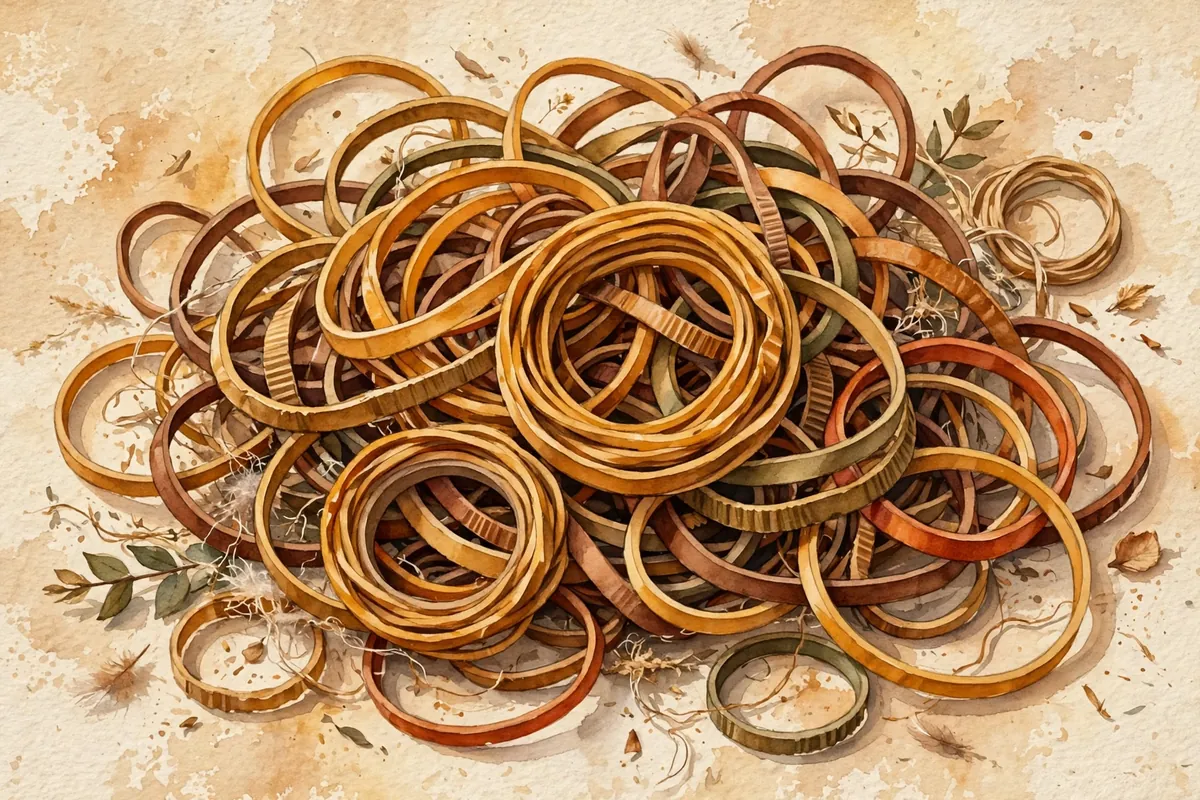
Check the junk drawer in almost any kitchen and you'll find a handful of rubber bands. They hold bread bags shut, bundle pencils, and keep the morning newspaper rolled up. They're so simple it's hard to imagine anyone had to invent them. But someone did.
The rubber band was patented in England on March 17, 1845, by Stephen Perry. The first ones were used to hold papers and envelopes together. But the material behind them, natural rubber, has a history stretching back thousands of years to the ancient peoples of Mexico and Central America.
Rubber Before Rubber Bands
The first people to use rubber were the indigenous cultures of Mesoamerica. The earliest evidence comes from the Olmec culture, who used latex from the rubber tree to make balls for the Mesoamerican ballgame. Later, the Maya and Aztecs used it too. The Aztecs made containers from rubber and used the sap to waterproof cloth.
Europeans caught on much later. In 1736, the Frenchman Charles Marie de La Condamine brought samples of rubber to the French Academy of Sciences. Then, in 1770, English scientist Joseph Priestley noticed that a piece of the material was excellent at rubbing out pencil marks. That's how rubber got its English name.
The Problem With Early Rubber
Raw rubber had a big flaw. It turned soft and sticky in the heat. Charles Goodyear spent the 1830s trying to fix that. In 1839, while experimenting with rubber and sulfur, he accidentally dropped the mixture onto a hot frying pan. Instead of melting, the rubber stayed firm and got harder as he turned up the heat.
That process became known as vulcanization. British inventor Thomas Hancock patented his own version in November 1843, about eight weeks before Goodyear's U.S. patent in January 1844. Just over a year later, Stephen Perry patented the rubber band.
How Rubber Bands Are Made
Most rubber bands are still made from natural rubber, because it's so elastic. It comes from the latex of rubber trees, which only grow in hot, humid places near the equator. Today most latex comes from Malaysia, Thailand, and Indonesia. Workers collect the latex by tapping into the tree's bark. Once it's exposed to the air, the milky sap begins to harden and turn rubbery.
The process is surprisingly simple. Rubber is pushed into a long tube, cured with heat, and then sliced across into rings, a little like slicing a long sausage. How far apart the cuts are decides the band's width.
In 1923, a man named William H. Spencer cut rubber bands by hand from Goodyear inner tubes in his basement. He talked newspapers into wrapping their papers with his bands so they wouldn't blow across lawns. His Alliance Rubber Company went on to find many more uses for them.
A Weird Bit of Science
Rubber bands also behave strangely with heat. Most things expand when heated, but a stretched rubber band does the opposite. Heat it and it contracts. Cool it and it relaxes.
You can feel another oddity yourself. Stretch a rubber band quickly and touch it to your lip, and it feels slightly warm. Let it snap back, and it cools a little. That's because stretching a rubber band releases heat, and letting it relax absorbs heat. Not bad for something that usually lives in a junk drawer.