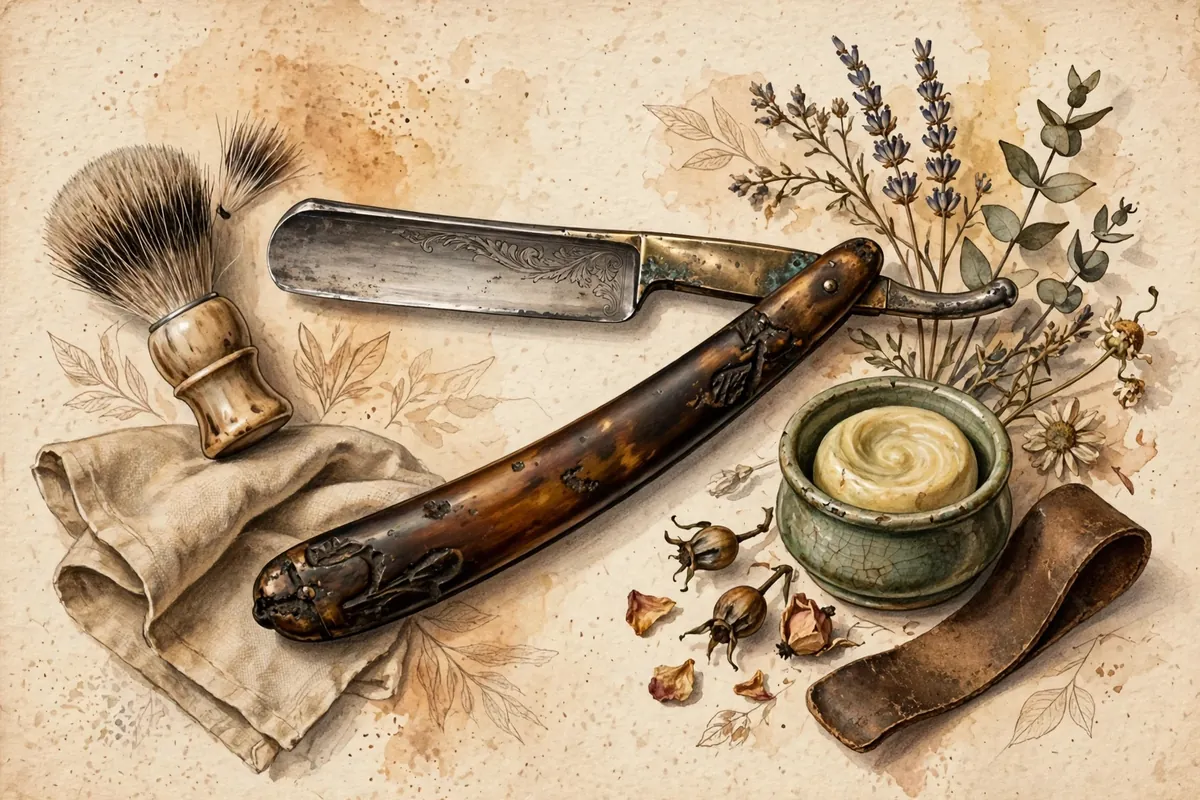
Picture a man shaving in the 1800s. He's holding a straight razor with a blade sharp enough to do real damage if his hand slips. Every day, he sharpens it on a leather strop, and honing it properly is often left to a professional. It's a skill, and a slightly nerve-racking one.
The safety razor changed that. The idea was simple: put a guard or holder between the blade and the skin so it's much harder to cut yourself. People tinkered with versions of it for more than a century. But it truly took off in the early 1900s, when King Camp Gillette paired a safe holder with a cheap, throwaway blade.
Guards, Hoes, and the First Safety Razors
Protective razors go back at least to the 1700s. Around 1762, a French cutler named Jean-Jacques Perret added a protective guard to an ordinary straight razor.
In 1847, William S. Henson described a razor with the blade set at a right angle to the handle, shaped somewhat like a garden hoe. That basic shape is still familiar today.
The term safety razor first appears in an 1880 patent filed by Frederic and Otto Kampfe of Brooklyn, New York. Their design held the blade in a metal holder with small teeth that let it cut hair without slicing the skin. They sold their razors under the Star Safety Razor brand. But these razors still had blades that needed regular sharpening.
Advice From the Bottle Cap Man
In 1891, a man named King Camp Gillette joined the Crown Cork and Seal Company in Baltimore. He became close friends with its founder, William Painter, the inventor of the disposable metal bottle cap.
Painter gave him a famous piece of advice: "King, you are always thinking and inventing something. Why don't you try to think of something like the Crown Cork which, when once used, is thrown away, and the customer keeps coming back for more?"
Gillette saw a real need. Razor blades were relatively expensive and dulled quickly. A blade you could simply toss out when it got dull would save men a lot of trouble.
The Hard Part Was the Blade
Making that blade turned out to be tough. Thin, cheap steel was hard to work and sharpen, which delayed the product for years. Machinist William Emery Nickerson improved the design and created machines to mass-produce the blades, along with methods for hardening and sharpening them.
Gillette founded his company in 1901 and filed his patent that year, which was granted in 1904. Sales started slowly. In 1903, the company sold just 51 razors and 168 blades. Even though the razor cost a hefty $5, about half a working man's weekly pay, it eventually sold by the millions.
A Wartime Boost
The real turning point came with World War I. Gillette won a contract to supply American troops with safety razors as part of their field kits, delivering 3.5 million razors and 32 million blades. Soldiers were allowed to keep them when they came home, and they kept their new shaving habits too.
One popular myth is that Gillette invented the business model of selling razors cheaply to sell more blades. In fact, his company borrowed that idea from competitors. Still, the next time you swap out a dull blade, you can thank a bottle cap and a bit of friendly advice.