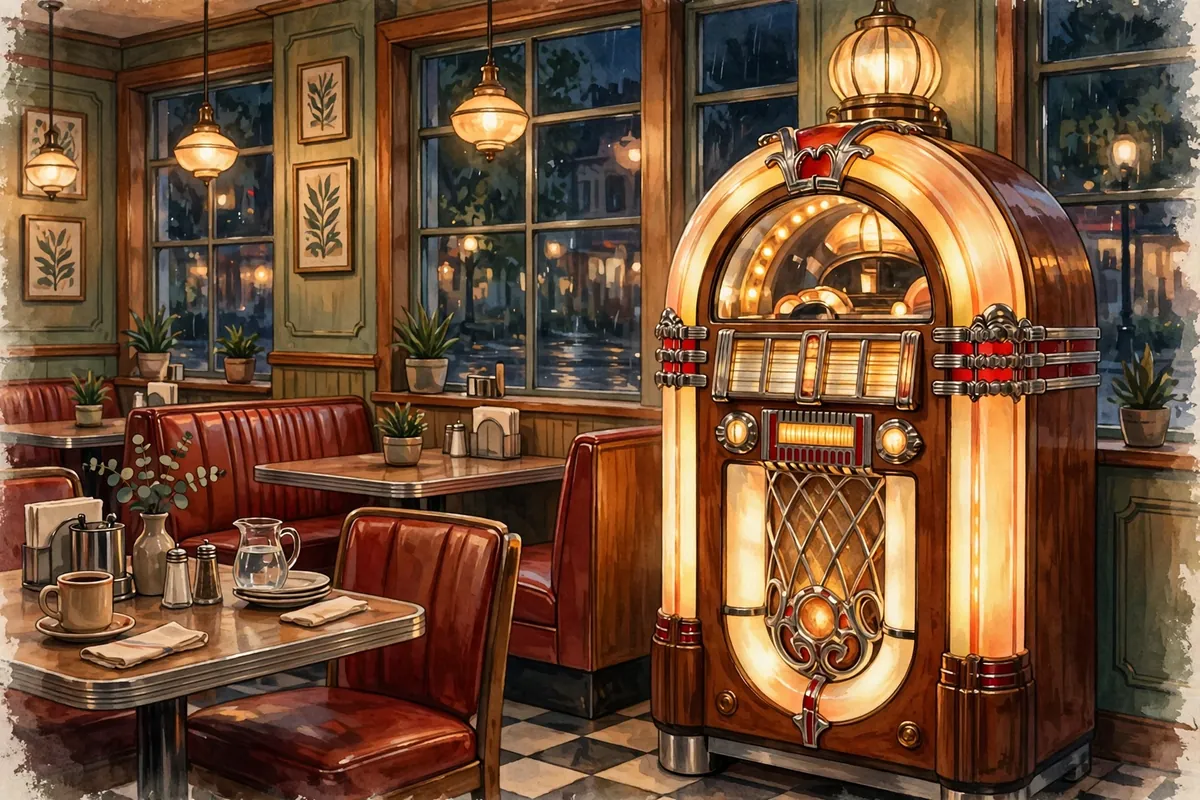
Few things say 1950s America like a glowing jukebox in the corner of a diner. Drop in a coin, press a button, and your favorite record drops onto the turntable. It feels wholesome and nostalgic now. But the name itself comes from a much rowdier place.
The word "jukebox" came into use in the United States around 1940. It refers to "juke joints," informal spots in the South with music, dancing, drinking, and gambling. The word juke is believed to come from the Gullah word joog or jug, meaning rowdy or disorderly. Because of those associations, manufacturers tried for years to avoid using the term.
Where the Word Comes From
Gullah is a creole language historically spoken by African Americans along the coast from North Carolina to Florida. Today around 5,000 people still speak it, mostly in South Carolina and Georgia. Scholars trace the word juke back even further, to a word in Wolof, a West African language, that means to misbehave.
Juke joints were mostly run by African Americans in the southeastern United States. Classic ones sat at rural crossroads and served workers who needed a place to unwind after a hard week, especially since Jim Crow laws barred them from most white establishments. They were often set up in simple or abandoned buildings on the edge of town.
During Prohibition, simple juke joints popped up at highway crossings and railroad stops. They were rarely called juke joints on the sign, going instead by names like "Lone Star," and many opened only on weekends.
Music was at the heart of these places, so the coin-operated record players inside them took on the juke name. Respectable or not, the nickname stuck.
Before It Was a Jukebox
The idea of paying for a song goes back further than the name. In 1889, Louis Glass and William S. Arnold installed a nickel-in-the-slot phonograph at the Palais Royale Saloon in San Francisco. There were no speakers. Listeners heard the music through tubes, a bit like an early set of headphones.
In 1928, Justus P. Seeburg, who made player pianos, combined a loudspeaker with a coin-operated record player. His Audiophone had eight turntables mounted on a rotating wheel, which let customers pick from eight records. Later machines grew more clever, with mechanisms that could pull out one record from a stack.
The Golden Age
Jukeboxes were most popular from the 1940s through the mid-1960s, especially in the 1950s. Big makers included Wurlitzer, Seeburg, Rock-Ola, and AMI. By the mid-1940s, three-quarters of the records made in America went into jukeboxes.
One famous model was the 1946 Wurlitzer 1015, nicknamed the "bubbler." It offered 24 selections, and more than 56,000 were sold in less than two years. Restaurants also added wallboxes, small remote controls at tables and booths that let diners pick songs without leaving their seats.
Jukeboxes were so important to the music business that Billboard magazine published a chart of jukebox plays in the 1950s. By 1959, their popularity had faded enough that Billboard stopped publishing it.
Still Spinning
Today, streaming services and internet-connected machines have mostly replaced the classic jukebox. Still, a few companies keep building retro-style models, and collectors prize the old ones.
So the next time you see one glowing in a diner, give a little nod to the juke joints that gave it its name. That cheerful machine has a rowdy family tree.