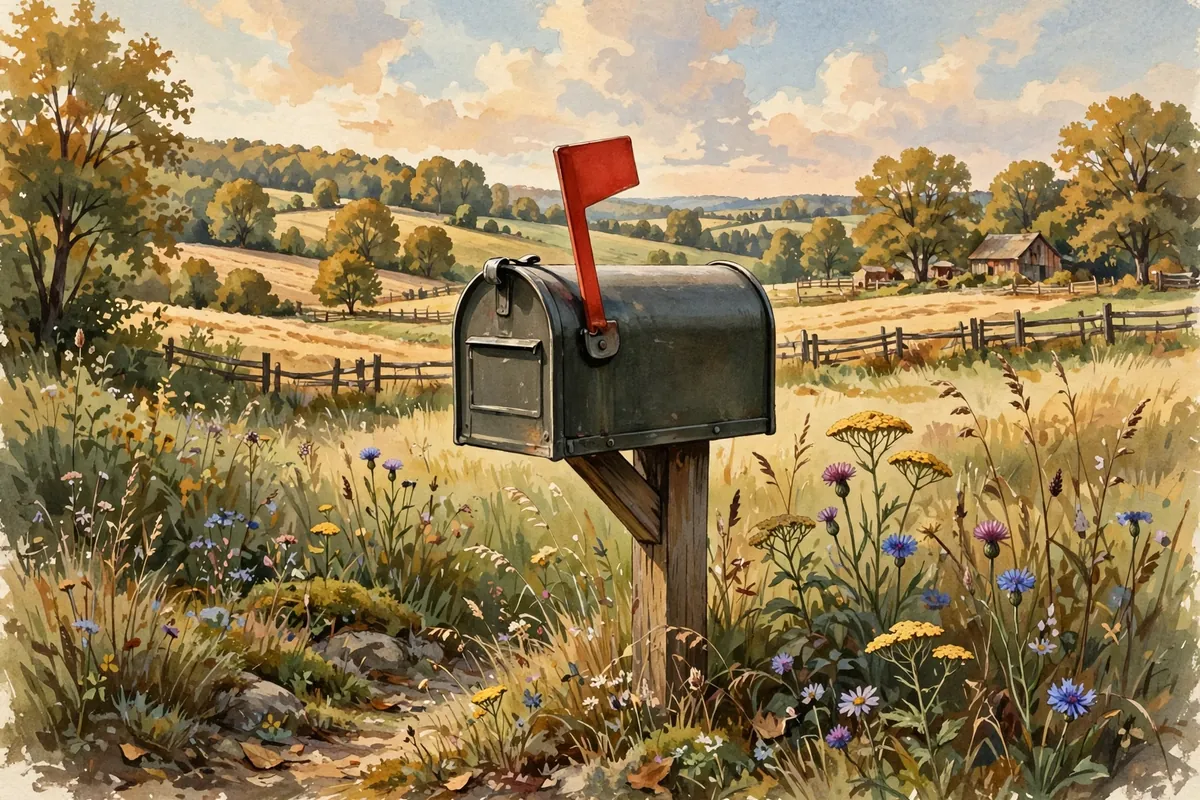
Drive down any country road in America and you'll see them standing at the end of each driveway: rounded metal mailboxes on posts, each with a little red flag on the side. Some flags are up, some are down. It's one of the simplest communication systems ever invented.
Here's the short answer. The flag is a signal. When it's raised, it tells the mail carrier there's outgoing mail inside to pick up. Curbside mailboxes were first designed only to receive mail, and the flag was added so carriers could collect letters too. In the early days, carriers also raised the flag to tell residents that mail had arrived.
Before Mail Came to the Farm
For much of American history, country folks had no mail delivery at all. Until the late 1800s, people in rural areas had to travel to a sometimes distant post office to collect their mail, or pay a private carrier to bring it.
That changed with Rural Free Delivery. The Post Office Department experimented with it in the 1890s, and in 1893, Georgia congressman Thomas E. Watson pushed through legislation requiring it. Rollout was slow, though, and it wasn't adopted generally across the country until 1902.
Not everyone was happy. Powerful express companies and some town merchants opposed it, worried they'd lose business, including to mail-order catalogs like Sears, Roebuck and Company.
A Flag That Talked Both Ways
Rural mail needed somewhere to go, so roadside mailboxes popped up along the routes. These were designed for incoming mail. Soon they were fitted with a signal flag on an arm to let the carrier know there was something to pick up.
At first, the flag worked in both directions. Residents raised it to signal outgoing mail, and carriers raised it to let families know mail had been delivered. That was a real kindness in freezing or stormy weather, since nobody had to trudge down a long driveway for nothing.
The Man Who Designed the Classic Mailbox
The familiar rounded mailbox has a designer. In 1915, the U.S. Post Office approved a box created by Roy J. Joroleman, a Post Office employee with a degree in mechanical engineering. His design had a curved, tunnel-shaped roof, a latching door, and a rotating red flag.
Every detail had a purpose. The arched roof kept rain and snow from piling up and resisted denting. It also made the box easier to mass-produce. A false floor helped keep letters dry. The whole thing needed only two rivets, three axle bolts, and four screws and nuts.
Here's the generous part. Joroleman's design wasn't patented. Its specifications were shared with any manufacturer who wanted to make it. Adopted across the United States, it has remained the top-selling mailbox since its introduction, and it's praised as a great example of American functional design.
Still Going Strong
Rural delivery grew fast. By 1930, more than 43,000 rural routes served nearly 6.9 million families. The arrival of parcel post in 1913 brought another boom, carrying newspapers, magazines, and mail-order goods to farms.
Today, rural delivery still matters. As of 2022, the U.S. Postal Service had about 133,000 rural letter carriers covering 80,000 routes. So the next time you flip up that little red flag, you're using a signal that has quietly connected country homes to the rest of the world for more than a century.