Ketchup feels as American as baseball and backyard cookouts. It's on burgers, fries, hot dogs, and scrambled eggs, depending on who you ask. But this bright red sauce had a long, winding journey before it ever met a tomato.
Here's the short answer. The word ketchup entered English in the late 1600s, likely borrowed from Asia, and early ketchups were thin, salty sauces made from things like mushrooms, oysters, mussels, and walnuts. Tomato ketchup didn't show up until the early 1800s, and the thick, sweet version we know took shape in the early 1900s.
Where the Word Came From
Nobody is completely sure where the word came from, and there are several competing theories. One points to the Hokkien language of coastal southern China, where kôe-chiap meant the brine of pickled fish or shellfish. Another links it to the Malay word kicap, which originally meant soy sauce. A third theory ties it to escabeche, a Spanish and Portuguese word for a pickling sauce.
Either way, the word appeared in English print as ketchup in 1682, then catchup in 1690, and catsup in 1730. That's why both spellings are still around today, with catsup still common in some southern states.
Mushrooms Before Tomatoes
In Britain, starting in the 1600s, ketchup was usually made with mushrooms as the main ingredient, not tomatoes. Recipes for many different types of ketchup appeared in British and then American cookbooks in the 1700s.
British colonists brought mushroom ketchup to America, where it dates back to at least 1770. Even in 1913, Webster's Dictionary still defined catsup as a table sauce made from mushrooms, tomatoes, walnuts, and more.
Enter the Tomato
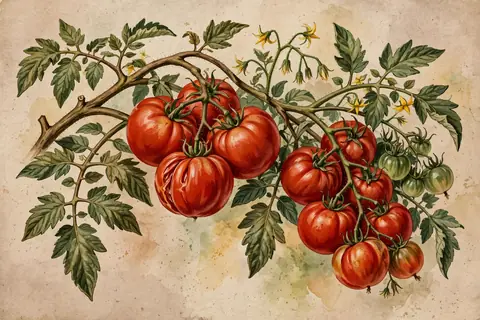
The first known tomato ketchup recipe was published by James Mease in 1812. A recipe from 1817 included anchovies and cochineal, a red dye made from insects. Fish stayed in the mix for a while, but by the mid-1850s, anchovies had disappeared from the ingredient list.
In 1824, tomato ketchup appeared in The Virginia Housewife, an influential cookbook by Mary Randolph, a cousin of Thomas Jefferson. Farmers sold it locally, and Jonas Yerkes is credited as the first American to sell it in a bottle. By 1837, he was distributing it nationally.
Here's a surprise: tomato ketchup was popular long before fresh tomatoes were. People were more willing to eat tomatoes once they'd been cooked down with vinegar and spices. By 1897, the Sears catalog said there were hundreds of brands of catsup on the market, "a few of them good."
How Ketchup Got Thick and Sweet
Modern ketchup was born out of a food safety fight. Harvey W. Wiley, often called the father of the Food and Drug Administration, challenged the safety of a preservative called sodium benzoate. Henry J. Heinz and others looked for a recipe that didn't need it.
Early commercial ketchups were watery, partly because they used unripe tomatoes. In 1909, Katherine Bitting, a government bacteriologist, showed that adding more sugar and vinegar would keep ketchup from spoiling without artificial preservatives. Using ripe tomatoes and more vinegar gave us the thick, sweet-and-tangy sauce we know.
So the next time you give the bottle a whack, remember its long trip from fish brine and mushrooms to your burger. It's a condiment with quite a past, and it's still finding new places on our plates.