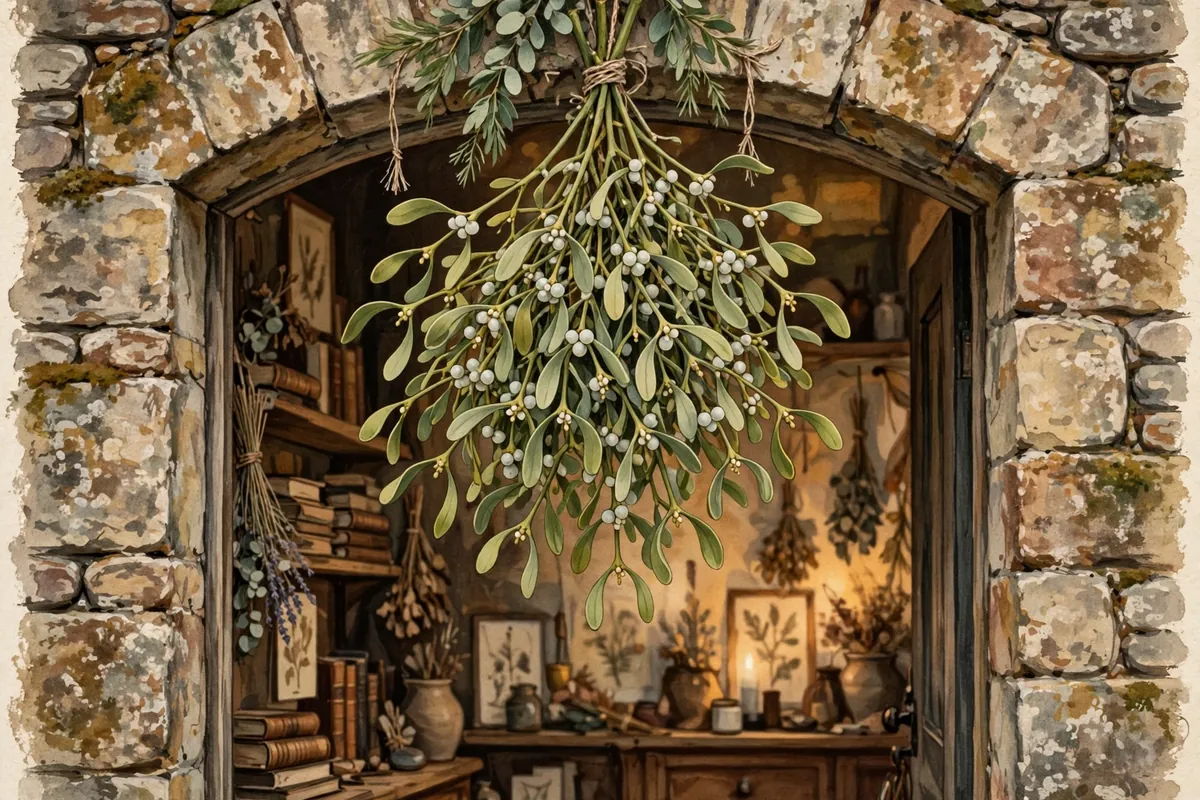
It's one of the sweetest holiday traditions. Someone hangs a little bunch of mistletoe over a doorway, and anyone caught standing beneath it is in for a kiss. But why this particular plant? And who decided it called for a smooch?
Here's the short answer. Mistletoe was linked to fertility and vitality for centuries, and in Christian times it became a Christmas decoration under which couples were expected to kiss. The kissing custom is recorded as popular among servants in late 18th-century England, and the serving class of Victorian England is credited with keeping it alive. Older roots are murkier, and historians aren't certain how it all began.
A Plant That Lives in the Treetops
Part of mistletoe's mystique comes from how it grows. It's a parasitic plant that attaches itself to a host tree or shrub and draws water and nutrients from it. It does make some of its own food through photosynthesis, so scientists call it a hemiparasite. There are hundreds of species, and most of them live in the tropics.
Birds do most of the planting. In Europe, the best-known mistletoe fan is a bird called the mistle thrush, while in the American Southwest it's a bird called the phainopepla. They eat the berries, and the seeds end up on branches, sometimes after a bird wipes its sticky beak on the bark. The seeds are coated in a gluey substance called viscin that hardens and attaches them firmly to their new home.
Ancient Legends
Mistletoe may have been important in ancient Druid rituals, though the only ancient writer to describe that use was the Roman author Pliny the Elder. Evidence from preserved bog bodies suggests the Celts may have used it as medicine instead.
In Norse mythology, mistletoe plays a dark role. The goddess Frigg asked everything on earth to promise never to harm her son Baldr, but she skipped the mistletoe. The trickster Loki then made a spear from it, and Baldr was killed. So in the old myth itself, mistletoe isn't a symbol of love at all. It's the weapon.
The Rules of the Kiss
By the Middle Ages, mistletoe was still linked with fertility and vitality, and it was also thought to protect against witches and demons. By the 18th century, it had become part of Christmas celebrations.
The old English custom had some firm rules. A man was allowed to kiss any woman standing under the mistletoe, and refusing was said to bring bad luck. In one version, a berry was plucked from the sprig with each kiss, and once the berries were gone, the kissing had to stop.
In England and Lowland Scotland, people also made a kissing bough. This globe-shaped frame was covered in greenery, decorated with apples, ribbons, or candles, and had mistletoe tied underneath.
A Word of Caution
Mistletoe looks festive, but some species are toxic. European mistletoe is more toxic than American mistletoe, so it's wise to keep the berries away from children and pets. If someone swallows some, call your doctor or poison control.
The name itself is pretty humble. It comes from the old word mistle plus the Old English word for twig. So this holiday season, if you find yourself under that little green twig, enjoy the moment. You're taking part in a tradition with a long, tangled, and surprisingly dramatic history.