For more than 160 million years, dinosaurs ruled the land. Then, in what amounts to a geological blink, they were gone. For a long time, scientists argued over what could possibly have ended such a successful group of animals.
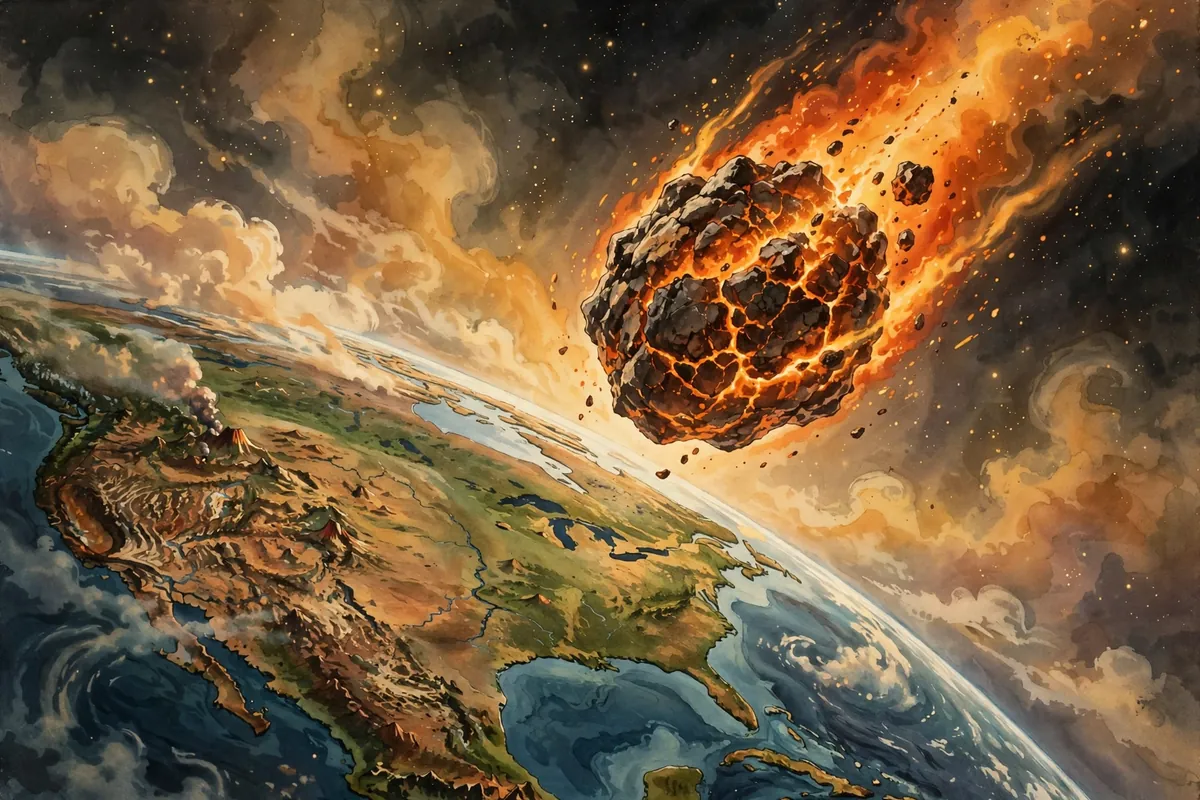
Today, the answer is widely accepted. A little over 66 million years ago, an asteroid about six miles across struck Earth near what is now Mexico's Yucatán Peninsula. The devastation and climate disruption that followed are considered the main cause of a mass extinction that wiped out about 75 percent of plant and animal species, including all dinosaurs except the ancestors of birds.
A Clue Hidden in Clay
The case began in Italy. In the late 1970s, geologist Walter Alvarez and his father, Nobel Prize-winning physicist Luis Alvarez, studied a thin layer of clay near the town of Gubbio. That layer marks the boundary between the age of dinosaurs and the age that came after.
The clay contained an unusually high amount of iridium, an element that's rare on Earth but common in asteroids. In places, it was up to 160 times the normal level. The team proposed that a giant asteroid had vaporized on impact and spread iridium-rich dust all over the planet. At the time, other suspects included a nearby exploding star and a flip in Earth's magnetic field. The team published its idea in 1980, and many paleontologists rejected it at first.
Finding the Crater
An impact that big should have left a huge scar, but where? As it turned out, two geophysicists, Antonio Camargo and Glen Penfield, had already spotted a strange buried structure while searching for oil in the Yucatán in the late 1970s. Penfield couldn't prove it was a crater at first and moved on.
In 1990, through contact with researcher Alan Hildebrand, Penfield obtained rock samples that pointed to an impact. The evidence included shocked quartz and a telltale gravity pattern. Today the crater is named Chicxulub, after a nearby village. It's about 120 miles wide and buried under roughly half a mile of younger rock. It ranks among the largest impact structures on Earth.
A Very Bad Day on Earth
The impact unleashed winds over 600 miles per hour near the blast and set off megatsunamis more than 300 feet tall. It triggered an earthquake estimated at magnitude 9 to 11. Waves scoured the seafloor all the way to what is now Louisiana, leaving giant ripples that can still be detected.
The worst came afterward. Dust and soot may have blocked sunlight for a decade or longer, cooling the planet dramatically. Plants struggled to grow, and the whole food chain suffered. Some scientists think huge volcanic eruptions in India, called the Deccan Traps, also played a role, though a 2020 climate modeling study favored the asteroid as the main culprit.
Who Made It Through
Not everything died. Animals that ate insects, worms, snails, or dead matter tended to fare better. Small mammals survived and later spread into new forms, eventually giving rise to horses, whales, bats, and primates, the group that includes us.
And the dinosaurs didn't vanish completely. A few species of ground and water birds survived, and they went on to produce every bird alive today.
So the next time a sparrow hops across your lawn, give it a second look. It's a living descendant of the dinosaurs, and a reminder that even the worst day in Earth's history had a few survivors.