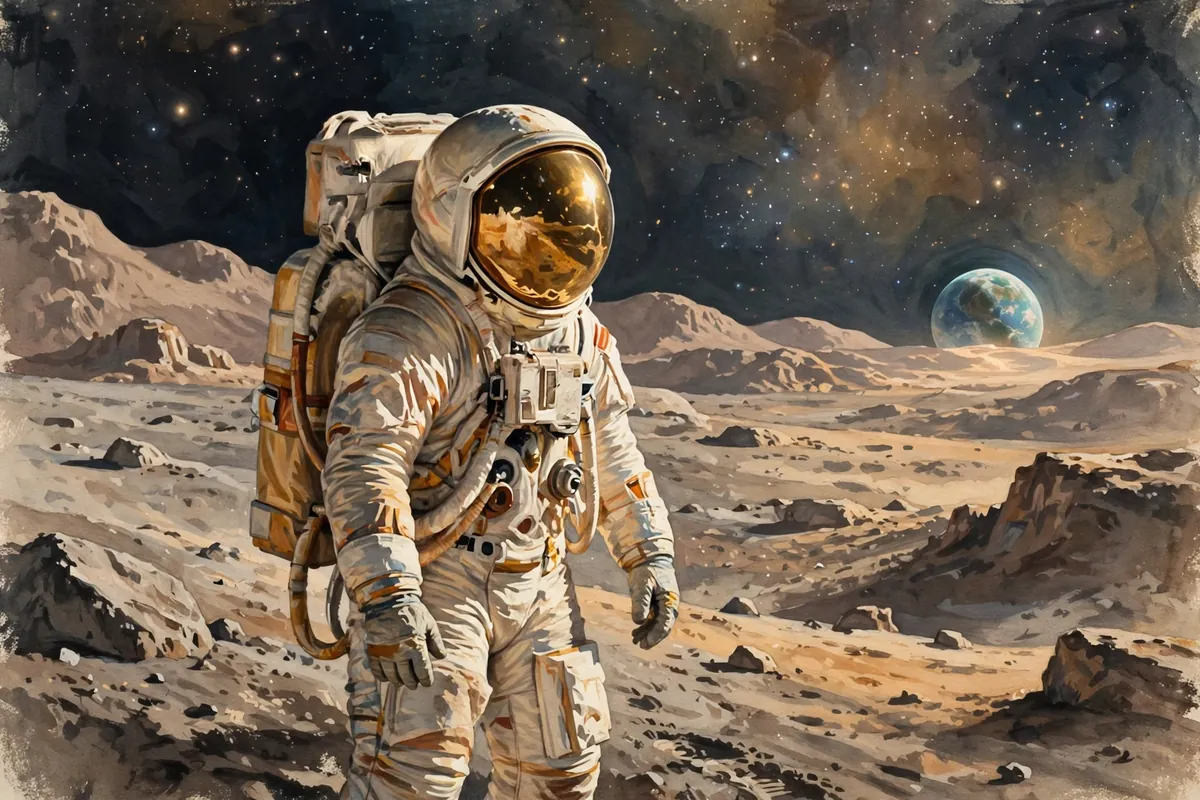
Photos from the Moon show something strange: the sky is black, even with the Sun shining. It looks like nighttime with the lights on. You might think that a black sky would mean easy viewing. But for the astronauts who walked there, eye protection was a must.
The reason is simple. On Earth, our thick atmosphere filters and softens sunlight. The Moon has almost no atmosphere at all, so the Sun's light, including its harmful ultraviolet rays, hits the surface and your eyes with nothing in the way. That's why astronauts wore protective visors, and why sunglasses flew to the Moon on the very first landing.
Earth's Invisible Sunshade
We rarely think about it, but our atmosphere is a giant shield. High up, the ozone layer absorbs 97 to 99 percent of the Sun's medium-frequency ultraviolet light, which would otherwise harm living things on the surface.
The Moon has nothing like that. Its so-called atmosphere is so thin that, for most practical purposes, scientists treat the Moon as surrounded by a vacuum. Its total mass is less than about 10 metric tons, spread around an entire world. With no air to scatter sunlight, the sky stays black, and the Sun blazes down unfiltered.
Sunglasses Went on Apollo 11
When Apollo 11 made the first Moon landing in 1969, a pair of classic pilot sunglasses made by American Optical was on board the lunar module Eagle. They were the first sunglasses used on a Moon landing.
NASA kept working on the problem. Scientists at its Jet Propulsion Laboratory developed special lenses that protected against harsh light in space, as well as during laser and welding work. The lenses used colored dyes and tiny particles of zinc oxide, the same ultraviolet-blocking ingredient found in some sunscreens. The technology was later adapted for deserts, mountains, and even offices lit by fluorescent lights.
Why Visors Look Gold
Outside the spacecraft, astronauts relied on their helmet visors. That shiny gold look isn't just for show. A super-thin layer of gold is so fine that you can see through it, yet it strongly reflects infrared light, which is radiant heat. That makes it useful in sun visors for spacesuits and in heat-resistant suits here on Earth.
Starting with Apollo 13, the commander's visor assembly even got a red stripe, along with red bands on his suit, so people could tell the two moonwalkers apart in photos.
A Surprisingly Dark Moon
Here's a twist. The Moon looks dazzling in our night sky, but its surface is actually dark. It reflects about as much light as asphalt. It seems bright to us mostly because it's big in our sky and lit by full sunlight against the darkness.
So the glare on the Moon isn't about a shiny surface. It's about the Sun itself, raw and unfiltered. On Earth, intense ultraviolet light can even give your eyes a painful sunburn, a condition called photokeratitis, better known as snow blindness. It's more common at high elevations, where there's less air overhead.
That's a good reminder for those of us who will never leave the planet. Sunglasses aren't just a fashion choice on a bright day at the beach or in the snow. If you have questions about protecting your eyes, talk to your eye doctor. And next time you look up at the Moon, picture a pair of aviators sitting on the dashboard of the Eagle.