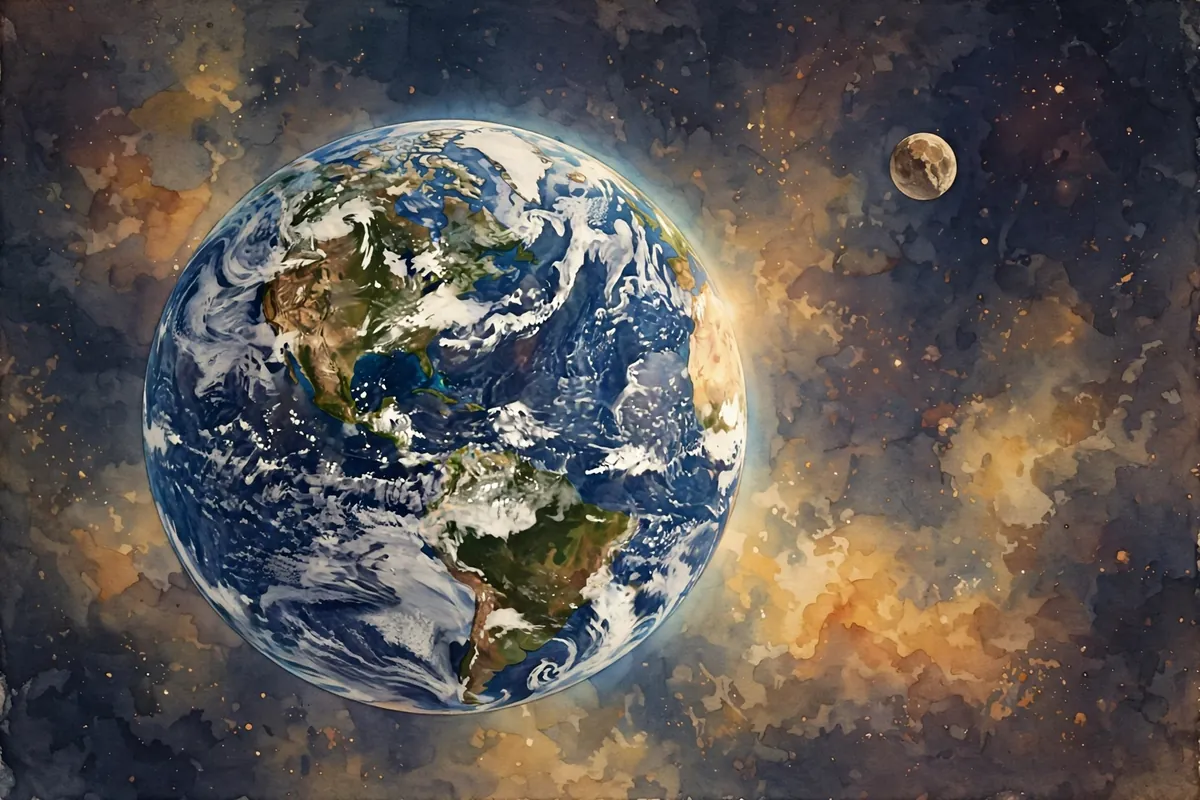
Imagine stepping outside one night and seeing two moons in the sky. It sounds like science fiction, yet every few years a news story claims Earth has picked up a "second moon." So has our planet ever really had two?
Here's the honest answer. The Moon is Earth's only true natural satellite, and no second moon has ever been confirmed. But Earth does occasionally capture tiny space rocks that circle it for a few months before drifting away. Scientists call them temporary satellites or mini-moons. They're only a few feet to a few dozen feet across, far too small to see without a telescope.
Meet the Mini-Moons
As of 2024, only three confirmed objects had been caught in orbit around Earth. The first, 2006 RH120, was spotted on September 14, 2006. It was about 5 meters, or roughly 16 feet, across. At first, astronomers thought it might be a leftover rocket stage from the Apollo 12 mission, but it turned out to be an asteroid. It stayed for about 13 months before heading back into orbit around the Sun.
The second, 2020 CD3, was discovered in February 2020 at the Mount Lemmon Observatory in Arizona. It was probably only 6 to 11 feet across, about the size of a car. Based on its path, it had been captured around 2016 to 2017 and escaped Earth's pull in May 2020.
The 2024 Visitor With a Surprising Origin
The most famous recent case is 2024 PT5, discovered in August 2024. It's roughly 36 feet wide. From late September to late November 2024, it moved slowly enough near Earth to be temporarily held by our planet's gravity. That's when headlines started talking about a second moon.
Then came a twist. Scientists studying its light found that it matched rock samples from the Moon. In January 2025, they concluded it's made of debris blasted off the Moon by an ancient impact. They also decided that its path was mostly an orbit around the Sun, so it shouldn't really be counted as a mini-moon at all. It's expected to come back around Earth in 2084 for about 43 days.
Objects That Only Look Like Moons
Earth also has a few space companions called quasi-satellites. One of the best examples, an asteroid named Kamoʻoalewa, was discovered in 2016. As it orbits the Sun, it appears to loop around Earth as well. But it's too far away to be a real moon of Earth. Others, called Earth trojans, travel the same path around the Sun as Earth, running ahead of or behind us.
The Second Moons That Never Were
People have been hunting for extra moons for a long time. In 1846, French astronomer Frédéric Petit announced he had found a second moon. His fellow scientists soon dismissed it. His proposed orbit would have dipped to about 7 miles above the ground, roughly where airliners fly today.
In 1898, a Hamburg scientist named Georg Waltemath claimed Earth had a whole system of tiny moons. He even predicted when one would be seen. It didn't show up, and his claims were discredited.
So no, Earth has never had a second Moon to rival our own. But it's nice to know our planet occasionally picks up a little hitchhiker for a few months. Our familiar Moon still has the night sky all to itself, and it's done a fine job of it.