Hand a child a box of crayons and ask them to draw the Sun, and you'll almost always get a bright yellow circle. Most adults picture it the same way. Even astronomers have long nicknamed stars like ours "yellow dwarfs." So why would the Sun look any different from space?
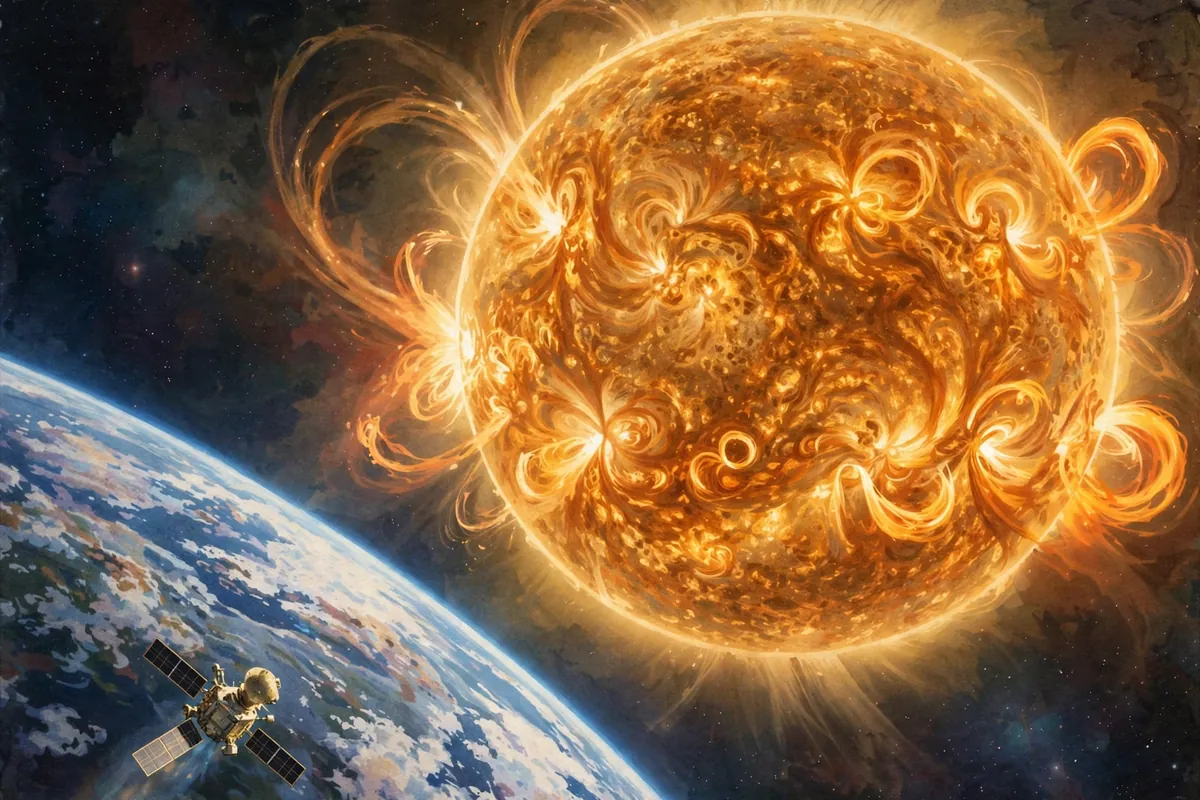
The short answer is that the Sun's true color is white. When it's seen from space, or when it's high in the sky, it shines white. What makes it look yellow, orange, or red from the ground is Earth's atmosphere, which scatters away some of the blue part of sunlight before it reaches our eyes. That effect is strongest at sunrise and sunset.
A Mix of Every Color
Sunlight is a blend of all the colors of the rainbow. When those colors arrive together in roughly balanced amounts, our eyes see white. The Sun's output actually peaks in the green part of the spectrum, but it gives off plenty of every other color too, so the overall effect is white, not green.
Above the atmosphere, nothing filters that mix. Astronauts see the Sun as a blazing white light against the black of space. Down here, the light has to pass through miles of air first, and that changes things.
How the Sky Steals the Blue
As sunlight passes through the air, it bumps into countless tiny gas molecules. Shorter wavelengths, like blue and violet, get scattered much more strongly than longer wavelengths like red and orange. This is called Rayleigh scattering, named after the British scientist Lord Rayleigh, who worked out the math in the late 1800s.
All that scattered blue light spreads across the whole sky, which is exactly why the daytime sky looks blue. Meanwhile, the light coming straight from the Sun has lost a little of its blue, so it leans slightly toward yellow.
Why Sunsets Glow Red
When the Sun is low on the horizon, its light travels through much more air to reach you. Even more blue gets scattered away along the way. That leaves the yellows, oranges, and reds, which is why the setting Sun can look like a glowing orange ball.
On rare occasions, the low Sun can even look green or blue. And the idea of what color the Sun is varies by culture. Some cultures picture it as yellow, and some as red. The reasons behind those differences are still debated.
One more interesting wrinkle: people suspected the scattering explanation centuries ago. Around 1506 to 1510, Leonardo da Vinci guessed that tiny particles in the air gave the sky its blue color.
The Yellow Dwarf That Isn't Yellow
Astronomers classify the Sun as a G-type star, a group often called yellow dwarfs. But scientists point out that the name is a misnomer. G-type stars range from white, for brighter ones like the Sun, to only very slightly yellowish for dimmer ones.
The word dwarf is misleading too. It's used to separate stars like ours from giants, but Sun-like stars still outshine about 90 percent of the stars in our galaxy. Most stars in the Milky Way are dimmer orange dwarfs, red dwarfs, and white dwarfs.
So go ahead and keep coloring the Sun yellow in birthday cards and kids' drawings. It's how it looks from where we stand. Just know that the real thing is a brilliant white, and please never stare at it directly to check.