Look up on a clear night and the stars seem eternal, as if they've always been there. But every one of them had a beginning. Somewhere out there, new stars are forming right now, hidden inside enormous clouds of gas and dust.
Here's the short answer. Stars are born when dense pockets inside cold clouds of gas, called molecular clouds, collapse under their own gravity. As the material falls inward, the center heats up. Eventually it becomes hot and dense enough for nuclear fusion to begin, and a new star lights up.
The Stellar Nurseries
Galaxies like our Milky Way are filled with thin gas and dust between the stars, mostly hydrogen, with helium and small amounts of heavier elements. In denser regions, this material gathers into clouds where stars are made. Astronomers sometimes call them stellar nurseries.
These clouds are astonishingly cold and enormous. A typical giant molecular cloud can be about 100 light-years across and hold up to 6 million times the mass of the Sun. Its average inside temperature is around 10 kelvins, or about minus 442 degrees Fahrenheit.
Our galaxy holds an estimated 6,000 of these big clouds, each with more than 100,000 times the mass of the Sun. The closest region where massive stars are forming is the Orion Nebula, about 1,300 light-years away.
The Big Squeeze
Inside these clouds, the Herschel Space Observatory revealed long, thread-like filaments of dense gas. These filaments break up into clumps called cores, and most of those cores go on to become stars.
Sometimes a cloud needs a nudge to start collapsing. Two clouds might collide, or the shock wave from a nearby exploding star, a supernova, might compress the gas. Scientists think something like that may have helped trigger the birth of our own Sun about 4.6 billion years ago.
From Clump to Protostar
As a clump collapses, it heats up. Dust in the cloud warms and gives off infrared light, carrying away energy and allowing the collapse to continue. The center grows denser and hotter until the gas pressure inside can push back against gravity. At that point, the young object is called a protostar.
Material keeps raining onto the protostar, much of it from a spinning disk of gas and dust around it. Once things get hot and dense enough, a heavy form of hydrogen called deuterium begins to fuse, which slows the collapse without stopping it. Young stars also blast out narrow jets of material from their poles. Astronomers think these jets help get rid of extra spin, so the star can keep growing.
That spinning disk matters, too. In our own solar system, the leftover disk of gas and dust around the young Sun went on to form the planets.
Born in Crowds
Stars rarely form alone. Most are born in groups called star clusters or stellar associations. Colder clouds tend to produce smaller, lower-mass stars, while giant clouds can form stars of every size.
Because young stars are hidden inside dusty clouds, astronomers often first spot them with infrared light, and later with ordinary visible light once the cloud clears away. X-rays help too, because young stars give off far more X-rays than grown-up stars like the Sun.
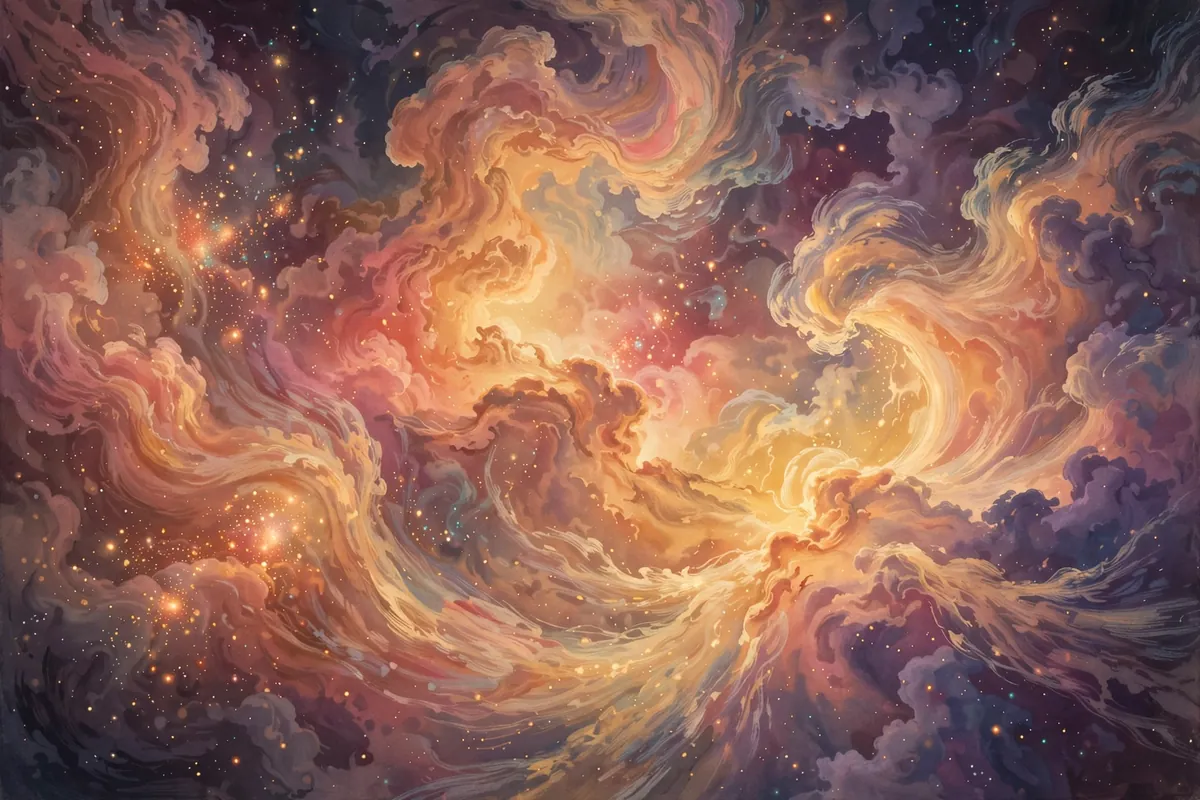
So the next time you see a photo of a glowing, colorful nebula, look closely. Hidden inside those clouds, new stars may be taking shape, just as our Sun did billions of years ago.